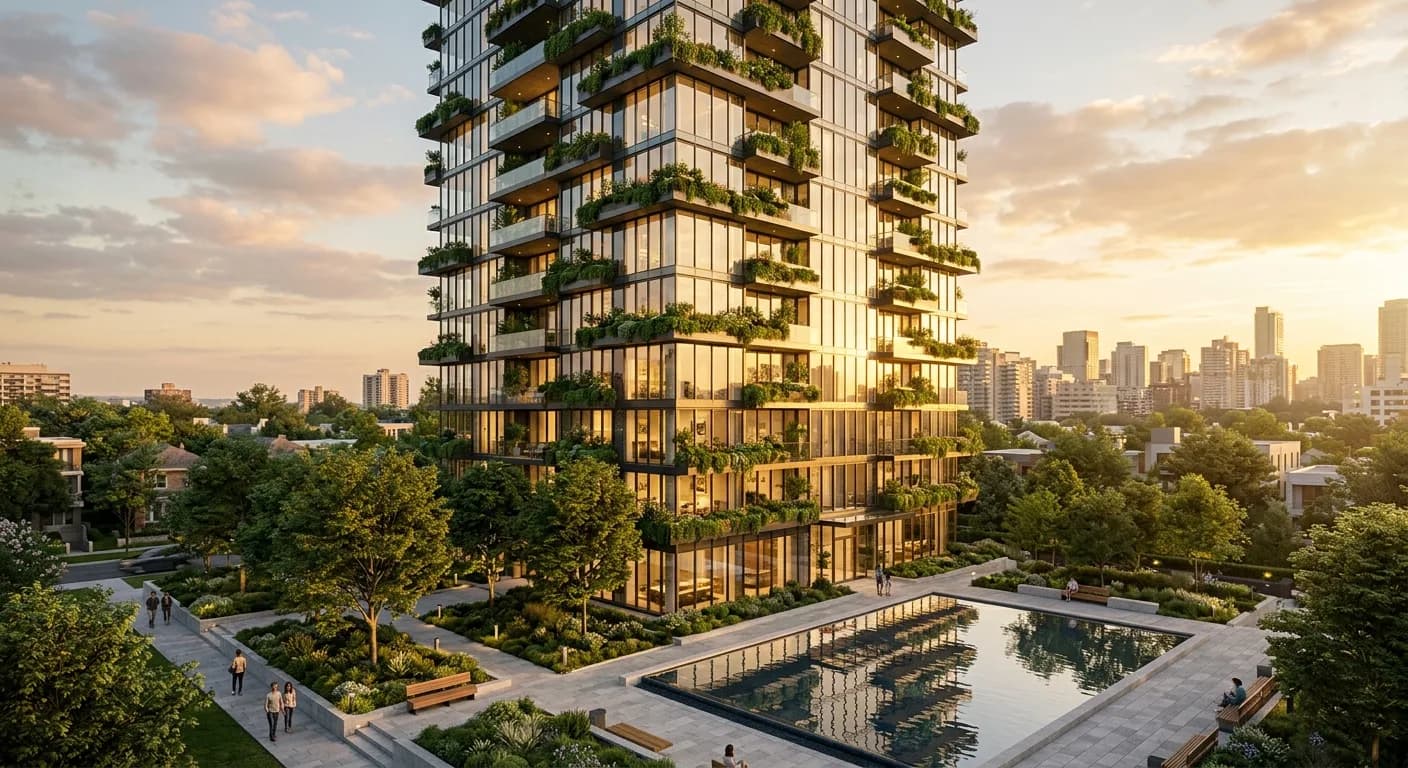
Mention green buildings to most property buyers in the Philippines and the reaction tends to fall into one of two camps. The first is mild enthusiasm — yes, sustainability sounds good, the environment matters, of course. The second is quiet skepticism — that sounds like it costs more, and how does that actually benefit me as a buyer or an investor? The second reaction is the more honest one, and it is the one this article is written to address directly.
Because the case for green-certified condominiums is not primarily an environmental argument. It is a financial one. Lower operating costs, stronger tenant demand, more resilient resale values, and a growing regulatory and institutional environment that is steadily raising the floor on building standards — these are the reasons that green buildings deserve a second look from buyers who care more about returns than about credentials. The environmental benefit is real, but it is a byproduct of decisions that make financial sense on their own terms. That distinction matters, and understanding it changes how you evaluate the premium that green-certified properties carry on the market.
What green certification actually means
UNDERSTANDING WHAT YOU ARE PAYING FOR
A green-certified building is not simply one that uses less electricity or has more plants in the lobby. Certification under any of the major frameworks — LEED, the internationally recognized standard developed in the United States; BERDE, the Building for Ecologically Responsive Design Excellence system developed specifically for the Philippine context; or EDGE, the Excellence in Design for Greater Efficiencies framework developed by the International Finance Corporation — requires third-party verification of specific performance standards across multiple building systems.
These standards typically cover energy efficiency, water consumption, materials sourcing, indoor environmental quality, and site sustainability. To achieve certification, a building must demonstrate measurable performance improvements over a conventional baseline — not just design intent, but actual verified outcomes. This is the distinction that matters for buyers: a certified green building has been evaluated by an independent body against defined criteria. It is not a developer's marketing claim. It is a verified standard.
BERDE is worth understanding specifically in the Philippine context because it was designed to account for local climate conditions, construction practices, and regulatory requirements. A building that performs well on BERDE criteria is optimized for the Philippine environment — tropical heat, high humidity, intense solar radiation, and the energy loads those conditions create — rather than for the temperate climate assumptions that underlie some international standards. For Philippine buyers evaluating green certification claims, BERDE certification is a particularly meaningful signal because it reflects performance in the conditions the building will actually operate in.
LEED certification, while designed for an international audience, carries significant weight in the corporate and institutional tenant market. Multinational companies with global sustainability commitments — and there are many of these operating in Metro Manila's CBDs — increasingly require LEED-certified office and residential addresses for their expatriate employees and regional headquarters. This creates a tenant demand dynamic that has direct rental implications for LEED-certified residential properties in key locations.
A brief historical note: the green building movement in the Philippines received a significant institutional push with the passage of Republic Act 11285, the Energy Efficiency and Conservation Act, signed into law in 2019. The law mandates energy efficiency standards for buildings and creates a regulatory framework that is progressively raising the baseline for building performance across the industry. What is currently a premium feature of certified green buildings will, over the next decade, increasingly become the regulated minimum for all new construction. Buyers who purchase green-certified properties today are ahead of a regulatory curve that the rest of the market will eventually be required to meet.
The operating cost argument — where the financial case begins
WHAT LOWER UTILITY COSTS ACTUALLY MEAN OVER A HOLDING PERIOD
The most immediate and tangible financial benefit of a green-certified condominium is the reduction in operating costs — specifically electricity and water consumption — that certified building systems deliver. This is not a theoretical benefit. It is a measurable difference in monthly expenditure that compounds over the life of ownership.
Green buildings typically achieve energy consumption reductions of twenty to thirty percent compared to conventional buildings of equivalent size and use, through a combination of high-performance glazing that reduces solar heat gain, more efficient air conditioning systems, LED lighting with motion-sensing controls, and building envelope design that minimizes the energy required to maintain comfortable indoor temperatures. In the Philippine context — where electricity rates are among the highest in Southeast Asia and air conditioning accounts for a dominant share of residential energy consumption — a thirty percent reduction in electricity consumption is a meaningful monthly saving for any occupant.
Water efficiency systems — low-flow fixtures, rainwater harvesting for common area irrigation, and recycled water systems for non-potable uses — similarly reduce monthly water bills and, in condominium developments, contribute to lower association dues over time as the building's shared utility costs are reduced. For investors who own units for rental, lower operating costs translate directly into higher net yields, because a tenant paying market rent in a building with lower utility costs is effectively getting more value for the same rent — which supports occupancy and rental renewal rates.
The cumulative effect of these savings over a typical holding period of ten to fifteen years is substantial. A conservative estimate of fifteen thousand pesos per year in utility savings — achievable in a well-certified one-bedroom unit — compounds to two hundred twenty-five thousand pesos over fifteen years before any adjustment for rising energy costs. As Philippine electricity prices have historically trended upward over time, the future value of energy efficiency is greater than its present value, meaning the financial benefit of green certification grows rather than shrinks as a building ages.
The rental market argument — who is demanding green and why
THE TENANT PROFILES DRIVING PREMIUM RENTAL DEMAND
The demand side of the green building equation is as important as the cost side, and it is evolving in ways that are directly relevant to investors in the Philippine market.
The most significant driver of premium rental demand for green-certified residential properties is the multinational corporate tenant segment. Large corporations operating in Metro Manila — particularly those with regional headquarters in Makati and BGC — have sustainability policies that extend to their employees' housing arrangements. Expatriate packages at major multinationals increasingly specify green-certified or sustainability-rated residential addresses, and human resources teams at these companies actively seek out certified buildings when arranging accommodation for incoming staff. This is not a marginal preference — it is a procurement criterion that effectively excludes non-certified buildings from consideration for a growing segment of the premium rental market.
The second driver is the domestic professional segment — specifically, younger Filipino professionals in the twenty-five to forty age bracket whose values around sustainability are meaningfully different from those of the generation that preceded them. This cohort is more likely to research a building's environmental credentials before signing a lease, more likely to pay a modest premium for a certified address, and more likely to remain as long-term tenants in buildings that align with their values. For landlords, tenant quality and tenure length are as important as headline rent — and the green-certified segment consistently performs well on both dimensions.
The third driver — less visible but increasingly significant — is the ESG-focused institutional investor. Real Estate Investment Trusts, institutional fund managers, and foreign investors with environmental, social, and governance mandates are systematically raising their preference for green-certified assets in their Philippine portfolios. As this institutional demand grows, it creates a secondary market premium for certified properties that benefits individual investors who hold them — particularly in the premium and luxury segments where institutional buyers are most active.
In the Philippines, Arthaland's projects provide the most studied local case study. Arya Residences in Bonifacio Global City — LEED Gold certified and among the first residential developments in the country to achieve that standard — has consistently commanded rental premiums and maintained strong occupancy rates that its non-certified neighbors in the same corridor have not always matched. The premium is not dramatic, but it is persistent, and persistence over a long holding period is what separates a sound investment from a merely acceptable one.
The resale value argument — what certification does to long-term liquidity
HOW GREEN CREDENTIALS AFFECT THE SECONDARY MARKET
Resale value is where the green building argument becomes most interesting for long-term investors, because the dynamics that affect secondary market pricing for certified buildings are moving in a clear and favorable direction.
In markets where green certification has been established for longer — Australia, Singapore, the United Kingdom — studies consistently show that certified buildings transact at premiums of five to fifteen percent over comparable non-certified properties in the secondary market. The premium is driven by the same factors that support rental demand: lower operating costs, stronger tenant appeal, and increasingly, regulatory compliance advantages as building performance standards tighten over time.
In the Philippine market, the resale premium for green-certified properties is still forming — the certified supply base is not yet large enough to generate the volume of secondary market transactions needed for definitive statistical analysis. But the directional indicators are consistent with international experience, and the regulatory trajectory under RA 11285 and related energy efficiency mandates suggests that the premium will widen rather than narrow as the regulatory baseline rises and non-certified older buildings become comparatively less attractive.
There is also a depreciation argument that works in favor of certified buildings. Conventional buildings age in ways that green-certified buildings are designed to resist. High-performance building systems — better materials, more durable mechanical and electrical specifications, superior building envelope performance — tend to reduce the rate of physical deterioration that drives maintenance costs up and resale values down over time. A green-certified building at fifteen years of age is typically in better relative condition than a conventional building of the same age, because the investment in quality at the design and construction stage pays dividends across the full building lifecycle.
The honest assessment — what green certification does not solve
WHERE THE PREMIUM IS NOT JUSTIFIED
The financial case for green-certified condominiums is real, but it is not universal. There are circumstances where the premium associated with certification is not justified by the returns it generates, and intellectual honesty requires acknowledging them.
Location still dominates. A green-certified building in a poorly located corridor — one with weak underlying rental demand, flood risk, or limited transit access — will not perform as well as a conventional building in a genuinely strong location. Certification improves the relative performance of a property within its competitive set, but it cannot override fundamental location deficiencies. The hierarchy remains: location first, developer track record second, building specification — including green credentials — third.
The certification premium on purchase price needs to be evaluated against the returns it generates over your specific holding period. For a buyer with a short investment horizon — three to five years — the operating cost savings and rental premium may not fully recover the additional acquisition cost. The green building argument is strongest for long-term holders who can capture the full compounding of utility savings, rental stability, and resale premium over a ten-year-plus period.
Not all green claims are equal. The Philippine property market, like any market where sustainability is a growing demand signal, has produced developers who use environmental language in their marketing without the third-party certification to back it up. "Eco-friendly features," "green design principles," and similar phrases in a developer's brochure are not substitutes for LEED, BERDE, or EDGE certification. Ask for the certification documentation. If it does not exist, treat the green claim as marketing rather than as a verified standard.
What to look for when evaluating a green-certified property
PRACTICAL CRITERIA FOR BUYERS
For buyers who have decided that green certification is a relevant criterion in their property search, a few practical considerations help translate the concept into actionable due diligence.
Verify the certification independently. Ask the developer or seller for the certification documentation and confirm it with the issuing body. LEED certifications can be verified through the US Green Building Council's online database. BERDE certifications are issued by the Philippine Green Building Council. EDGE certifications are issued through the IFC's EDGE platform. A certification that cannot be independently verified should be treated with skepticism.
Ask about the building's actual energy and water consumption data. Certified buildings should have performance monitoring systems that track actual consumption against design targets. A developer or building administrator who can provide actual consumption data — not just design specifications — is demonstrating that the certification reflects real performance rather than theoretical intent.
Evaluate the association dues structure. Green-certified buildings often have higher upfront construction costs that can translate into higher association dues if the building's management does not capture the efficiency savings in its operating budget. Ask for a breakdown of what the association dues cover and whether the building's energy efficiency features are reducing shared utility costs in ways that benefit unit owners.
Consider the building's age relative to its certification. Green certification requires periodic renewal and performance verification. A building that was certified ten years ago and has not maintained its certification may no longer perform at the standard its original certification implied. Active, current certification is more meaningful than historical certification that has not been renewed.
The skepticism that many Philippine property buyers bring to green-certified condominiums is understandable. The sustainability conversation in real estate has been accompanied by enough marketing noise and greenwashing that healthy skepticism is a reasonable default. But the financial case for verified, third-party certified green buildings — built on lower operating costs, stronger tenant demand, more resilient resale values, and a regulatory trajectory that is moving in their favor — is more substantial than the skepticism gives it credit for.
Green buildings are worth a second look not because of what they do for the environment, though that is real. They are worth a second look because of what they do for the numbers — and in real estate, the numbers are ultimately what everything comes back to.
DISCLAIMER
This article is intended for general informational purposes only and does not constitute legal, financial, or real estate investment advice. References to certification standards, market trends, and financial estimates are based on publicly available information at the time of writing and are subject to change. Past performance of green-certified properties does not guarantee comparable outcomes. Readers are encouraged to conduct independent research and consult with a licensed real estate broker, a qualified financial advisor, and legal counsel before making any property purchase decision. The author and publisher assume no liability for actions taken based on the information provided in this article.