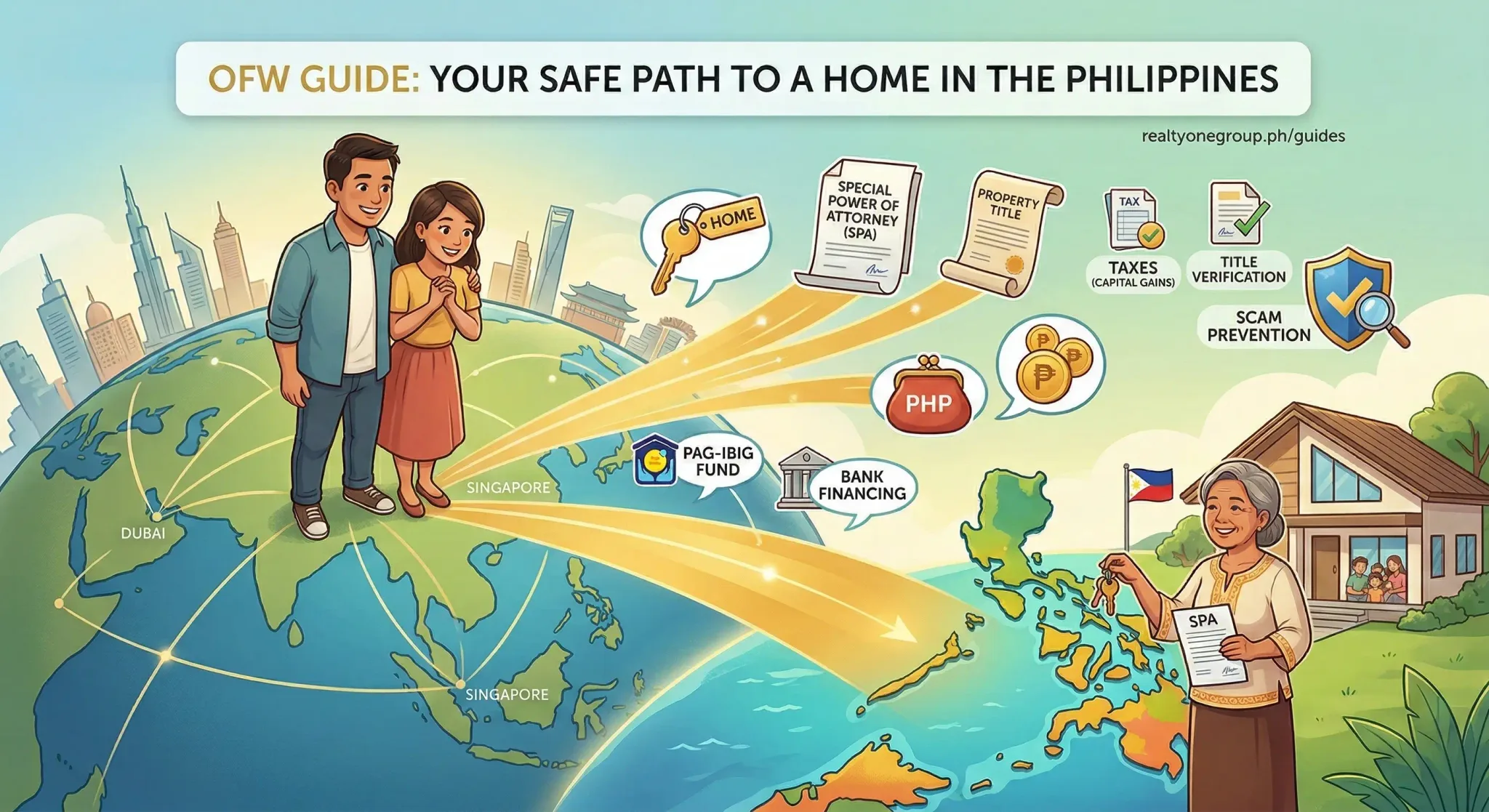
For many OFWs, buying or selling a home in the Philippines is one of the biggest financial decisions they’ll make—often while managing the process from thousands of miles away. This article breaks down the end-to-end steps for purchasing or selling property remotely, with special focus on the Special Power of Attorney (SPA), title verification, and working with a trusted representative. It also compares Pag-IBIG and bank financing, outlines key documents and taxes, and flags common scam tactics so you can protect your savings and complete the transaction with confidence.
Every peso you earn abroad is for a dream. For many OFWs, that dream is a home in the Philippines---a place for your family and a foundation for your future. However, the distance can make trusting someone with your life savings feel impossible, especially with common stories of scams and deals gone wrong.
This guide provides the essential real estate tips you need to navigate the process safely, understand which documents are critical, and avoid common pitfalls. Let's build your future, one safe step at a time.
Are You Buying or Selling? Your First Critical Decision
Before you dive into Philippine real estate, you must decide: are you buying or selling? Your preparation, documents, and challenges depend entirely on this goal. Your main focus changes completely based on what you want to achieve.
Buying Focus: Proving your income and saving for a down payment.
Selling Focus: Proving you have clean ownership (the Title) and preparing for taxes.
Defining your goal from the start saves time and stress. Since most OFWs are looking to secure a family home, we will focus on the buyer's journey.
Your 5-Step Guide to Buying a Home from Abroad
Buying a home from thousands of miles away is manageable with a clear path. Here is the process broken down into five main steps:
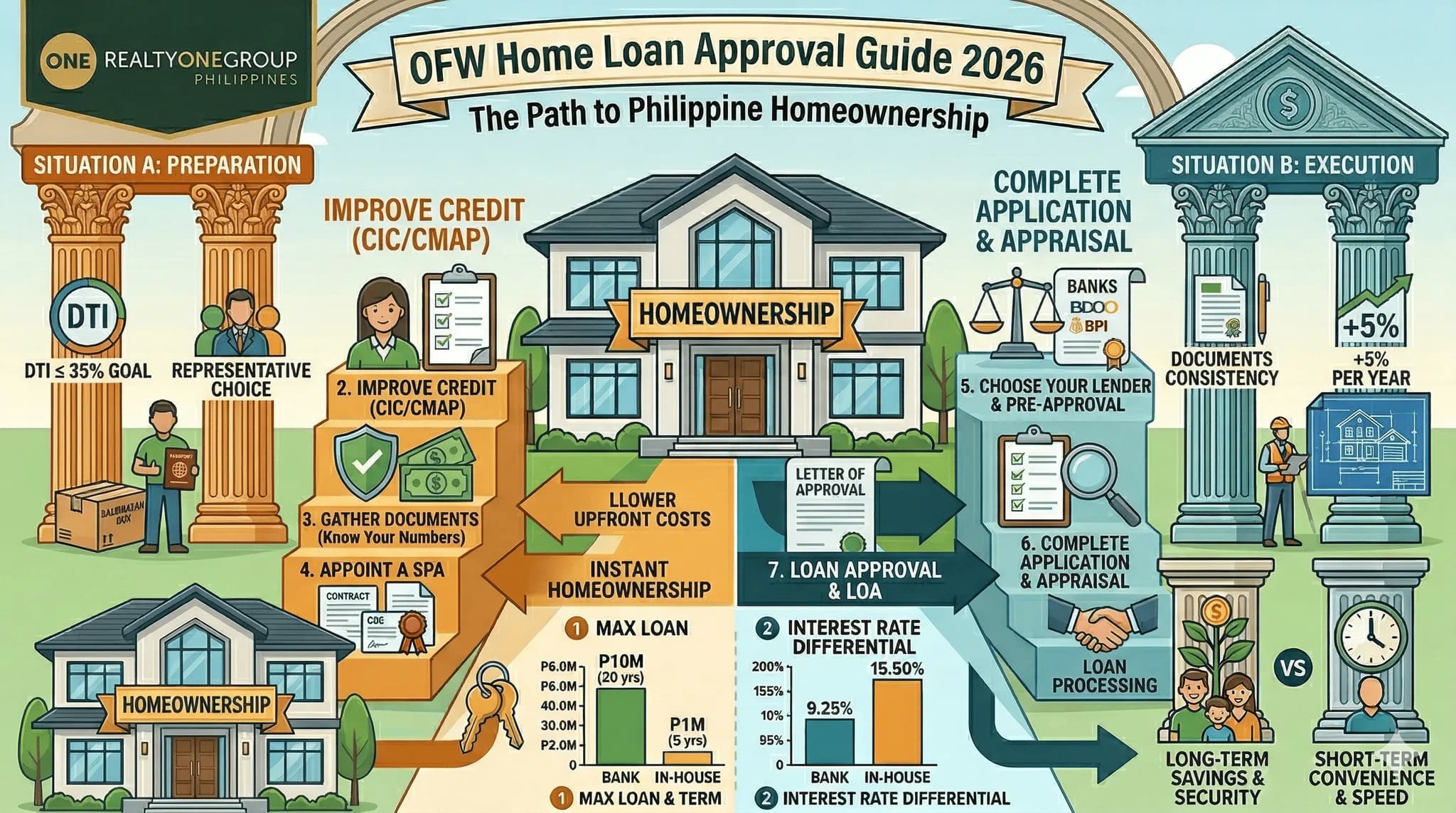
Financial Check & Choosing Your Representative: Prepare your savings and documents, then appoint a person you trust completely in the Philippines (like a spouse or parent) to act on your behalf.
Property Hunting & Reservation: Find your ideal property and pay a small reservation fee. This shows the seller you are serious and takes the unit off the market while you process paperwork.
Securing Your Loan (Pag-IBIG or Bank): Apply for a housing loan to cover the largest part of the property's cost.
Signing Documents via Your Representative: Your chosen representative will legally sign contracts and handle paperwork for you.
Final Payments, Turnover, and Title Transfer: Settle all remaining costs, inspect the finished property (the "turnover"), and complete the title transfer process to become the official owner.
How to Secure Your Home Loan: Pag-IBIG vs. Bank Financing
After reserving your dream home, the next step is financing. For most OFWs, this decision comes down to two main paths: borrowing from the Pag-IBIG Fund or from a commercial bank. This choice will affect your monthly payments and total costs for years to come.
The Pag-IBIG housing loan for overseas members is a popular government-backed option known for lower, fixed interest rates. A fixed rate means your monthly payment won't change for a long period---sometimes up to 30 years---providing peace of mind and easier budgeting from abroad.
On the other hand, bank financing might be better if you need a larger loan for a more expensive property. The trade-off is that bank interest rates are often variable, meaning they can be repriced every 1, 3, or 5 years, which could increase your monthly payment in the future.
Both require similar OFW housing loan requirements, primarily your employment contract and payslips to prove your capacity to pay. Since you cannot apply in person, you'll need a legal representative.
The Most Important Document: Your Special Power of Attorney (SPA)
Since you can't be in the Philippines to sign contracts, you must legally grant that power to a trusted representative through a Special Power of Attorney (SPA). This document is a formal, legal permission slip authorizing a specific person to act on your behalf for the exact purpose of buying or selling your property.
Without a valid SPA, your representative has no legal authority to sign a Deed of Sale or a loan agreement. To get an SPA, a lawyer in the Philippines must draft the document. You will then bring it to the nearest Philippine Embassy or Consulate in your country of work for authentication (a process called an Apostille), making it legally recognized in the Philippines.
Selling Your Property from Abroad: A Quick 4-Step Checklist
With a trusted representative holding an SPA, you can handle a property sale without flying home. This checklist covers the critical steps for a smooth transaction:
Gather Proof of Ownership: Prepare the original Owner's Duplicate Copy of the Title and the latest Tax Declaration. The Title is your ultimate proof of ownership, while the Tax Declaration shows that property taxes are up to date.
Settle the Seller's Tax: The seller must pay the Capital Gains Tax, a mandatory 6% tax on the property's final selling price, to the Bureau of Internal Revenue (BIR).
Execute the Deed of Sale: This is the final legal contract where you officially transfer the property to the buyer. Your representative signs this on your behalf.
Red Flag Alert: 5 Signs of a Real Estate Scam
Your hard-earned money deserves maximum protection. Being aware of these red flags is one of the best real estate tips for avoiding fraud.
Be on high alert if the person you're dealing with:
Refuses to show you a copy of the property title. This is a huge warning sign.
Asks for large cash payments to a personal bank account instead of the developer's or owner's official account.
Cannot provide a valid PRC ID. All licensed real estate brokers must have a Professional Regulation Commission (PRC) ID.
Rushes you into paying a "reservation fee" for a deal that "expires today."
Offers a price that is suspiciously far below market value. If it seems too good to be true, it usually is.
Above all, independently verify the property title. Your representative must get a Certified True Copy of the Title directly from the Registry of Deeds, the government office that holds all official land records. This is your ultimate proof that the property and its owner are legitimate.
Your Dream Home Is Within Reach
The path to owning a home in the Philippines, while complex from a distance, is achievable with the right preparation. The success of your investment rests on two key elements: an absolutely trustworthy representative and a legally authenticated Special Power of Attorney (SPA).
The SPA is the legal key that empowers your representative to sign documents and complete transactions on your behalf, making it the single most important document you will prepare. By focusing on securing these two pillars, you can confidently turn your hard-earned savings into a physical foundation for your family's future. Your dream home is an achievable goal.
Q&A
Question: Can I buy or sell property in the Philippines without flying home? Short answer: Yes. You must execute a Special Power of Attorney (SPA) that authorizes a trusted representative in the Philippines (e.g., spouse or parent) to act on your behalf for the specific transaction. A Philippine lawyer drafts the SPA, and you bring it to the nearest Philippine Embassy or Consulate for authentication (Apostille). Without a valid, authenticated SPA, your representative cannot legally sign a Deed of Sale or a housing loan agreement for you.
Question: How do I choose between Pag-IBIG and bank financing as an OFW? Short answer: Choose Pag-IBIG if you want typically lower, fixed interest rates and stable monthly payments—often fixed for long periods (up to 30 years)—which makes budgeting from abroad easier. Choose bank financing if you need a larger loan for a higher-priced property, noting that bank rates are usually variable and can be repriced every 1, 3, or 5 years, potentially raising future payments. Both options require proof of income (e.g., employment contract and payslips) and a legal representative to process your application in the Philippines.
Question: What are the key steps to buying a home from abroad, and what does the reservation fee do? Short answer: The buyer’s journey has five steps: (1) prepare finances and appoint a trusted representative via SPA, (2) find a property and pay a reservation fee, (3) secure financing through Pag-IBIG or a bank, (4) have your representative sign contracts and handle paperwork, and (5) make final payments, complete turnover, and process title transfer. The reservation fee signals you’re a serious buyer and temporarily takes the unit off the market while you complete requirements.
Question: I’m selling from overseas—what should I prepare and what taxes do I need to pay? Short answer: Work through your representative with an SPA and prepare: (1) the original Owner’s Duplicate Copy of the Title, (2) the latest Tax Declaration, and (3) the Deed of Sale for execution. As the seller, you must pay the Capital Gains Tax—6% of the property’s final selling price—to the BIR. These are the core steps to legally transfer ownership to the buyer.
Question: How can I spot and avoid real estate scams while I’m abroad? Short answer: Watch for red flags: refusal to show a copy of the title, requests for large cash payments to personal accounts, no valid PRC ID from the broker, pressure to pay a “reservation fee” that “expires today,” and prices far below market value. Always have your representative verify the property by securing a Certified True Copy of the Title directly from the Registry of Deeds and making payments only to official developer/owner accounts.