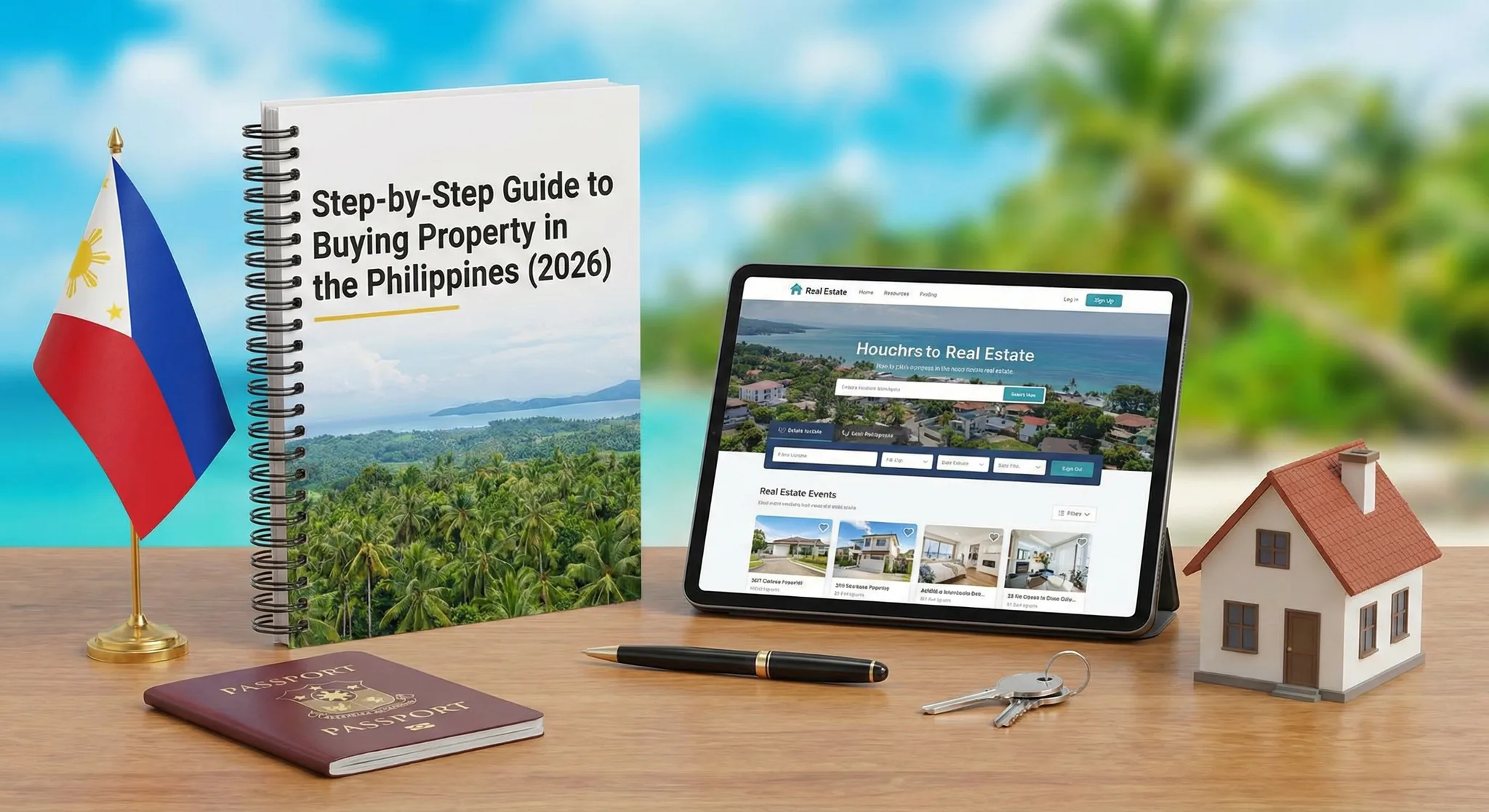
Step-by-Step Guide to Buying Property in the Philippines (2026)
What is the process of buying property in the Philippines?
Buying property in the Philippines involves six main steps: (1) Find a licensed real estate broker, (2) Search for and evaluate properties, (3) Submit a Letter of Intent and reservation fee (₱20,000–₱100,000), (4) Conduct due diligence on the title and property, (5) Sign the Contract to Sell and arrange financing, and (6) Execute the Deed of Absolute Sale and transfer the title at the Registry of Deeds. The process typically takes 30–90 days for ready-for-occupancy properties and 2–5 years for pre-selling units.
Whether you’re a first-time homebuyer, an OFW purchasing for your family, or a foreign national investing in a Philippine condominium, understanding the buying process is essential to protecting your investment and avoiding costly mistakes.
This guide walks you through every step of the property purchase process in the Philippines as it works in 2026, including the documents you’ll need, the taxes you’ll pay, and the timeline you should expect.
Step 1: Find a Licensed Real Estate Broker
The most important decision in your property purchase is choosing the right broker. In the Philippines, real estate brokers must be licensed by the Professional Regulation Commission (PRC) under Republic Act No. 9646 (the Real Estate Service Act). Working with an unlicensed agent exposes you to legal risk and potential fraud.
A good broker will help you identify properties that match your budget and goals, verify property documents and developer credentials, negotiate pricing and payment terms on your behalf, guide you through the legal and tax requirements, and coordinate with banks, notaries, and government offices.
✔ Realty ONE Group Philippines Advantage
With 60 franchise offices and over 600 PRC-licensed agents nationwide, Realty ONE Group Philippines provides access to properties across Metro Manila, Cebu, Davao, and all major provincial markets. Our agents are trained in both residential and investment transactions. Visit realtyonegroup.ph to find a broker near you.
Step 2: Search for and Evaluate Properties
Once you’ve engaged a broker, you’ll begin the property search. In the Philippines, there are three main channels:
Pre-Selling Properties (From Developers)
Pre-selling units are purchased before or during construction, typically at a lower price than ready-for-occupancy (RFO) units. Buyers pay a reservation fee, followed by monthly amortizations during the construction period (usually 24–60 months), and then the balance upon turnover. This is the most common way Filipinos buy new properties.
Ready-for-Occupancy (RFO) Properties
RFO units are completed and available for immediate move-in. They cost more than pre-selling units but eliminate construction risk and waiting time. Some developers offer discounts on unsold RFO inventory, making this a potential value play in 2026 given the current buyer’s market for condominiums.
Secondary Market (Resale Properties)
Buying from an existing owner on the secondary market offers the widest range of options, including older buildings in prime locations, foreclosed properties, and house-and-lot properties in established subdivisions. Due diligence is especially important in secondary transactions to verify clean title and absence of liens.
Step 3: Submit a Letter of Intent and Reservation Fee
Once you’ve selected a property, the process formalizes with two documents:
Letter of Intent (LOI)
The LOI is a written expression of your intention to purchase, outlining the agreed price, payment terms, and any conditions (such as the buyer needing to arrange financing). While not strictly required by law, an LOI is standard practice and protects both parties by documenting the agreed terms before contracts are prepared.
Reservation Fee
The reservation fee—typically ranging from ₱20,000 to ₱100,000 depending on the property’s price and the developer’s policy—secures the unit and takes it off the market. This fee is usually applied to the purchase price but may be non-refundable. Your LOI should clearly state the conditions under which the reservation fee is refundable (for example, if due diligence reveals a title defect).
✔ Pro Tip
Always get the refund terms in writing. For pre-selling properties, check that the developer’s License to Sell from DHSUD is valid and current before paying any reservation fee.
Step 4: Conduct Due Diligence
Due diligence is the most critical step in any property transaction. Skipping or rushing this step is the single biggest mistake buyers make. Here’s what to verify:
Title Verification
Obtain a Certified True Copy (CTC) of the title from the Registry of Deeds. For condominiums, this is the Condominium Certificate of Title (CCT). For land, it’s the Transfer Certificate of Title (TCT).
Verify that the title is clean—no liens, encumbrances, adverse claims, or lis pendens annotations.
Cross-reference the title with the tax declaration from the local Assessor’s Office to confirm the property dimensions and ownership match.
Developer Verification (For New Properties)
Confirm the developer holds a valid License to Sell from the Department of Human Settlements and Urban Development (DHSUD).
Check the developer’s track record: Have they delivered previous projects on time? Are there pending complaints with DHSUD?
For condominiums, verify the building’s Master Deed and Declaration of Restrictions.
Tax Clearance
Request a Certificate of No Tax Delinquency (or Real Property Tax clearance) from the City or Municipal Treasurer’s Office to confirm all real property taxes are current.
Physical Inspection
For RFO and secondary properties, conduct a thorough physical inspection. Check structural integrity, plumbing, electrical systems, and any visible damage or defects.
For pre-selling properties, visit the construction site and review the developer’s specifications and floorplan.
Step 5: Sign the Contract to Sell and Arrange Financing
Contract to Sell (CTS)
The Contract to Sell is the primary agreement between buyer and seller (or developer). It outlines the full purchase price, payment schedule, penalties for late payment, turnover date, and conditions for cancellation. Review this document carefully with your broker or attorney before signing.
Key items to verify in the CTS:
Total contract price and breakdown of payments (reservation, down payment, monthly amortization, balance)
Turnover date and penalty clauses if the developer is delayed
Cancellation and refund policies under Republic Act No. 6552 (the Maceda Law), which protects buyers who have paid at least two years of installments
Specifications of the unit including floor area, parking allocation, and included fixtures
Arranging Financing
If you’re financing the purchase, this is when you apply for a home loan. The three main options are:
Bank financing (BDO, BPI, Metrobank, etc.): Best rates (6–9% fixed for 3–5 years), requires 20–30% down payment, loan term up to 20–25 years
Pag-IBIG Fund: Lowest rates (3–5.375%), maximum loan of ₱6 million, terms up to 30 years, requires active membership and contributions
Developer in-house financing: Most flexible terms but highest rates (12–18%), shorter terms (5–10 years)
Banks will conduct their own appraisal of the property. The loan amount is based on the bank’s appraised value, not the selling price. If the appraisal comes in lower than the selling price, the buyer must cover the difference in cash.
Step 6: Execute the Deed of Absolute Sale and Transfer Title
Upon full payment (or upon loan approval and release of funds from the bank), the transaction moves to its final phase:
Deed of Absolute Sale (DOAS)
This is the definitive document that transfers ownership from seller to buyer. It must be notarized by a Philippine notary public. The notarial fee is typically 1–2% of the selling price.
Tax Payments
Before the title can be transferred, the following taxes must be paid:
Capital Gains Tax (CGT): 6% of the selling price or zonal/fair market value, whichever is higher. Due within 30 days of the sale.
Documentary Stamp Tax (DST): 1.5% of the selling price or zonal/fair market value, whichever is higher. Due within 5 days of the following month.
Transfer Tax: 0.5–0.75% of the selling price, paid to the local Treasurer’s Office.
Title Transfer
With the taxes paid and the DOAS notarized, the following steps complete the transfer:
Obtain a Certificate Authorizing Registration (CAR) from the Bureau of Internal Revenue (BIR)—this confirms all taxes have been settled.
Present the CAR, DOAS, and other documents to the Registry of Deeds to transfer the title to the buyer’s name.
Update the Tax Declaration at the local Assessor’s Office to reflect the new owner.
Timeline: For bank-financed RFO properties, expect the entire process from reservation to title transfer to take approximately 60–90 days. For pre-selling properties, the title transfer occurs after turnover, which may be 2–5 years from reservation. BIR processing and Registry of Deeds transfers have historically been the slowest parts of the process, sometimes taking 3–6 months.
Documents Checklist for Buyers
Keep the following documents organized throughout the process:
Valid government-issued ID (passport for foreigners)
Tax Identification Number (TIN)—foreigners must obtain a Philippine TIN
Proof of income or financial capacity (for financing applications)
Letter of Intent and Reservation Agreement
Contract to Sell
Official Receipts for all payments made
Deed of Absolute Sale (notarized)
Certificate Authorizing Registration (CAR) from BIR
Transfer Certificate of Title (TCT) or Condominium Certificate of Title (CCT)
Updated Tax Declaration
Common Mistakes to Avoid
Buying without a licensed broker: You lose the protection of professional accountability and may miss critical due diligence issues.
Skipping title verification: Title fraud and double-selling do occur in the Philippines. Always get a certified true copy from the Registry of Deeds.
Not reading the Contract to Sell: Understand every clause, especially cancellation policies, turnover dates, and penalties.
Ignoring the 40% foreign ownership cap: If you’re a foreign buyer purchasing a condo, verify the building’s current foreign ownership percentage before paying.
Underestimating total costs: Budget 8–12% above the purchase price for taxes, fees, and other closing costs.
The Bottom Line
Buying property in the Philippines is a straightforward process when you follow the correct steps and work with licensed professionals. The legal framework is well-established, and protections like the Maceda Law provide meaningful safeguards for buyers.
The key to a successful purchase is preparation: choose the right broker, conduct thorough due diligence, understand your financing options, and budget for the full cost of the transaction.
Realty ONE Group Philippines guides buyers through every step—from property search to title transfer. With 60 offices and 600+ licensed agents nationwide, we’re the Philippines’ largest real estate franchise network. Visit realtyonegroup.ph or contact us to start your property journey today.
Disclaimer: This article is for informational purposes only and does not constitute legal advice. Laws, tax rates, and procedures may change. Consult a licensed attorney and real estate professional for advice specific to your transaction.