Scroll through any social media feed and you will find no shortage of posts glamorizing the real estate life — photos of model units, luxury condominiums, closing day celebrations, and captions that make it sound like anyone with a phone and a smile can earn six figures a month showing properties. The reality is more nuanced, more demanding, and far more honest than that narrative suggests.
Real estate is a legitimate, rewarding, and potentially lucrative profession. But it is also one of the most misunderstood careers in the Philippines when it comes to income. People see the commission percentages and do the math in their heads — "five percent of three million, that's one hundred fifty thousand pesos, easy money" — without accounting for everything that stands between a listing and a closed deal. The truth is that real estate is a sales profession, and selling is one of the hardest things a person can do for a living. You are not selling a product someone picks up off a shelf. You are selling one of the largest financial decisions a person or a family will ever make in their lifetime. That takes skill, patience, persistence, and a level of professionalism that most people underestimate until they are in the middle of it.
This article gives you an honest, grounded look at how real estate income actually works in the Philippines — the commission structures, the split models, the difference between working under a franchise versus independently, and what you should realistically expect in your first year.
The Foundation: How Real Estate Commissions Work
In the Philippines, real estate practitioners — whether brokers or accredited salespersons — earn primarily through commission. Unlike salaried employees, there is no base pay, no guaranteed monthly income, and no safety net if a deal falls through. Your income is entirely a function of the transactions you close.
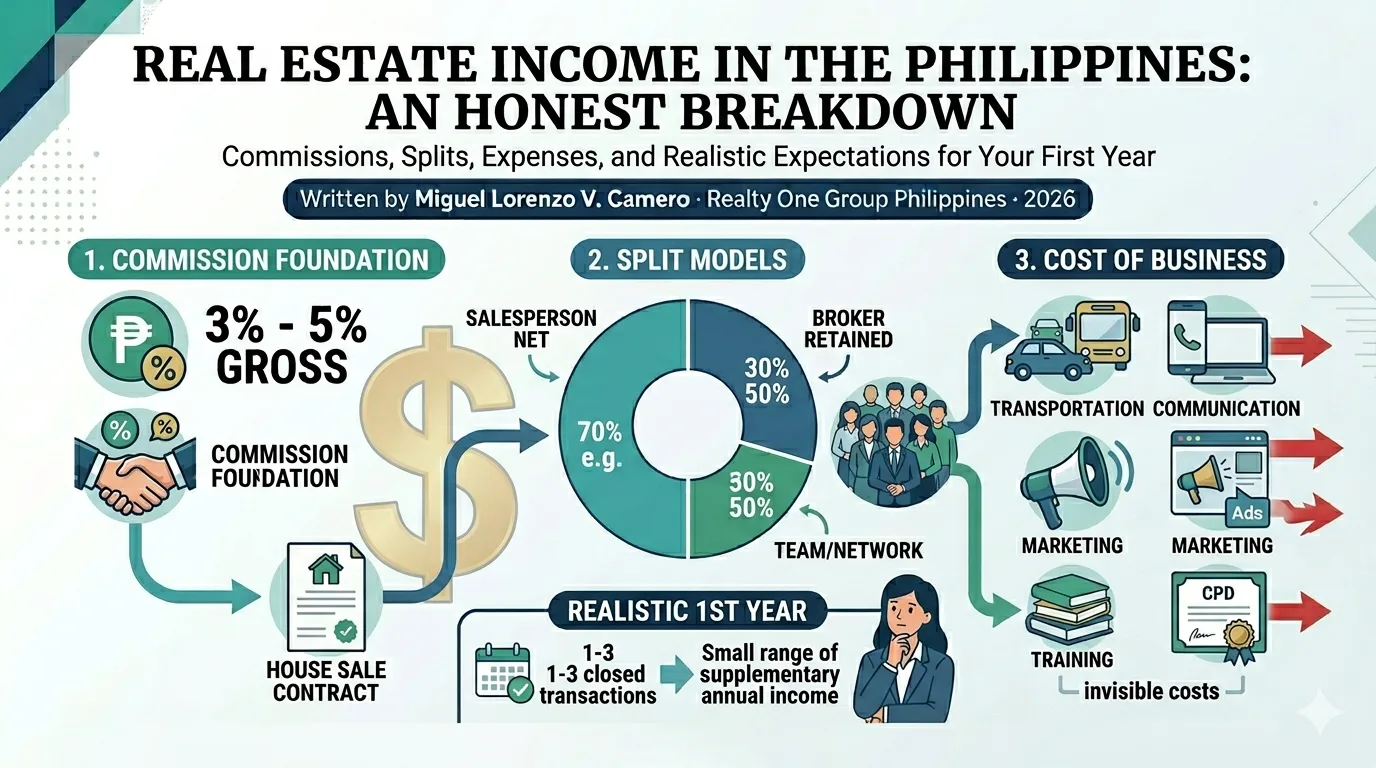
The standard commission rate on a real estate sale in the Philippines generally falls between 3% and 5% of the property's selling price. This rate is not mandated by law — it is a market convention that varies depending on the property type, the arrangement between the practitioner and the developer or seller, and the specific terms negotiated for each transaction.
For primary market transactions — meaning brand-new properties sold directly by developers — the commission is typically paid by the developer and is built into the project's pricing structure. This means the buyer does not pay the commission separately; it comes out of the developer's sales budget. For secondary market transactions — meaning resale properties — commission is typically paid by the seller, though this is negotiable and varies by agreement.
To put this in concrete terms, consider a property priced at ₱3,000,000. At a 3% commission rate, the gross commission on that transaction is ₱90,000. At 5%, it is ₱150,000. Those are the numbers people see when they think about real estate income. What they do not immediately see is that this gross commission is rarely — if ever — what the individual agent actually takes home.
Commission Split Models: What You Actually Take Home
The commission split is where income projections meet reality. Unless you are a fully licensed broker operating completely independently with your own direct seller or developer agreements, a portion of every commission you earn will be shared with someone else. Understanding how splits work is essential before you enter the profession.
The Broker-Salesperson Split
As discussed in earlier articles, a PRC-accredited real estate salesperson must work under a supervising broker. When a salesperson closes a transaction, the gross commission is received by the supervising broker first, and then a portion is released to the salesperson based on their pre-agreed arrangement. There is no government-mandated split ratio — it is a private agreement between the two parties.
In practice, splits commonly range from 50/50 to 80/20 in favor of the salesperson, depending on the broker's platform, the support and leads they provide, and the experience level of the salesperson. A newer salesperson with less experience and more reliance on the broker's network might be on a 50/50 or 60/40 split. A seasoned salesperson who generates their own leads and closes with minimal broker involvement might negotiate a split closer to 80/20 or even 90/10.
Using the ₱3,000,000 property example at a 5% commission rate: the gross commission is ₱150,000. On a 70/30 split in the salesperson's favor, the salesperson takes home ₱105,000 and the broker retains ₱45,000. On a 50/50 split, both parties receive ₱75,000. These are pre-tax figures, and they assume the deal closes without complications.
The Team or Network Split
Many real estate practitioners in the Philippines work within larger sales teams — whether under a developer's accredited sales force or within a real estate network or franchise. In these arrangements, there may be additional layers to the split: a portion goes to the team leader, a portion to the brokerage or network, and the remainder to the individual agent. It is not uncommon for an agent in a multi-tier structure to net 40% to 60% of the gross commission after all splits are accounted for.
This is not inherently unfair — the network, the developer accreditation, the marketing materials, the training, and the leads all have value. But it is something every aspiring agent must understand clearly before signing up with any team or organization. Always ask for the split structure in writing before you begin working.
Franchise vs. Independent: How the Setup Affects Your Income
One of the most significant structural decisions in a real estate career is whether to work within a franchise brokerage or to operate independently. Both models have real advantages and real trade-offs when it comes to income.
The Franchise Model
Real estate franchise brokerages — established networks with brand recognition, training systems, operational support, and developer accreditations already in place — offer a ready-made platform for agents to plug into. The trade-off for that infrastructure is typically a fee or a higher split that goes to the franchise or brokerage.
The advantages are real: you get access to listings, developer partnerships, marketing support, a recognizable brand that helps with client trust, and often a community of fellow agents you can learn from. For someone new to the industry, this scaffolding can dramatically shorten the learning curve and reduce the cost of building a client base from scratch.
The income trade-off is equally real: because the franchise or brokerage takes a portion of your commission, your net per transaction will be lower than what an independent broker operating with a direct developer agreement might earn on the same sale. However, the volume of transactions available through a well-connected franchise can more than compensate for the lower per-deal net — particularly in the early years of your career when you are still building your own client network.
The Independent Model
A fully licensed broker who operates independently — with their own direct developer accreditations, their own seller relationships, and no franchise fees to pay — keeps a larger share of each commission. This is the ceiling of real estate income in the Philippines at the individual practitioner level.
But independence comes at a cost that is often invisible to outsiders. Building direct developer accreditations takes time and a track record. Generating your own leads without a network or brand behind you requires significant investment in marketing, personal branding, and relationship-building. Handling compliance, contracts, and administrative work without organizational support falls entirely on you. The independent broker who earns well has typically spent years — sometimes a decade or more — building the reputation and relationships that make their independence viable.
Independence is not where you start. It is where you arrive, if you do the work.
The Number Nobody Talks About: The Cost of Doing Business
One of the most overlooked realities of real estate income is that commission checks are not profit — they are gross revenue. Out of every commission you earn, you will be spending on things that most people outside the profession never think about.
There are transportation costs for property viewings, client meetings, and developer offices. There are marketing expenses — social media advertising, printed materials, professional photography of listings. There are communication costs, professional development fees, CPD units required for license renewal, and the occasional expense of tools and platforms that help you work more efficiently. If you are working in Metro Manila or any major urban center, the cost of simply being present and active in the market adds up faster than most new agents anticipate.
Beyond direct expenses, there is the cost of time. Real estate transactions in the Philippines do not close overnight. A buyer who expresses interest today may take three to six months — or longer — before they are ready to commit. A deal that appears to be on track can fall apart at the last moment because of financing complications, title issues, family disagreements, or a buyer who simply changes their mind. None of that time spent is compensated. You absorb it as the cost of the profession.
This is the reality that separates people who succeed in real estate from people who do not: the ability to sustain yourself financially and emotionally through long periods of effort without guaranteed return.
Realistic First-Year Expectations
Let us be direct about this, because too many people enter the profession with expectations that are not grounded in reality, and the disappointment that follows is one of the primary reasons the dropout rate among new real estate agents is so high.
In your first year as a real estate salesperson or newly licensed broker, the most honest expectation is this: you may close between one and three transactions, and you may not. There are agents who close their first deal in their second month and agents who take eight months to close their first. The variance is wide, and it depends on the quality of your network, the effort you put into building relationships, the market segment you are working in, and frankly, a degree of timing and circumstance that no one can fully control.
If you close two transactions on mid-range properties in the ₱2,000,000 to ₱4,000,000 range, and you are on a 70/30 split with your broker at a 5% commission rate, your net income for the year from those two deals might fall somewhere between ₱140,000 and ₱420,000. That is not a monthly figure. That is an annual figure. For many first-year agents, real estate income in year one is supplementary — it is not yet a replacement for a primary income source.
This is not meant to discourage you. It is meant to prepare you, because the agents who survive year one and go on to build genuinely strong real estate careers are the ones who entered with clear eyes, a financial cushion, and the patience to build something that takes time to build. The ones who burn out are usually the ones who expected the income before they had done the work to earn it.
By year two or three, with a growing referral network and a track record of closed deals, the picture begins to change. Agents who are consistent, professional, and genuinely client-focused start to see compounding returns on their reputation — repeat clients, referrals, and a pipeline that is no longer built from scratch every month. This is where real estate income starts to feel like a career rather than a gamble.
What Separates the Agents Who Succeed
Real estate is not a passive income stream. It is not a side hustle you can run on autopilot. It is a full-contact, relationship-driven, commission-only sales profession — and the word "sales" carries real weight.
You are asking people to make one of the largest financial commitments of their lives, often in a market they do not fully understand, with money they have spent years saving. To do that well — to earn their trust, guide them through the process, and close the transaction — requires genuine knowledge of the market, the legal framework, the financing options, and the specific property you are selling. It requires follow-through, responsiveness, and the kind of professional integrity that makes a client feel safe in your hands.
The agents who earn consistently well in this profession are not the ones with the most listings on their social media. They are the ones whose clients call them back years later when they are ready to buy their second property, and who refer their relatives and friends without being asked. That kind of reputation is built one honest transaction at a time, over years — not weeks.
Real estate income in the Philippines is real, it is meaningful, and for those who build their practice with discipline and professionalism, it can be genuinely life-changing. But it is not easy, it is not fast, and it is not for everyone.
The commission structures are straightforward — 3% to 5% of the selling price, split according to your arrangement, received upon closing. What is less straightforward is everything required to get to that closing: the relationships built, the follow-ups made, the objections handled, the deals that almost happened and did not, and the patience to keep going anyway.
If you are entering real estate because you think it is easy money, the market will correct that assumption quickly. If you are entering because you genuinely want to help people navigate one of the biggest decisions of their lives — and you are willing to put in the work that requires — then real estate is one of the most rewarding professions you can build a career in.
Know the numbers. Know the splits. Know what your first year will realistically look like. And then decide if you are ready to do the work.
For the most current commission guidelines, licensing requirements, and professional standards, visit prc.gov.ph or consult a licensed real estate broker in your area.
About the Author
Miguel Lorenzo V. Camero · Realty One Group Philippines
This article was written to share an honest and grounded perspective on real estate income in the Philippines with fellow Filipinos who are considering a career in the profession — or who simply want to understand how it works. It is shared in the spirit of education and community, because every Filipino who enters this industry deserves to do so with clear eyes and realistic expectations. For property inquiries or real estate guidance, reach out through Realty One Group Philippines.
Disclaimer: This article is for general informational and educational purposes only. It is not an official publication of the Professional Regulation Commission (PRC), the Department of Human Settlements and Urban Development (DHSUD), or any government agency, nor is it endorsed by any regulatory body, real estate organization, or financial institution. Commission rates, split structures, income figures, and market conditions referenced in this article are illustrative examples based on general market practice at the time of writing and are subject to change. Actual income will vary significantly depending on market conditions, individual effort, transaction volume, split arrangements, and other factors outside the author's control. Nothing in this article constitutes financial, legal, or career advice. Always consult a licensed real estate professional, a financial advisor, or a legal practitioner for guidance specific to your situation.