Your first real estate transaction will teach you more about this profession than any training program, any seminar, or any article — including this one. There is no substitute for the experience of actually guiding a client through one of the largest financial decisions of their life, navigating the paperwork, the waiting, the complications that arise without warning, and the mixture of relief and quiet pride that arrives when the title is finally in your client's name.
But there is also no reason to walk into that first transaction unprepared. The mistakes most new agents make are not the result of incompetence — they are the result of not knowing what comes next, not having the documents ready, not asking the right questions early enough, and not communicating with the client consistently enough to keep them calm and confident through a process that can feel opaque and intimidating to someone who has never been through it before.
This article is a complete, honest walkthrough of a real estate transaction in the Philippine market — from the moment a buyer reaches out to the moment the title transfers — written specifically for new agents who want to know what to expect, what to prepare, and what to avoid. It does not cover every possible variation or complication, because no article could. What it does is give you a clear picture of the standard flow so that when variations and complications arise — and they will — you have a foundation to navigate from rather than starting from confusion.
One important note before we begin: every transaction is different. The specific steps, timelines, documents, and requirements can vary depending on whether the property is primary or secondary market, whether financing is through Pag-IBIG, a bank, or in-house, whether the property is a condominium or a house and lot, and the specific developer, seller, or financial institution involved. Use this article as a framework, not a checklist — and always verify specific requirements with your supervising broker, the developer or seller, and the relevant financial institution before proceeding.
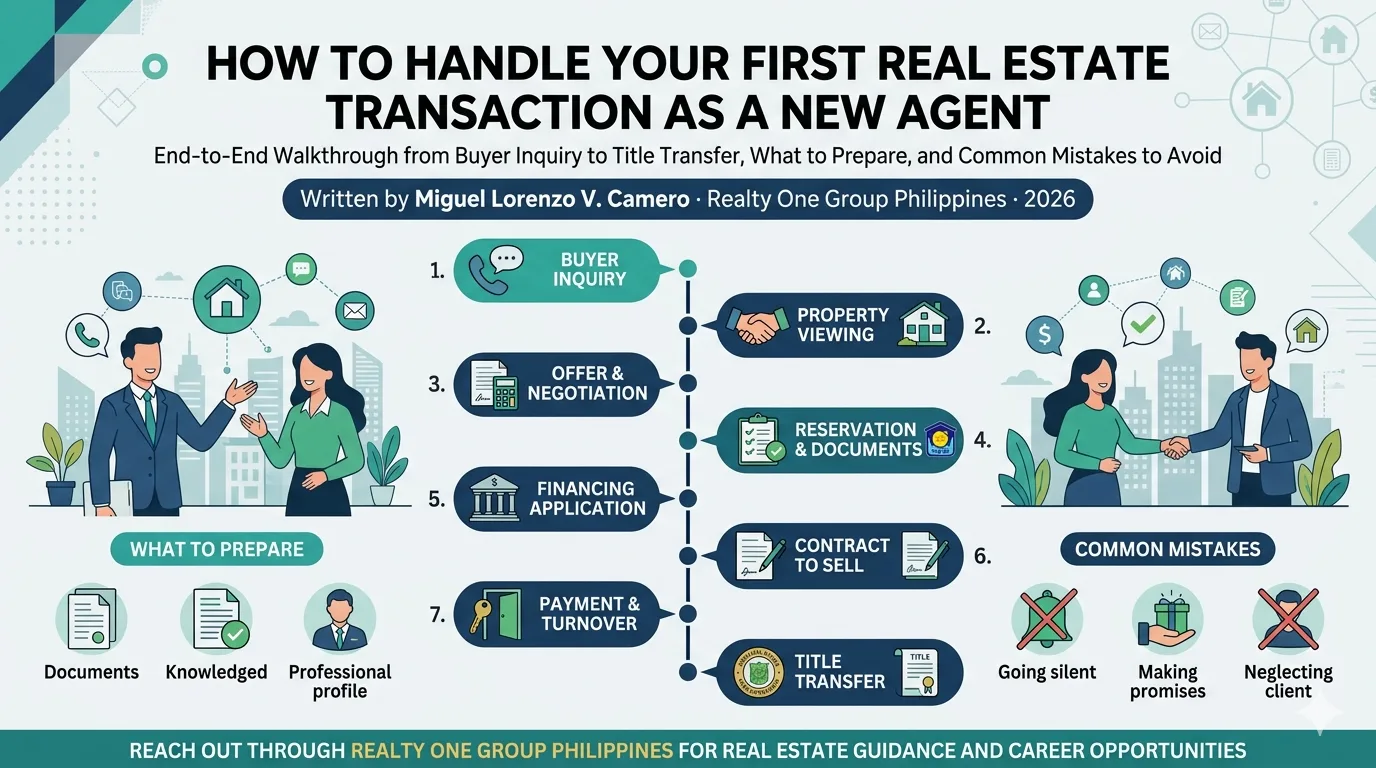
Before the Buyer Calls: What You Need to Have Ready
The preparation that happens before your first buyer inquiry determines how professionally you handle that inquiry when it arrives. New agents who have not prepared often find themselves scrambling to answer basic questions, promising to call back with information they should already know, and making a first impression that undermines the trust they need to build quickly.
Know your inventory. Before you begin actively generating leads, develop a working familiarity with the properties you are authorized to sell — whether that is a specific developer's project, a set of listings in your target area, or a combination of primary and secondary market properties. Know the floor plans, the pricing, the payment schemes, the developer's background and track record, the amenities, the location advantages, the nearby schools, hospitals, and transport options, and the financing programs available. You do not need to have every figure memorized to three decimal places. You need to know enough to answer the most common questions confidently and to know where to find the rest quickly.
Know your financing options. A significant portion of buyer inquiries in the Philippine market will involve questions about how to finance the purchase. Understand the basics of Pag-IBIG housing loans — the eligibility requirements, the loan limits, the interest rates, the contribution requirements, and the application process. Understand how bank financing works — the LTV ratios, the income requirements, the processing timelines, and the key differences between major lending banks in the market. Understand in-house financing — when it makes sense, what it costs, and what the risks are. You do not need to be a mortgage specialist. You need to know enough to orient a buyer and help them identify which path makes sense for their situation.
Have a clean, professional profile ready. When a buyer inquires, one of the first things they will do — often before responding to you — is look you up online. Make sure your social media profiles, any listing portals where your name appears, and your digital business card present you as the professional you intend to be.
Establish your relationship with your supervising broker. Your supervising broker is your first call when something in a transaction goes beyond your experience or authority. Before any transaction begins, make sure you have a clear working relationship — you know how to reach them, what decisions you can make independently, what requires their involvement, and how the commission split and administrative process works between you. Do not figure this out in the middle of your first deal.
Stage One: The Buyer Inquiry
Every transaction begins with a conversation. How you handle the first inquiry sets the tone for everything that follows — and the discipline to handle it well, even when it comes at an inconvenient time or through an informal channel, is one of the most important habits a new agent can build.
Respond promptly. In the Philippine market, buyers who inquire about properties are often talking to multiple agents simultaneously. The agent who responds first, and responds professionally, captures a disproportionate share of serious buyers. Aim to respond to every inquiry within the hour during business hours and within a reasonable timeframe outside of them. A delayed response is not just an inconvenience — it is a signal about how you will handle the rest of the transaction.
Ask the right qualifying questions. Your goal in the first conversation is not to sell — it is to understand. Before you recommend anything, find out what the buyer is actually looking for and whether you are genuinely positioned to help them. The questions that matter most at this stage are: What type of property are you looking for — condo, house and lot, lot only? What is your budget range? Is this for personal use, investment, or both? Where is your preferred location, and why? What is your timeline — are you looking to move within six months, or is this a longer-term plan? How are you planning to finance the purchase — do you have a Pag-IBIG contribution history, are you looking at bank financing, or are you paying in cash?
These questions do more than help you match the buyer to a property. They help you assess the buyer's readiness — whether they are a motivated, near-term buyer or an early-stage researcher who will need months of nurturing before they are ready to transact. Both are worth serving, but they require different approaches.
Be honest about what you have. If the buyer's requirements do not match what you are currently positioned to offer, say so — and offer to help them find what they need, even if it means referring them to another agent or developer. The short-term loss of a lead is far outweighed by the long-term reputation of being an agent who tells the truth and puts the client's needs first.
Stage Two: Property Presentation and Viewing
Once you have established that you have a property that genuinely fits the buyer's requirements, the next step is to present it — and in most cases, to facilitate a physical or virtual viewing.
Prepare the property presentation thoroughly. Before showing any property, make sure you can speak to it completely: the floor area, the layout, the floor level and orientation if it is a condominium, the view, the finishes and fixtures, the building or subdivision amenities, the homeowner association dues or condominium dues applicable, the parking situation, and the price and payment scheme. Know the surrounding area — the nearest major roads, public transport options, schools, hospitals, shopping centers, and other amenities that buyers consistently ask about.
For primary market properties, coordinate with the developer's sales team or your developer liaison to arrange the showing — whether at a model unit, a show suite, or a site visit. Bring the developer's marketing materials, but do not rely on them exclusively. Your value as a broker in a primary market showing is not the brochure — the buyer can read the brochure themselves. Your value is the knowledge, context, and honest perspective you bring to the presentation.
For secondary market properties, coordinate with the seller or the seller's representative to arrange access. Inspect the property yourself before bringing the buyer whenever possible — not just to familiarize yourself with it, but to identify any conditions or issues that you should be aware of before the buyer asks about them. Nothing undermines a buyer's confidence faster than an agent who is visibly seeing a property for the first time alongside them.
During the viewing, listen more than you talk. Watch what the buyer responds to — what they linger on, what they question, what makes them visibly uncomfortable. Their reactions tell you more about what they actually need than their stated preferences often do. Ask open questions: "What do you think of the layout?" "How does this compare to what you had in mind?" "Is there anything here that concerns you?" The answers guide everything that follows.
After the viewing, follow up the same day. A simple message — "Great to show you the property today. What were your initial impressions? Is there anything you'd like to know more about?" — keeps the conversation alive and signals that your interest in their decision continues beyond the showing.
Stage Three: Offer and Negotiation
When a buyer expresses genuine interest in a property and indicates they are ready to move forward, the transaction enters the offer and negotiation stage. For new agents, this is often the most nerve-wracking part of the process — and the stage where the quality of your preparation and your supervising broker's guidance matters most.
For primary market transactions, the negotiation dynamic is different from secondary market. Developer pricing is typically fixed — particularly for pre-selling projects — and the negotiation is less about price and more about payment scheme, reservation requirements, spot cash discounts, deferred down payment structures, and the specific unit or lot within the project. Know what flexibility exists within the developer's pricing structure before you sit down with the buyer, so you can present options rather than simply saying "the price is the price."
For secondary market transactions, price negotiation is standard, and your role as the buyer's agent is to represent their interests in that negotiation professionally and effectively. Before advising any offer amount, do your homework: what have comparable properties in that area sold for recently? How long has this property been listed? Is the seller motivated — have they already purchased elsewhere, or are they in no particular hurry? What is the property's condition relative to the asking price? These factors determine the realistic offer range, and going in with an offer that is grounded in this analysis is far more effective than simply anchoring to the buyer's desired discount.
Communicate offers in writing. Verbal offers create ambiguity, misunderstandings, and disputes. From your first transaction onward, establish the habit of documenting every offer, counteroffer, and agreed term in writing — even if the initial conversation happens verbally. A simple message summarizing the offer terms, sent to all relevant parties after the verbal discussion, creates a paper trail that protects everyone.
Involve your supervising broker. Negotiation is one of the areas where an experienced broker's guidance is most valuable to a new agent. Do not try to navigate a complex negotiation alone in your first transaction. Consult your supervising broker before making or accepting any significant representations on behalf of your client.
Stage Four: Reservation and Initial Documentation
When buyer and seller reach agreement on the price and terms, the transaction is formalized through a reservation — a payment made by the buyer to secure the property while the formal documentation and financing process proceeds.
The Reservation Fee. The reservation fee is a payment — typically ranging from ₱10,000 to ₱50,000 or more depending on the property type and developer — that takes the property off the market and signals the buyer's commitment to proceed. For primary market transactions, the reservation fee is paid directly to the developer and is typically non-refundable. For secondary market transactions, the equivalent is often a good faith deposit or earnest money paid to the seller. Always clarify the refundability terms and the conditions under which the reservation or deposit may be forfeited before the buyer pays anything.
The Reservation Agreement or Letter of Intent. This document formalizes the buyer's intent to purchase at the agreed terms. Review it carefully with your buyer before they sign. Make sure the property details — unit number, floor area, location, price — are accurately stated, the payment scheme is clearly laid out, and any agreed conditions or contingencies are documented. Do not rush the buyer through this step. This is the moment to read carefully, ask questions, and ensure that what the buyer believes they are agreeing to is what the document actually says.
Collect and organize the buyer's documents. At this stage, you need to begin gathering the documentary requirements for whatever financing path the buyer is taking. For Pag-IBIG financing, the standard buyer requirements include valid government-issued IDs, the Pag-IBIG Member's Data Form, proof of income, employment documents such as a Certificate of Employment and payslips, and the buyer's Pag-IBIG contribution history. For bank financing, requirements vary by bank but generally include similar income and identity documents plus additional financial documentation such as bank statements and income tax returns. For in-house financing, the developer's documentary requirements typically include basic identity and income documents but are generally less stringent than Pag-IBIG or bank requirements.
Create a document tracker — a simple list of every document required, who is responsible for providing it, and whether it has been received. This tracker becomes your operational map for the next several weeks or months.
Stage Five: Financing Application and Approval
For the majority of transactions that involve financing — which is the majority of transactions in the Philippine market — this is the longest and most administratively intensive stage. It is also the stage where most first-time agents make the mistake of going quiet, assuming that the financing institution is handling everything and there is nothing for them to do until approval comes through.
There is always something for you to do.
For Pag-IBIG financing, the application process involves submitting the completed loan application package to Pag-IBIG — either through the developer's accredited liaison or directly through a Pag-IBIG branch or Virtual Pag-IBIG. The package typically includes the buyer's application form, identity and income documents, the developer's documents, and the property's legal documents. Processing timelines for Pag-IBIG housing loans have historically ranged from several weeks to several months depending on application volume and the completeness of the submission. Follow up regularly — both with Pag-IBIG through available channels and with the developer's liaison who is coordinating the application.
For bank financing, the process begins with the buyer's loan application at their chosen bank, accompanied by the required income and identity documents. The bank will conduct its own property appraisal — an important step, because the bank's appraised value, not the agreed purchase price, determines the maximum loan amount. If the bank's appraised value comes in lower than the purchase price, the buyer may need to cover the difference through a larger down payment. Make sure your buyer understands this possibility before the appraisal so they are not caught off guard if it happens. Bank processing timelines are generally faster than Pag-IBIG — often two to eight weeks for a complete application — but vary significantly by bank and application complexity.
Follow up consistently and document every interaction. Every call you make to a Pag-IBIG branch, every email you send to a bank officer, every developer liaison update you receive — keep a log. This documentation protects your client if anything goes wrong and protects you if questions arise about the handling of the application.
Keep your buyer informed throughout. The financing stage involves long periods where nothing visible is happening, and silence from an agent during these periods creates anxiety. A brief update message once a week — even if the update is simply "I followed up with Pag-IBIG today and the application is still being processed; I'll update you as soon as I hear anything" — keeps the buyer calm and confident that they are in capable hands.
Stage Six: Contract to Sell and Formal Agreements
Once financing is approved — or in cash transactions, once the payment terms are confirmed — the formal contract documents are prepared and executed. The primary document at this stage is the Contract to Sell, which is the binding agreement between buyer and seller that governs the terms of the transaction prior to full payment and title transfer.
Review the Contract to Sell carefully. This is not a formality. It is a legal document that defines the rights and obligations of both parties, the payment schedule, the conditions under which the contract may be cancelled, the penalties for default, and the specific property being sold. Read it thoroughly — ideally with your supervising broker and, for significant transactions, with the buyer's legal counsel. Flag any terms that differ from what was agreed at the reservation stage. Identify any clauses that impose obligations on the buyer that they may not be aware of — particularly penalty clauses for late payment, conditions that could lead to forfeiture, and provisions related to project delays for pre-selling properties.
Ensure the buyer understands what they are signing. It is not enough to hand a buyer a contract and wait for them to sign. Walk through the key provisions with them. Explain what the payment schedule means in practical terms. Make sure they understand the consequences of missing a payment. Make sure the property details — every specification that matters to them — are accurately captured in the document. A buyer who signs a contract they do not fully understand is a buyer who may become a dissatisfied client, or a complainant, when reality does not match their expectations.
Stage Seven: Payment Completion and Turnover
For pre-selling properties, this stage may be months or years after the contract is signed — the buyer makes their scheduled down payment installments while the property is under construction, and the balance is paid through the approved financing upon completion. For ready-for-occupancy properties, the payment timeline is compressed, and turnover follows completion of financing more quickly.
Monitor the payment schedule. Particularly for buyers on deferred down payment schemes, missed payments can trigger penalty provisions or contract cancellation. While it is ultimately the buyer's responsibility to make their payments on time, a proactive agent who reminds their client of upcoming payment obligations — especially early in the process when the habit is still forming — is providing genuine value and protecting a transaction that represents months of work.
The turnover process involves the developer or seller formally handing over the property to the buyer — typically after full payment or after the financing proceeds have been released to the developer by Pag-IBIG or the bank. For condominium and subdivision properties, turnover usually involves a unit or lot inspection, the signing of a punch list of any defects or items to be remediated, the release of keys and access cards, and the processing of the buyer's move-in requirements.
Attend the turnover with your client whenever possible. The turnover inspection is important — it is the buyer's opportunity to identify and document any defects that the developer is obligated to remedy before they accept the unit. An agent who accompanies their client to this inspection, helps them conduct it systematically, and ensures that any issues are properly documented and submitted to the developer is providing a level of service that most clients do not expect and deeply appreciate.
Stage Eight: Title Transfer
Title transfer is the final stage of the transaction — the legal process by which ownership of the property is formally transferred from the seller or developer to the buyer and recorded in the name of the buyer at the Registry of Deeds. It is also the stage that new agents are least familiar with, because it involves government processes, tax payments, and coordination across multiple agencies that can feel complex and slow.
The taxes and fees involved in title transfer for a standard sale transaction in the Philippines generally include the following. Capital Gains Tax — equivalent to 6% of the selling price or the property's zonal value, whichever is higher — is typically the seller's obligation, though this is sometimes negotiated as part of the transaction terms. Documentary Stamp Tax — 1.5% of the selling price or zonal value, whichever is higher — is also typically a seller's obligation under standard arrangements, though again, negotiable. Transfer Tax is paid to the local government unit where the property is located and is typically 0.5% to 0.75% of the selling price. Registration Fee is paid to the Registry of Deeds for the formal registration of the title in the buyer's name. Notarial fees for the Deed of Absolute Sale and other notarized documents are also part of the closing costs.
The sequence of title transfer generally flows as follows. Once full payment has been made or financing proceeds have been released, the Deed of Absolute Sale is executed and notarized. The Capital Gains Tax and Documentary Stamp Tax are paid at the Bureau of Internal Revenue. The Transfer Tax is paid at the local treasurer's office of the municipality or city where the property is located. The notarized Deed of Absolute Sale, the tax clearance documents, and the original Transfer Certificate of Title or Condominium Certificate of Title are submitted to the Registry of Deeds for the cancellation of the seller's title and the issuance of a new title in the buyer's name. The new title is then presented to the local assessor's office for the issuance of a new Tax Declaration in the buyer's name.
Processing timelines for title transfer vary significantly depending on the Registry of Deeds, the BIR, and the local government offices involved, the completeness of the documentary submission, and factors that are sometimes outside anyone's direct control. In Metro Manila, the process can take anywhere from a few months to considerably longer under congested conditions. In provincial registries, timelines may be shorter or longer depending on the specific office. Set realistic expectations with your client at the outset, and follow up regularly with each agency to keep the process moving.
Your role in the title transfer process as a new agent is primarily to coordinate, communicate, and follow up — not to process the documents yourself, which is typically handled by the developer's in-house documentation team for primary market transactions or by a third-party documentation service or lawyer for secondary market transactions. Know who is handling the title transfer, maintain regular contact with them, keep your client updated on progress, and escalate any significant delays or complications to your supervising broker promptly.
Common Mistakes New Agents Make in Their First Transaction
Every new agent makes mistakes in their first transaction. The goal is not to be perfect — it is to make mistakes that are recoverable, to learn from them immediately, and to build the habits that prevent them from recurring. The following mistakes are the ones that most consistently affect first-time agents and that cost the most when they happen.
Going silent during the long waiting periods. The financing stage, the title transfer process, and other waiting periods in a transaction can stretch for months. New agents who stop communicating with their clients during these periods — because there is nothing new to report — create anxiety and erode trust. Communicate consistently even when the update is simply that things are in process. The client does not need news. They need to know you are still there and still on top of it.
Not verifying documents independently. A title that appears clean to a cursory review may carry encumbrances, liens, or annotations that are not immediately visible. A developer accreditation that appears current may have lapsed. An income document that looks complete may be missing a critical page. New agents who take documents at face value without verifying them — or without ensuring that someone qualified is verifying them — expose their clients and themselves to serious complications. Build the habit of verification from your first transaction.
Making promises you cannot keep. The pressure to reassure an anxious client is real, and the temptation to give optimistic timelines and confident assurances is understandable. Resist it. If you do not know when the Pag-IBIG approval will come through, say you do not know and that you will follow up to find out. If you are not certain whether a particular unit is still available, confirm before telling the client it is. Promises you cannot keep destroy trust far more thoroughly than honest uncertainty ever would.
Not involving your supervising broker early enough. New agents sometimes hesitate to involve their supervising broker because they want to demonstrate independence or because they do not want to share the commission. Both reasons are shortsighted. Your supervising broker's experience is a resource you are paying for through your split arrangement — use it. The transactions where new agents get into serious trouble are almost always the ones where they tried to figure something out alone rather than asking for help when the question first arose.
Neglecting the client after closing. The transaction is done, the commission has been received, and the natural impulse is to move on to the next deal. The agents who build the strongest referral practices are the ones who resist this impulse — who check in on the client after they have moved in, who send a message on the anniversary of the closing, who remain genuinely present in the client's life as a real estate resource even when there is no active transaction. The next referral from that client, or the next transaction when they are ready to buy again, begins in the weeks after the first closing.
Your first transaction will not be perfect. It will be complicated in ways you did not anticipate, slower than you hoped, and educational in ways no training program can replicate. That is exactly as it should be. The agent you are after your first transaction is meaningfully more capable than the agent you were before it — because you will have been through the process once, with a real client, with real stakes, and with the experience of navigating something that mattered.
What you bring to that first transaction — preparation, consistency, honesty, and the humility to involve your supervising broker when you need guidance — determines whether your client comes out of it feeling well-served and whether you come out of it having built the foundation of a professional reputation worth building on.
Know the stages. Prepare your documents. Communicate consistently. Verify everything. Ask for help when you need it. And when it is done — really done, title transferred and client settled — take a moment to understand what you learned and carry it into the next one.
For real estate guidance, career opportunities, or property inquiries, reach out through Realty One Group Philippines.
About the Author
Miguel Lorenzo V. Camero · Realty One Group Philippines
This article was written to give new real estate agents in the Philippines an honest, practical guide to navigating their first transaction from beginning to end. It is shared in the spirit of education and professional community — because every Filipino entering this profession deserves to understand the full process they are guiding their clients through, with enough clarity and preparation to do it well. For property inquiries or real estate guidance, reach out through Realty One Group Philippines.
Disclaimer: This article is for general informational and educational purposes only. It is not an official publication of the Professional Regulation Commission (PRC), the Department of Human Settlements and Urban Development (DHSUD), the Home Development Mutual Fund (Pag-IBIG Fund), the Bureau of Internal Revenue (BIR), the Registry of Deeds, or any government agency, nor is it endorsed by any regulatory body, financial institution, or real estate organization. The transaction process, documentary requirements, timelines, tax obligations, and procedures described in this article reflect general market practice at the time of writing and are subject to change. Specific requirements will vary depending on the property type, financing method, location, developer, financial institution, and other transaction-specific factors. All figures and examples used are illustrative only. Nothing in this article constitutes legal, financial, or professional advice. Always verify current requirements with the relevant government agencies, your supervising broker, and a licensed legal professional before proceeding with any real estate transaction. The author and Realty One Group Philippines assume no liability for decisions made based on the contents of this article.