There is a version of real estate practice that treats ethics as a compliance checkbox — something you acknowledge during a CPD seminar, file away, and rarely think about again until renewal season. And then there is the version practiced by the brokers and agents who build careers that last decades, whose clients refer them without being asked, and whose reputation in the market is their most valuable professional asset. The difference between those two versions of the profession is not talent, not market conditions, and not luck. It is the consistent, deliberate decision to practice with integrity — not because the law requires it, but because the clients you serve deserve it and because the kind of career worth building cannot be built any other way.
That said, the law does require it. Republic Act No. 9646 — the Real Estate Service Act of the Philippines, commonly referred to as RESA — is not simply the legislation that created the licensing and accreditation framework for Philippine real estate practitioners. It is the legal foundation of ethical practice in the profession, defining what real estate service practitioners are obligated to do, what they are prohibited from doing, what happens when those prohibitions are violated, and how clients and the public can seek redress when practitioners fall short of the standards the law sets.
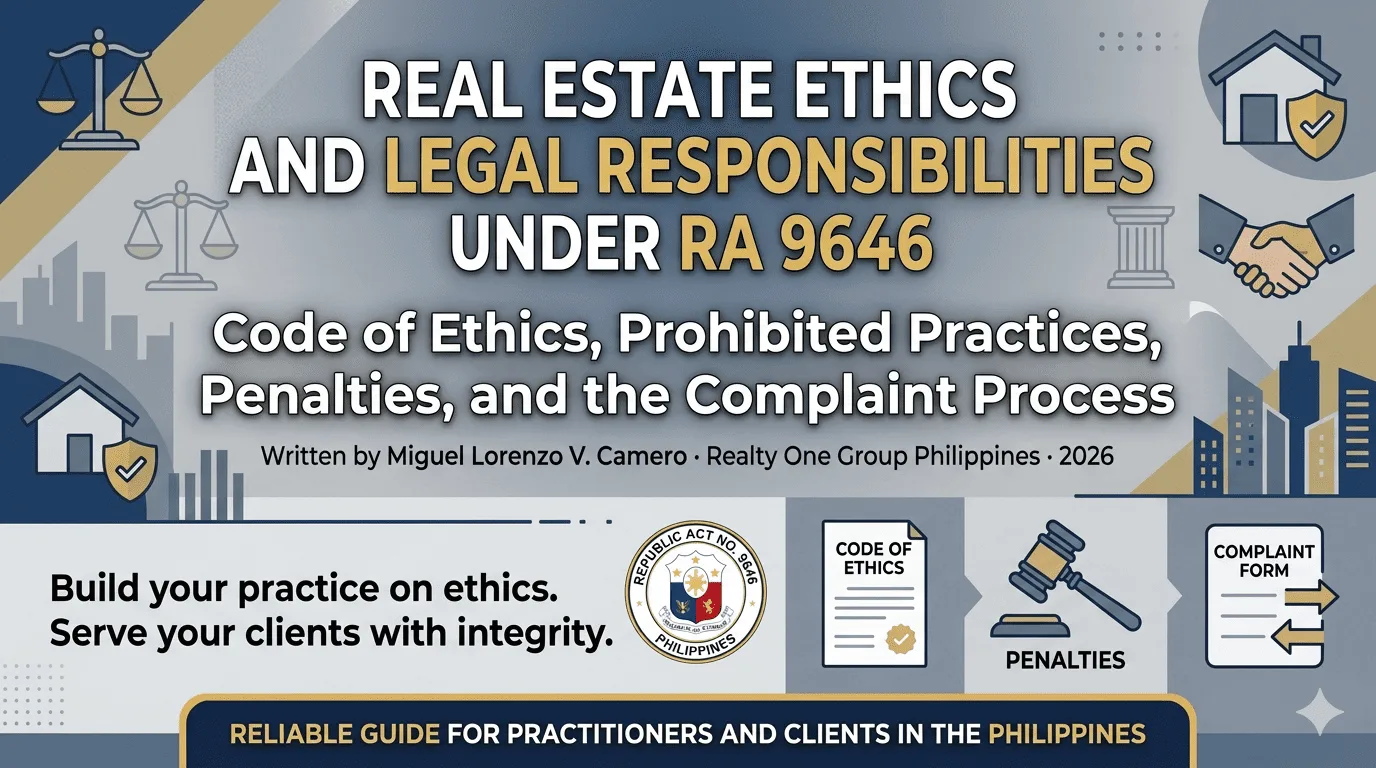
This article gives you a thorough, honest breakdown of the ethical and legal framework that governs real estate practice in the Philippines — the code of ethics, the specific prohibited practices under RESA and related regulations, the penalties that apply to violations, and the complaint process available to clients and the public. Whether you are a practitioner building your practice on solid ethical ground or a client who wants to understand your rights, this article is written for you.
The Foundation: What RA 9646 Establishes and Why It Matters
Republic Act No. 9646 was signed into law in 2009 and established the regulatory framework for real estate service practice in the Philippines. Before RESA, the real estate profession operated under a significantly less structured regulatory environment — one that left considerable room for unqualified practitioners, deceptive practices, and inadequate consumer protection. RESA addressed this by creating a professional licensing system, establishing a Code of Ethics and Responsibilities for real estate service practitioners, defining prohibited practices and their penalties, and creating enforcement mechanisms through the Professional Regulation Commission and, subsequently, the Department of Human Settlements and Urban Development.
The law applies to all real estate service practitioners — brokers, salespersons, appraisers, and consultants — and to anyone who engages in real estate service practice within the Philippines, whether Filipino or foreign national. Its reach is broad by design: the transactions it governs involve some of the largest financial commitments Filipino families and businesses make, and the public interest in ensuring those transactions are conducted honestly, competently, and ethically is significant.
Understanding RESA is not optional for anyone practicing in or entering the profession. Ignorance of the law is not a defense under Philippine jurisprudence, and the practitioners who claim they did not know a particular practice was prohibited face the same consequences as those who violated the law knowingly. Know the framework. Practice within it. Build your career on its requirements rather than around them.
The Code of Ethics: What Real Estate Practitioners Are Obligated to Uphold
The Code of Ethics and Responsibilities for real estate service practitioners, established under the implementing rules and regulations of RA 9646, defines the professional standards that govern how practitioners must conduct themselves in their relationships with clients, with fellow practitioners, and with the public. It is not an aspirational document — it is a professional obligation, and violations of its provisions carry disciplinary consequences.
The Obligation of Competence
Real estate service practitioners are obligated to maintain the level of knowledge and skill necessary to serve their clients competently. This means staying current on market conditions, legal requirements, financing options, and professional developments — not just at the moment of licensing, but continuously throughout their practice. The CPD requirement exists precisely to enforce this obligation structurally. But the ethical obligation goes beyond CPD compliance. It means being honest with yourself about the boundaries of your competence, referring clients to specialists when a transaction requires expertise you do not have, and never representing yourself as having knowledge or qualifications that you do not possess.
A practitioner who takes on a complex commercial transaction without the expertise to handle it, who provides financing advice beyond their understanding, or who represents a property's legal status without verifying it is not just making a mistake — they are violating their ethical obligation to their client and potentially exposing that client to serious financial harm.
The Obligation of Loyalty and Client Representation
Practitioners who represent buyers or sellers are obligated to act in their client's best interests — not in their own financial interest, not in the interest of the other party, and not in the interest of closing a transaction that may not be right for the client. This obligation of loyalty is foundational to what makes a real estate broker worth engaging. A client who retains a broker trusts that broker to advocate for them — to provide honest advice, to negotiate on their behalf, to flag risks and problems rather than minimize them, and to prioritize the client's outcome over the commission.
Violations of loyalty — recommending a property because the commission is higher, concealing information that might cause the client to reconsider, or steering a client toward a transaction that serves the practitioner's interests at the client's expense — are among the most serious ethical breaches in the profession. They are also, practically speaking, the breaches most likely to generate complaints, legal exposure, and lasting reputational damage.
The Obligation of Honesty and Full Disclosure
Practitioners are obligated to be honest in all their representations — about properties, about market conditions, about their qualifications, and about any material facts that might affect a client's decision. Full disclosure is the specific obligation to proactively share information that the client needs to make an informed decision, even when that information is not explicitly requested and even when sharing it might complicate or derail a transaction.
Material facts that require disclosure include known defects in a property, encumbrances or liens on a title, zoning restrictions that affect the intended use of the property, pending litigation or regulatory action affecting a development, and any other information that a reasonable buyer or seller would consider significant in deciding whether to proceed and on what terms. The practitioner who knows about a structural issue with a property and does not disclose it to the buyer — hoping the transaction closes before it comes to light — is not just behaving unethically. They are exposing themselves to legal liability for the consequences of that non-disclosure.
The Obligation of Confidentiality
Practitioners are obligated to protect the confidential information of their clients — information shared in the course of the professional relationship that the client has not authorized to be disclosed to third parties. This obligation persists after the transaction has ended. A broker who shares a client's financial situation with a seller to facilitate a negotiation, who discloses a buyer's maximum budget without authorization, or who uses information obtained in confidence from one client to benefit another is violating both the ethical obligation of confidentiality and the fundamental trust on which the client relationship is built.
The Obligation of Professional Conduct Toward Fellow Practitioners
The Code of Ethics also governs how practitioners treat each other. This includes obligations not to disparage fellow practitioners, not to interfere in another practitioner's client relationships without proper authorization, and to cooperate in transactions where multiple practitioners are involved in ways that serve the clients rather than creating unnecessary conflict. In a profession where reputation within the professional community matters as much as reputation with clients, the way a practitioner treats their colleagues is not a minor matter.
Prohibited Practices: What RA 9646 and Related Regulations Explicitly Forbid
Beyond the general ethical obligations, RESA and its implementing rules define specific prohibited practices — acts that are explicitly forbidden and that carry defined penalties. The following are among the most significant.
Unauthorized Practice of Real Estate Service
Perhaps the most fundamental prohibited practice under RESA is engaging in real estate service without the appropriate PRC license or accreditation. This means selling, buying, leasing, or facilitating real estate transactions for a fee or commission without being a licensed broker, an accredited salesperson under a licensed broker, a licensed appraiser, or a licensed consultant. It applies to individuals who have never been licensed, to those whose licenses have lapsed and have not been renewed, and to accredited salespersons who operate without a supervising broker.
The prohibition is comprehensive and applies regardless of how the unauthorized practitioner describes or titles themselves. Calling yourself a "property consultant," a "real estate agent," or any other title does not create legal authorization to practice. Only a valid PRC license or current PRC accreditation under a licensed supervising broker creates that authorization.
Misrepresentation and Fraud
Making false representations about a property, about the practitioner's qualifications, or about any material fact in a transaction is explicitly prohibited. This covers a wide range of conduct: overstating a property's floor area, misrepresenting its proximity to amenities, concealing known defects, falsifying documents, fabricating credentials, and providing misleading comparables to influence a client's pricing decision. Misrepresentation that causes financial harm to a client creates not just disciplinary exposure but potential civil and criminal liability as well.
Conflict of Interest Without Disclosure
A practitioner who has a personal or financial interest in a transaction — who is buying or selling property from or to their own client, who has a relationship with the other party that could affect their advice, or who stands to benefit from a transaction in ways beyond their standard commission — is not automatically prohibited from proceeding. But they are absolutely prohibited from proceeding without fully disclosing that conflict of interest to their client and obtaining the client's informed consent to continue. The failure to disclose a conflict of interest, even in the absence of actual harm, is a serious ethical and legal violation.
Commingling of Funds
Practitioners who receive funds on behalf of clients — reservation fees, earnest money, down payment installments — are prohibited from commingling those funds with their own personal or business accounts. Client funds must be held separately and accounted for clearly. Commingling of funds is both an ethical violation and, if misappropriation follows, a criminal matter. The discipline required to maintain clear separation of client funds from personal finances is non-negotiable from the first transaction forward.
Splitting Fees with Unlicensed Individuals
A licensed broker or accredited salesperson is prohibited from sharing their commission or professional fee with an unlicensed individual in exchange for referral or assistance in a transaction. This prohibition addresses the common informal practice of paying "referral fees" or "finder's fees" to friends, relatives, or contacts who are not themselves licensed or accredited practitioners. The law permits fee sharing within the licensed community — between brokers, or between a broker and their accredited salespersons — but not with individuals who have no standing under RESA.
Soliciting Clients of Another Broker
Actively soliciting or attempting to persuade a client who is in an existing professional relationship with another licensed broker to terminate that relationship and engage the soliciting practitioner instead is a prohibited practice under the Code of Ethics. This does not prevent a potential client from choosing to change brokers — that is the client's right. It prevents practitioners from engineering that change through improper solicitation.
Practicing Under a Suspended or Revoked License
Continuing to practice after a PRC license has been suspended or revoked is an aggravated violation of RESA that compounds the underlying offense that led to the suspension or revocation. It demonstrates a disregard for regulatory authority that courts and disciplinary bodies treat with particular seriousness.
Advertising Violations
Practitioners are prohibited from advertising properties or services in ways that are false, misleading, or likely to deceive the public. This includes misrepresenting property prices, making unsubstantiated claims about investment returns, using photographs or descriptions that materially misrepresent the property's actual condition or location, and presenting oneself in advertising as having qualifications, designations, or affiliations that do not exist or have not been properly earned.
Penalties: What Violations Actually Cost
RESA prescribes penalties for violations that range from administrative sanctions to criminal prosecution, depending on the nature and severity of the offense. Understanding these penalties is important both as a deterrent for practitioners considering questionable conduct and as a resource for clients who have been harmed and want to understand the consequences available to them.
Administrative Penalties
For violations of the Code of Ethics and professional standards, the PRC — through the Board of Real Estate Service — may impose administrative sanctions including reprimand, suspension of the professional license or accreditation for a defined period, or revocation of the license or accreditation. Revocation is the most severe administrative sanction and effectively ends the practitioner's ability to operate legally in the profession. A revoked license cannot simply be renewed — restoration requires a formal application process with no guarantee of approval.
Administrative penalties may also include fines. The specific fine amounts applicable to particular violations are defined in the implementing rules and regulations and are subject to periodic adjustment. They are not trivial amounts, and they are imposed in addition to — not instead of — other disciplinary action.
Criminal Penalties
For more serious violations — particularly unauthorized practice of real estate service — RESA provides for criminal penalties. Under Section 39 of RA 9646, any person who practices real estate service without being authorized under the Act, or who violates any provision of the Act, shall upon conviction be punished by a fine of not less than One Hundred Thousand Pesos and not more than Two Hundred Thousand Pesos, or imprisonment of not less than two years and not more than four years, or both, at the discretion of the court.
These are not theoretical penalties. They reflect the legislature's judgment that unauthorized practice of real estate service — engaging in transactions that affect clients' financial lives and property rights without the qualification and accountability that licensing provides — is a serious enough offense to warrant criminal prosecution. Practitioners who operate without licenses, and those who knowingly assist or enable unauthorized practitioners, should understand this clearly.
Civil Liability
Beyond administrative and criminal penalties, practitioners who harm clients through negligence, misrepresentation, fraud, or breach of fiduciary duty face civil liability — the obligation to compensate clients for the financial harm caused by their conduct. Civil claims in real estate transactions can involve significant amounts, particularly when the harm relates to a property transaction where the client's financial loss may be in the hundreds of thousands or millions of pesos. Civil liability is independent of administrative and criminal penalties — a practitioner may face all three simultaneously for a single serious violation.
The Complaint Process: How Clients and Practitioners Can Seek Redress
When a client believes a real estate service practitioner has violated their ethical or legal obligations, there is a formal complaint process available. Understanding this process — both as a practitioner who may one day be the subject of a complaint and as a client who may need to use it — is an important part of knowing how the profession's accountability framework operates.
Filing a Complaint with the PRC
Complaints against licensed real estate brokers, appraisers, and consultants for violations of RESA and the Code of Ethics are filed with the Professional Regulation Commission, specifically through the Board of Real Estate Service. The complaint must be in writing, signed by the complainant, and must include a clear statement of the facts giving rise to the complaint, identification of the respondent practitioner, and any documentary evidence supporting the complaint — contracts, receipts, correspondence, and other relevant documents.
The PRC will evaluate the complaint and determine whether it falls within its jurisdiction and whether there is sufficient basis to proceed. If the complaint is accepted, the respondent practitioner is notified and given the opportunity to respond. The process may involve formal hearings where both parties present evidence and argument. Upon conclusion of the process, the Board issues a decision that may include the administrative penalties described above.
Filing a Complaint with DHSUD
For violations related to the sale of subdivision lots, condominium units, and other properties regulated under DHSUD's jurisdiction — including complaints about developer practices and the conduct of practitioners involved in those transactions — complaints may be filed with the Department of Human Settlements and Urban Development. DHSUD has its own adjudicatory process for complaints within its regulatory scope, and its jurisdiction is separate from and complementary to that of the PRC.
Clients who have been harmed in a primary market transaction — a pre-selling condominium purchase where the developer misrepresented the project, a subdivision lot sale where the broker concealed material information — may have grounds for complaints with both the PRC and DHSUD, depending on the nature of the violation.
Filing a Civil or Criminal Case
Where a practitioner's conduct has caused financial harm through misrepresentation, fraud, or negligence, the client may pursue civil remedies through the regular courts — filing a civil case for damages against the practitioner and, where applicable, the developer or seller. Where the conduct constitutes a criminal offense under RESA or other applicable laws, a criminal complaint may be filed with the Office of the City or Provincial Prosecutor, which will evaluate whether probable cause exists to file criminal charges.
What to Prepare When Filing a Complaint
A well-prepared complaint is significantly more likely to be acted upon promptly and effectively than a vague or undocumented one. Before filing, gather and organize the following: the full name and PRC license or accreditation number of the practitioner you are complaining about; a clear, chronological narrative of what happened and how it harmed you; copies of all relevant documents — reservation agreements, contracts, receipts, text messages, emails, and any other written communications; and the names and contact information of any witnesses who can support your account of events. Consult a lawyer before filing a formal complaint, particularly if you are pursuing civil or criminal remedies alongside the administrative process.
Why Ethics Is Not Just a Legal Obligation — It Is a Business Strategy
It would be easy to read the preceding sections — the code of ethics, the prohibited practices, the penalties, the complaint process — and conclude that ethical practice is primarily about avoiding punishment. That framing misses something important.
The practitioners who are most consistently successful in Philippine real estate over long careers are not the ones who are merely avoiding violations. They are the ones who have internalized the principles behind the rules — honesty, loyalty, competence, and full disclosure — and who apply them not because the Board of Real Estate Service is watching, but because they have understood that a practice built on those principles is self-sustaining in a way that a practice built on anything less never can be.
Referrals — the engine of sustainable real estate income — flow toward practitioners who clients trust absolutely. Trust is built through transactions where the client experienced genuine loyalty, complete honesty, and professional competence from their broker or agent. It is destroyed permanently by a single transaction where the client felt misled, unrepresented, or taken advantage of. The ethical practitioner is not just the morally admirable one. In the long run, they are also the commercially successful one — because the market rewards integrity in ways that compound over time just as surely as any investment.
The broker who discloses a property defect that complicates a transaction loses the commission on that deal. The broker who conceals it closes the deal but creates a client who, when they discover the concealment, becomes someone who warns every person in their network away. The math of ethical practice, computed over a career rather than a single transaction, is straightforwardly in favor of doing the right thing every time.
Practical Ethics: Situations You Will Actually Face
Theory is useful. What is more useful is understanding how ethical obligations apply in the specific situations that practitioners actually encounter — because the moments that test your ethics rarely announce themselves clearly as ethical dilemmas. They arrive as pressures, as convenient rationalizations, and as small decisions that feel minor in the moment but define the kind of practitioner you are becoming.
A seller tells you privately that the property has a flooding issue during heavy rain, and asks you not to mention it to buyers because it will reduce the price. Your obligation of full disclosure to buyers — and potentially to prospective buyers who are not yet your clients but who are entitled to material information about the property — is directly in conflict with the seller's instruction. The ethical path is clear even though it is commercially uncomfortable: material defects must be disclosed. If the seller refuses to allow disclosure, you may need to withdraw from the representation.
A buyer you are working with confides that their maximum budget is significantly higher than the offer they have authorized you to make. In a negotiation with the seller, sharing that information — even subtly — would be a betrayal of the confidence placed in you and a violation of your loyalty obligation. The buyer's budget is their information. It is not yours to use, imply, or disclose, regardless of the pressure you may feel to close the transaction.
A fellow agent asks you to co-broke a transaction and split the commission, but you discover during due diligence that the property they are representing has a title issue that has not been disclosed to your buyer client. Your obligation to your client requires you to disclose what you have found and to advise them accordingly — even though doing so may collapse the transaction, end the co-broke arrangement, and create friction with the other agent. The client's interests come first, every time.
A developer offers you a significantly higher commission if you prioritize their project over alternatives that may better fit your client's stated requirements. The conflict of interest this creates must be disclosed to your client. You cannot accept a financial incentive that compromises your independent professional judgment without your client's knowledge and consent. If the developer's project genuinely is the best fit for the client's needs, recommending it is ethical. Recommending it because of the commission without disclosure is not.
These situations do not have easy resolutions. Ethical practice sometimes means losing a commission, creating a conflict, or disappointing a seller or fellow practitioner. What it never means is betraying the client who trusted you with one of the most significant financial decisions of their life.
RA 9646 is more than a licensing law. It is the legal expression of what the Philippine real estate profession owes to the public it serves — a standard of honesty, competence, loyalty, and accountability that protects Filipino families and businesses from the very real harm that unethical and unqualified real estate practice can cause.
The code of ethics defines who a real estate service practitioner is obligated to be. The prohibited practices define the specific lines they must not cross. The penalties define the consequences when those lines are crossed. And the complaint process defines how accountability is enforced when the profession fails to hold itself to its own standards.
For practitioners, the framework is both a boundary and a foundation. Stay within it, and you are building something that can last. Ignore it, and you are building on ground that will eventually give way.
For clients, the framework is both protection and empowerment. You have rights in every real estate transaction you enter. You have recourse when those rights are violated. You are entitled to a practitioner who serves your interests honestly, competently, and with full disclosure — and when that standard is not met, there are formal channels through which accountability can be sought.
Build your practice on ethics. Serve your clients with integrity. Know the law that governs your profession and practice within it not as a ceiling but as a floor — the minimum standard below which no practitioner should fall, and the foundation on which a genuinely excellent practice is built.
For real estate guidance, career opportunities, or property inquiries, reach out through Realty One Group Philippines.
About the Author
Miguel Lorenzo V. Camero · Realty One Group Philippines
This article was written to share a clear, honest overview of the ethical and legal framework that governs real estate practice in the Philippines under Republic Act No. 9646. It is shared in the spirit of education and professional accountability — because every Filipino who enters the real estate profession, and every Filipino who engages a real estate practitioner, deserves to understand the standards the law sets and the rights it protects. For property inquiries or real estate guidance, reach out through Realty One Group Philippines.
Disclaimer: This article is for general informational and educational purposes only. It is not an official publication of the Professional Regulation Commission (PRC), the Department of Human Settlements and Urban Development (DHSUD), the Board of Real Estate Service, or any government agency, nor does it constitute legal advice or an authoritative interpretation of Republic Act No. 9646 or any other legislation. The ethical obligations, prohibited practices, penalties, and complaint procedures described in this article reflect general guidance based on publicly available information at the time of writing and are subject to change through amendments to the law, updated implementing rules and regulations, and evolving regulatory practice. Penalty amounts, complaint procedures, and enforcement mechanisms may have been updated since the time of writing. Always verify current legal requirements and procedures directly with the PRC at prc.gov.ph, DHSUD at dhsud.gov.ph, or a licensed legal professional. Nothing in this article creates an attorney-client relationship. Consult a licensed attorney for legal advice specific to your situation. The author and Realty One Group Philippines assume no liability for decisions made based on the contents of this article.