The real estate broker who succeeds in the Philippine market of 2026 looks meaningfully different from the broker who succeeded in 2016 — or even in 2021. The market has changed. The clients have changed. The tools have changed. And the gap between brokers who have adapted and brokers who have not is becoming increasingly visible in the numbers: in pipeline size, in closing rates, in client retention, and in the kind of reputation that generates referrals without requiring a constant advertising spend to sustain.
This is not an article about chasing every new trend or acquiring every new tool the technology industry markets to professionals. It is about understanding which skills have become genuinely foundational to effective real estate practice in the Philippine market right now — and being honest about the gap between where most brokers are and where the best ones have arrived.
Some of what follows will be familiar. Some of it will be uncomfortable. All of it is relevant to any broker who is serious about building a practice that is still standing and still growing five years from now.
The Starting Point: Skills Have Always Mattered More Than Luck
Before getting into the specific skills, it is worth naming something that tends to get lost in conversations about tools and technology. The broker who consistently outperforms their peers in any market environment is not primarily the one with the best CRM or the most followers on Instagram. They are the one who has invested seriously in becoming genuinely better at their craft — at understanding people, at communicating clearly, at analyzing markets, and at navigating the complexity of high-stakes financial transactions on behalf of clients who trust them.
Technology amplifies skill. It does not replace it. A broker who is poor at negotiation does not become a good negotiator by using an AI tool. A broker who does not understand the local market does not gain that understanding by posting more content. The skills discussed in this article are tools in service of professional excellence — not substitutes for it.
With that clearly stated, here is what the modern skill stack of a high-performing Philippine real estate broker looks like in 2026.
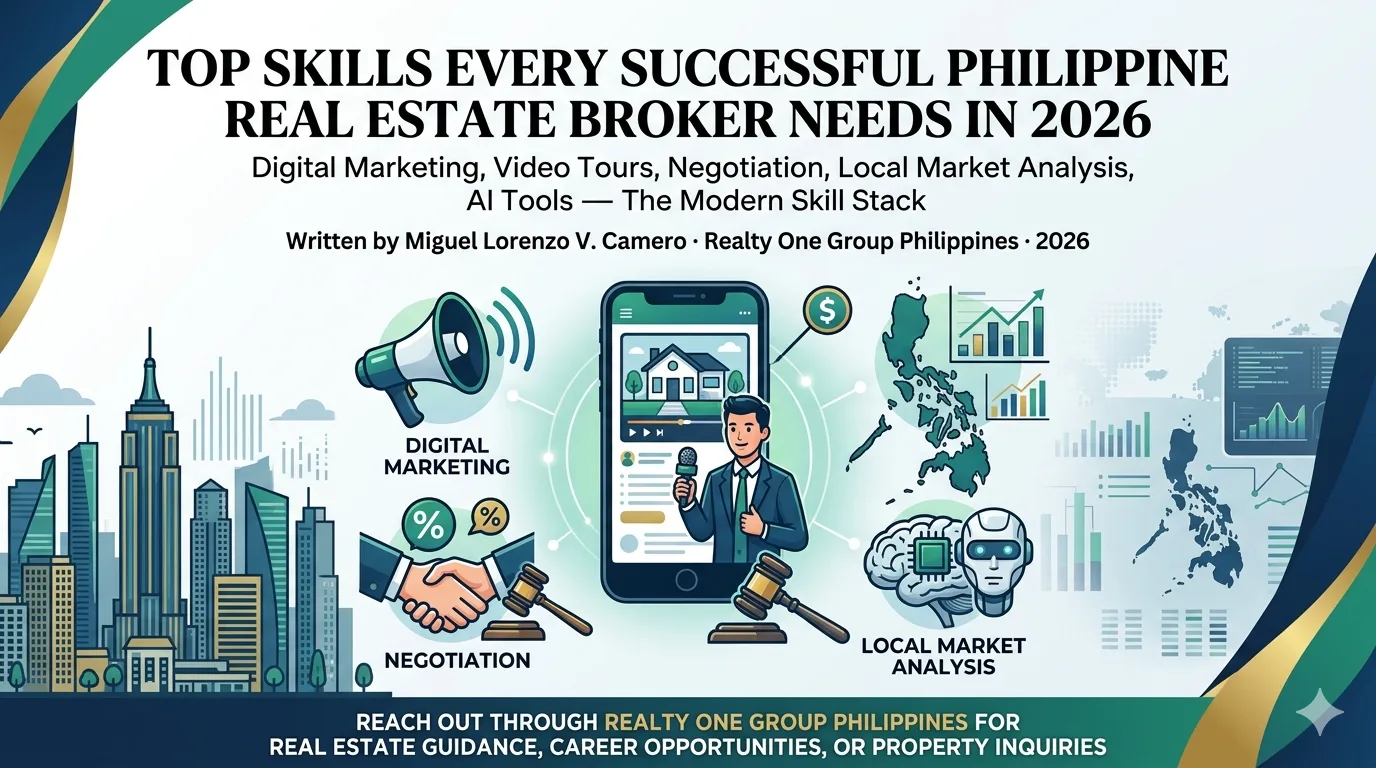
Skill One: Digital Marketing That Actually Builds Trust
Digital marketing is no longer a supplementary skill for real estate brokers in the Philippines. It is a core competency — one that, when practiced well, functions as a lead generation engine, a credibility builder, and a client relationship tool simultaneously. When practiced poorly, it is an enormous drain on time and money with minimal return.
The brokers who have figured out digital marketing in the Philippine market share a few characteristics that distinguish them from the majority who are still posting listing photos and developer flyers on a loop.
They understand that content is not advertising. Advertising tells people what you are selling. Content demonstrates who you are, what you know, and why that matters to someone navigating the property market. The distinction sounds simple but has profound implications for what you create and how you create it. A post that explains, clearly and practically, what the difference between a clean title and a reconstituted title means for a buyer — and why it matters before signing anything — does more for your credibility and your pipeline than fifty listing posts ever will.
They are consistent without being mechanical. Showing up regularly on the platforms where your target clients spend their attention is the baseline requirement of digital marketing. But consistency without genuine substance produces noise, not reputation. The brokers who build real digital audiences in this market are the ones who post with purpose — who have something useful to say, and say it in a voice that is recognizably theirs rather than a generic real estate marketing template.
They understand where their specific clients are. Facebook remains the broadest reach platform in the Philippines across demographics and geographic markets. Instagram serves the mid to high-end segment particularly well, especially for visually compelling properties and lifestyle-oriented content. TikTok and YouTube Shorts have opened access to younger first-time buyer audiences in a way that would have been difficult to reach through any other channel just five years ago. LinkedIn continues to perform for brokers targeting the corporate and professional segment — executives, OFWs, and business owners making investment-oriented property decisions. The broker who understands which platforms their specific target clients use — and focuses their energy there rather than spreading thinly across everything — consistently outperforms the one who tries to maintain a presence everywhere simultaneously.
They track what works and adjust accordingly. Digital marketing is not a set-and-forget activity. Engagement rates, reach, message inquiries, and lead quality all provide feedback about what content resonates and what does not. Brokers who pay attention to these signals and adjust their content strategy based on what the data shows are building a marketing approach that improves over time. Brokers who post without looking at any of this data are essentially guessing — and guessing expensively.
Skill Two: Video — The Communication Medium That Changed Everything
If there is a single skill that has produced the most dramatic separation between high-performing and average brokers in the Philippine market over the past three years, it is video. Not production-quality corporate video — though that has its place — but the ability to communicate clearly, genuinely, and effectively on camera in formats that the platforms actually distribute to large audiences.
The reason video matters so much is straightforward. Real estate is a trust business, and trust is built through familiarity. Text and static images create familiarity slowly. Video creates it fast — because seeing and hearing a person talk, seeing how they carry themselves, watching how they explain something complicated in a way that makes it feel manageable, gives a prospective client far more information about who they are dealing with than any amount of written content. A three-minute video walkthrough of a property, narrated by an agent who clearly knows what they are talking about and who makes the viewer feel like they are getting a genuine inside look — that video does more selling than a professionally shot gallery of still photographs.
For property tours specifically, video has become an expectation rather than a differentiator in the upper segments of the market. Buyers — particularly OFW buyers and relocating professionals who cannot easily visit properties in person — now routinely make initial shortlists based entirely on video content. The broker who cannot produce a compelling, informative video tour of a property is effectively invisible to this segment of the market.
The barrier to producing good real estate video in 2026 is lower than it has ever been. A recent-model smartphone, decent natural lighting, a basic lavalier microphone, and the willingness to appear on camera and speak clearly are sufficient to produce video content that performs well on every relevant platform. The technical bar is not high. The personal bar — the comfort with being on camera, the discipline to prepare and deliver clearly, the patience to learn what the platforms reward and what they suppress — is where most brokers either develop the skill or decide it is not for them.
Develop it. The brokers who decided video was not for them three years ago are watching the ones who leaned into it build audiences and pipelines that now sustain themselves.
Beyond property tours, video works powerfully for educational content — explaining the Pag-IBIG loan process, walking through what happens on closing day, demystifying the title transfer process, answering the questions that first-time buyers are too embarrassed to ask their agent directly. This kind of content positions you as a resource rather than a salesperson, and in a market where buyers are increasingly doing extensive research before engaging any agent, being the broker whose educational video they found six months ago is an extraordinary advantage when they are finally ready to transact.
Skill Three: Negotiation — The Craft at the Heart of the Profession
Every skill in this article matters. This one is the one that makes you worth hiring. Negotiation is the core craft of the real estate broker — the ability to represent a client's interests effectively in a transaction where the other party has competing interests, where information is asymmetric, where emotions run high, and where the financial stakes are among the largest any of the parties involved will ever face.
Negotiation in Philippine real estate practice is more nuanced than the word typically suggests. It is not primarily about aggressive bargaining or theatrical tactics. In a market where relationships and face are significant cultural considerations, effective negotiation is about understanding what each party actually needs — as distinct from what they are asking for — and finding structures that address those underlying needs in ways that allow both parties to feel the outcome was fair.
A buyer who offers below asking price on a resale property is not simply trying to pay less. They may be anxious about overcommitting financially, uncertain about the property's true market value, or using the negotiation as a test of the seller's flexibility and motivation. Understanding the source of the position — not just the position itself — gives a skilled broker the leverage to address it constructively rather than simply playing a numbers game.
A seller who refuses a reasonable offer is not always being irrational. They may have an emotional attachment to the property that is coloring their valuation, a financial obligation that the reduced price would not cover, or a timeline constraint that the buyer's offer does not accommodate. Identifying and addressing those underlying factors — often through questions rather than arguments — is where experienced negotiators earn their commission.
The skills that build negotiation competence are learnable: active listening, the ability to ask questions that surface underlying interests rather than just stated positions, comfort with silence, the discipline to resist the impulse to fill every pause with a concession, and the judgment to know when a deal is genuinely worth saving and when walking away is the right advice to give a client. These are developed through practice, reflection, and deliberate study — not through instinct alone.
Study negotiation as a discipline. Read foundational texts on principled negotiation. Review your own transactions after they close — what worked, what you would do differently, where you left value on the table or created unnecessary friction. The brokers who negotiate well do not simply have a natural gift for it. They have treated it as a craft worth developing seriously over time.
Skill Four: Local Market Analysis — Knowing Your Numbers Cold
Clients in 2026 are more informed than they have ever been. They have access to listing portals, price histories, developer announcements, and market commentary through their phones before they ever speak to a broker. What they do not have — and what a skilled broker provides — is the ability to interpret that information accurately in the context of a specific property, a specific location, and a specific transaction.
Local market analysis is the skill of knowing your market so thoroughly that you can give a client a grounded, evidence-based opinion on whether a property is fairly priced, what a realistic offer range looks like, how long comparable properties have been sitting before selling, what the rental yield on the investment looks like relative to alternatives, and what market trends suggest about value trajectory in that specific submarket over the next two to five years.
This is not the same as having opinions about the market in general. It is having specific, verifiable knowledge about the neighborhoods, developments, and property types you work in — the kind of knowledge that comes from tracking transactions consistently over time, visiting properties regularly, maintaining relationships with developers and fellow brokers who share market intelligence, and paying close attention to the economic and infrastructure developments that affect property values in specific locations.
In the Philippine context, local market knowledge is particularly powerful because the market is highly fragmented. Property values, rental demand, buyer profiles, and transaction dynamics in Quezon City's residential corridors are fundamentally different from those in Taguig's BGC, Cebu's IT Park corridor, or a township development in Laguna. The broker who knows their specific market deeply is worth far more to a client than one who knows the national market broadly.
Build your market knowledge systematically. Track comparable sales in your target areas. Visit new inventory regularly. Monitor infrastructure developments — new transit lines, road projects, commercial developments, school expansions — that signal future value movement. Develop relationships with property appraisers and fellow brokers who can provide market intelligence you would not otherwise access. And be willing to tell clients when a property is not worth what the seller is asking — even when that honesty makes the transaction harder — because the broker whose market analysis clients trust is the one who builds the referral reputation that sustains a long career.
Skill Five: AI Tools — Practical Application, Not Hype
Artificial intelligence tools have entered the daily workflow of productive professionals across nearly every industry, and real estate is no exception. In the Philippine market, the adoption curve among brokers has been uneven — some practitioners have integrated AI tools deeply into how they work, while others are still approaching the topic with skepticism or confusion about what it actually means in practice.
The honest position on AI in real estate brokerage is this: it is not magic, it is not a replacement for expertise or judgment, and it is not something you need to understand at a technical level to use productively. What it is, used well, is a significant multiplier of the time and cognitive bandwidth you have available for the parts of your work that genuinely require a skilled, experienced human being — client relationships, negotiations, market judgment, and the nuanced navigation of complex transactions.
The most practically useful AI applications for Philippine real estate brokers in 2026 cluster around a few specific areas.
Content creation and marketing copy is where most brokers first encounter AI tools productively. Writing property descriptions, drafting social media captions, creating email sequences for client follow-up, preparing presentation materials — these are tasks that consume significant time and that AI tools handle competently when given clear direction. A broker who previously spent an hour writing a property description can produce a strong first draft in minutes using an AI writing tool, then spend fifteen minutes refining it to reflect their voice and specific knowledge. The time saved compounds across every piece of content produced.
Client communication drafting is a related application. Responding to inquiries, following up with prospects, preparing summaries of property options for clients who are evaluating multiple choices — AI tools can accelerate the drafting of these communications significantly without reducing their quality, provided the broker reviews and personalizes the output before sending.
Market research and information synthesis is an area where AI tools are increasingly useful for brokers who want to stay current on developments affecting their market — regulatory changes, economic indicators, infrastructure project updates, developer announcements. AI-powered research tools can surface and synthesize relevant information faster than manual research, giving brokers a more current and comprehensive picture of their market environment.
Transaction preparation and document review support — while not a substitute for legal counsel or the broker's own professional judgment — can also benefit from AI assistance in organizing information, flagging potential issues for closer examination, and preparing summaries of complex documents that clients need to understand before signing.
The skill with AI tools is not technical proficiency. It is knowing how to direct them effectively — how to give clear, specific instructions that produce useful output, how to evaluate that output critically rather than accepting it uncritically, and how to integrate AI assistance into your workflow in ways that genuinely save time and improve quality rather than simply adding a step. This is a learnable skill, and brokers who develop it now are building a productivity advantage that will only compound as the tools continue to improve.
Skill Six: Client Experience Design — The Skill Nobody Names but Everyone Notices
This skill does not appear on most lists of real estate competencies, but it is one of the most powerful differentiators between brokers who generate consistent referrals and those who do not. Client experience design is the intentional shaping of every touchpoint a client has with you — from the first inquiry to the closing day to the follow-up six months later — into an experience that feels professional, attentive, and genuinely caring about the client's outcome rather than the broker's commission.
Most brokers do not design the client experience. They respond to it — reacting to what clients need when they express it, following up when prompted, providing information when asked. The broker who designs the experience proactively — who anticipates what the client needs before they ask, who communicates at each stage of the process so the client always knows where things stand, who checks in after the transaction has closed because they genuinely care how the client is settling in — creates a qualitatively different experience that clients remember, talk about, and actively recommend to the people in their lives.
In a market where the vast majority of clients have never bought a property before and are navigating a process that feels complex and intimidating, the broker who makes that process feel manageable and well-guided is providing something of enormous value. That value is not captured in the commission percentage. It is captured in the referral call that comes six months later, and in the returning client who trusts you with their second property purchase because the first one felt so well-handled.
Think carefully about every stage of the client journey. What does a first-time caller experience when they reach out? What communication do clients receive during the waiting periods in a transaction — when the loan is processing, when the title transfer is underway — that keeps them informed and reassured? What happens after the closing that reinforces the relationship rather than ending it? Every one of these touchpoints is an opportunity to be significantly better than what the client expected, and consistently exceeding expectations is the most reliable referral generation strategy available.
Skill Seven: Financial Literacy Deep Enough to Guide Clients Honestly
Real estate brokers in the Philippines are not financial advisors, and this article is not suggesting they should practice as one. But the broker who lacks sufficient financial literacy to help a client understand the actual cost of a property decision — the total acquisition cost, the financing options and their long-term implications, the tax obligations, the carrying costs, and the realistic return on investment profile of an investment property — is a broker who is limited in the value they can provide and potentially dangerous to the clients who rely on their guidance.
Financial literacy in the context of real estate brokerage means understanding the Pag-IBIG and bank loan structures deeply enough to explain them clearly to a client who has never encountered them before. It means understanding what documentary stamp tax, capital gains tax, transfer tax, and registration fees mean for the actual cost of a transaction — and being able to give a client a realistic total acquisition cost figure rather than just the selling price. It means understanding what a rental yield calculation looks like and being able to give an investment buyer a grounded sense of what returns on a rental property realistically look like in a specific location and property type. It means knowing when a client's financial situation suggests they are not yet ready for the transaction they are pursuing — and being willing to tell them that honestly, even when it means delaying or losing a commission.
This level of financial literacy is not innate. It is developed through deliberate study, through asking questions of mortgage officers and financial professionals, through tracking the financing landscape as it changes, and through the accumulated experience of walking clients through transactions where the financial details matter. Build it seriously. The broker who can help a client understand not just what they are buying but what it will truly cost them, and what it might be worth to them over time, is a fundamentally more valuable professional than one who can only show properties and fill in offer forms.
The Skill That Connects All the Others: Intellectual Honesty
Running through every skill on this list is a single disposition that separates the brokers who build lasting careers from those who produce short-term results at the cost of long-term credibility. Intellectual honesty — the willingness to tell clients the truth even when it is inconvenient, to acknowledge what you do not know rather than bluffing through it, to recommend against a transaction when the client's interests genuinely argue against it — is the foundation on which every other skill rests.
A broker who is a brilliant digital marketer but dishonest with clients will build a pipeline and then destroy it through the reputational damage that dishonesty creates over time. A broker who negotiates aggressively but without regard for their client's actual interests will close deals at the cost of referrals that will never come. A broker who uses AI tools to produce content faster but does not ensure that content is accurate and genuinely useful is accelerating the production of things that erode rather than build trust.
Every skill in this article is more valuable when practiced with intellectual honesty than without it. And intellectual honesty — unlike video production or digital marketing or AI tool proficiency — is not a technical skill. It is a professional character trait. It is the decision, made consistently over time, to be the kind of broker whose clients can trust what they say. That reputation, once built, is the most durable competitive advantage the profession offers.
The modern skill stack of a high-performing Philippine real estate broker in 2026 is both broader and deeper than it was a decade ago. Digital marketing competence, video communication, principled negotiation, rigorous local market knowledge, productive AI tool integration, intentional client experience design, and genuine financial literacy — these are not optional extras for ambitious practitioners. They are the baseline expectations of the clients who are increasingly discerning about who they trust with one of the largest decisions of their financial lives.
None of these skills are acquired overnight. All of them are developed through deliberate practice, honest self-assessment, and the professional seriousness to keep learning long after the license has been issued and the first few transactions have closed. The broker who treats their skill development as an ongoing investment — as seriously as they treat their pipeline and their commission splits — is the broker who will be standing, and thriving, in whatever version of this market arrives next.
Invest in the skills. Do the work. Build the practice that deserves to last.
For real estate guidance, career opportunities, or property inquiries, reach out through Realty One Group Philippines.
About the Author
Miguel Lorenzo V. Camero · Realty One Group Philippines
This article was written to share an honest and practical perspective on what it takes to build a genuinely competitive real estate practice in the Philippine market of 2026. It is shared in the spirit of professional education and community — because every Filipino real estate broker deserves to know not just how to enter the profession, but how to grow within it with the skills that the modern market actually rewards. For property inquiries or real estate guidance, reach out through Realty One Group Philippines.
Disclaimer: This article is for general informational and educational purposes only. It is not an official publication of the Professional Regulation Commission (PRC), the Department of Human Settlements and Urban Development (DHSUD), or any government agency, nor is it endorsed by any regulatory body, real estate organization, or technology provider. The skills, tools, strategies, and observations described in this article reflect the author's professional perspective and general market practice at the time of writing. The real estate market, technology landscape, and regulatory environment are subject to continuous change. Results achieved by applying the approaches described in this article will vary significantly depending on individual effort, market conditions, geographic location, client base, and other factors outside the author's control. Nothing in this article constitutes financial, legal, investment, or career advice. Always consult licensed professionals for guidance specific to your situation.