One of the most common misconceptions among aspiring real estate professionals in the Philippines is that you need to pass a board exam before you can legally sell property. The truth is more accessible than that — and understanding the distinction between a real estate salesperson and a real estate broker is the first step toward building a legitimate, rewarding career in this industry.
This article walks you through everything you need to know about becoming a PRC-accredited real estate salesperson in the Philippines: what it is, why it matters, what the requirements are, and how it compares to becoming a fully licensed broker.
What Is a Real Estate Salesperson — and Why Does Accreditation Matter?
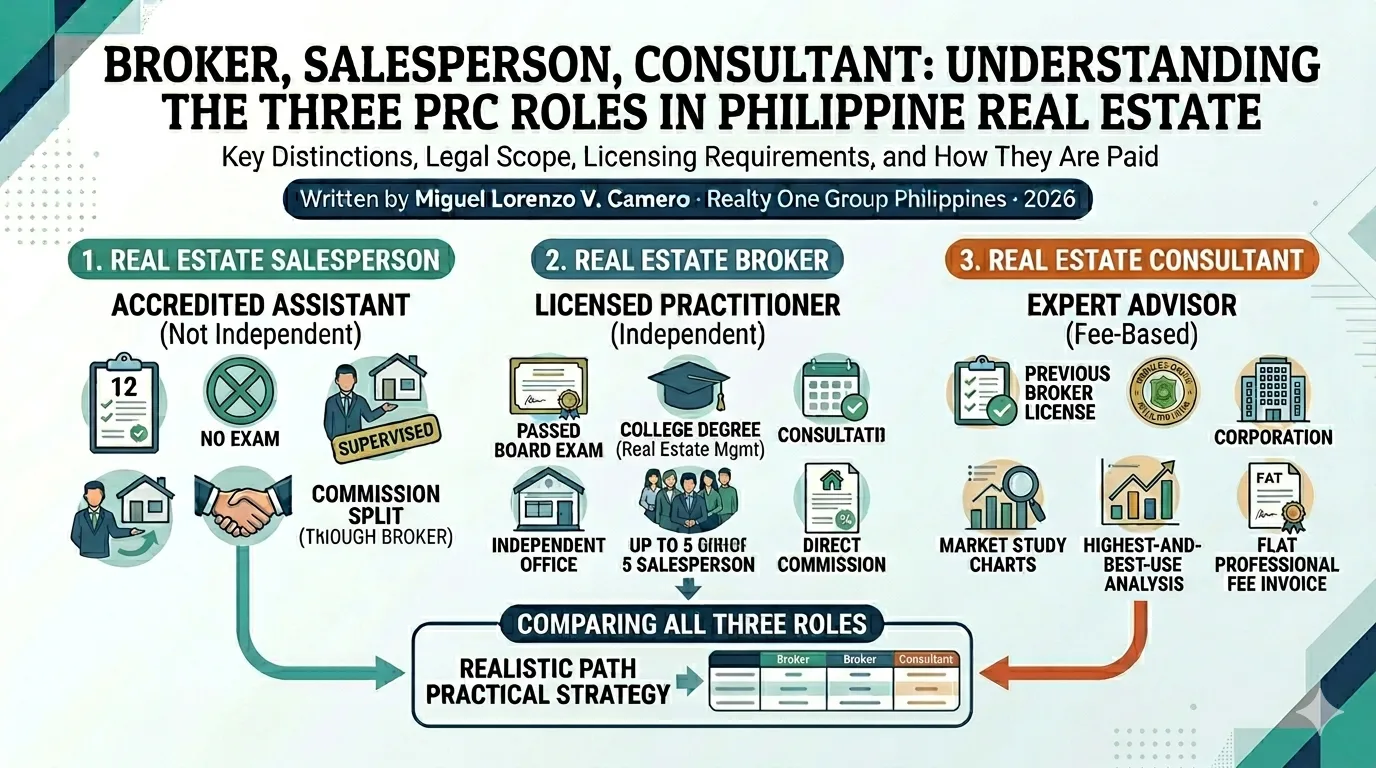
A real estate salesperson is an individual who is legally authorized to sell, market, and facilitate real estate transactions — but only under the supervision of a PRC-licensed real estate broker. Think of the salesperson as the broker's authorized representative in the field.
Under Republic Act No. 9646, also known as the Real Estate Service Act of the Philippines (RESA Law), it is illegal to engage in real estate practice without proper authorization. This means that if you are selling property — even on a commission basis — without being accredited as a salesperson or licensed as a broker, you are operating outside the law. Accreditation is not just a formality. It is the legal foundation of your real estate career.
The good news: unlike brokers, salespersons are not required to pass a PRC board examination. Accreditation is processed directly through the PRC, but the pathway is significantly more straightforward.
The Three Main Players in Philippine Real Estate Practice
Before diving into the process, it helps to understand how the RESA Law structures the profession.
1. Real Estate BrokerA fully licensed professional who has passed the PRC Real Estate Brokers Licensure Examination. Brokers can operate independently, sign contracts on behalf of clients, and supervise salespersons. They are the only individuals legally authorized to practice real estate without supervision.
2. Real Estate SalespersonAn accredited individual who works under — and is legally bound to — a supervising broker. Salespersons can market properties, assist buyers and sellers, and facilitate transactions, but they cannot operate independently. All official documents, contracts, and representations must flow through their supervising broker.
3. Real Estate Consultant and AppraiserSeparate licensed categories under RESA that require their own examinations and are outside the scope of this article.
No Board Exam Required — Here Is How Salesperson Accreditation Works
The PRC accreditation process for real estate salespersons does not involve a licensure examination. Instead, the process is document-driven and requires you to be formally affiliated with a licensed broker who will act as your supervisor.
Here is a step-by-step breakdown of the general accreditation process.
Step 1: Find a Supervising PRC-Licensed Broker
Before you can apply, you must secure a supervising broker — a PRC-licensed real estate broker who agrees to take professional responsibility for your practice. This relationship is not optional. Without a supervising broker, your application cannot proceed. Many salespersons find their supervising broker through the real estate company or developer they intend to work with. This is one of the key practical advantages of joining an established brokerage or developer's sales team early in your career.
Step 2: Complete a 12-Unit Real Estate Brokerage Course
You are required to complete a 12-unit real estate brokerage course from a school recognized by the Commission on Higher Education (CHED) or an accredited CPD provider. This is not a full degree program — it is a focused short course that introduces you to real estate principles, laws, contracts, and ethical practice. Several universities and real estate training providers across the country offer this course, often in a condensed evening or weekend format.
Step 3: Gather Your Documentary Requirements
The core documentary requirements for PRC salesperson accreditation generally include the following. Always verify the current and complete list directly with the PRC, as requirements are subject to updates.
Duly accomplished PRC application form for real estate salesperson accreditation
Original and photocopy of a valid government-issued ID
Passport-sized ID photos with white background (as specified by PRC)
Transcript of Records or proof of completion of the 12-unit real estate brokerage course
Certificate of Employment or Affiliation signed by your supervising broker (using their official PRC broker's license number)
Photocopy of your supervising broker's valid PRC ID or Certificate of Registration
National Bureau of Investigation (NBI) Clearance
Birth Certificate issued by the Philippine Statistics Authority (PSA)
Community Tax Certificate (Cedula)
Payment of the applicable PRC accreditation fee
Step 4: Submit Your Application to the PRC
Applications are submitted in person at any PRC Regional Office or through the PRC's online portal, depending on the current processing setup. Processing times can vary, so it is advisable to apply well ahead of any planned transactions or sales activities.
Step 5: Receive Your Certificate of Accreditation
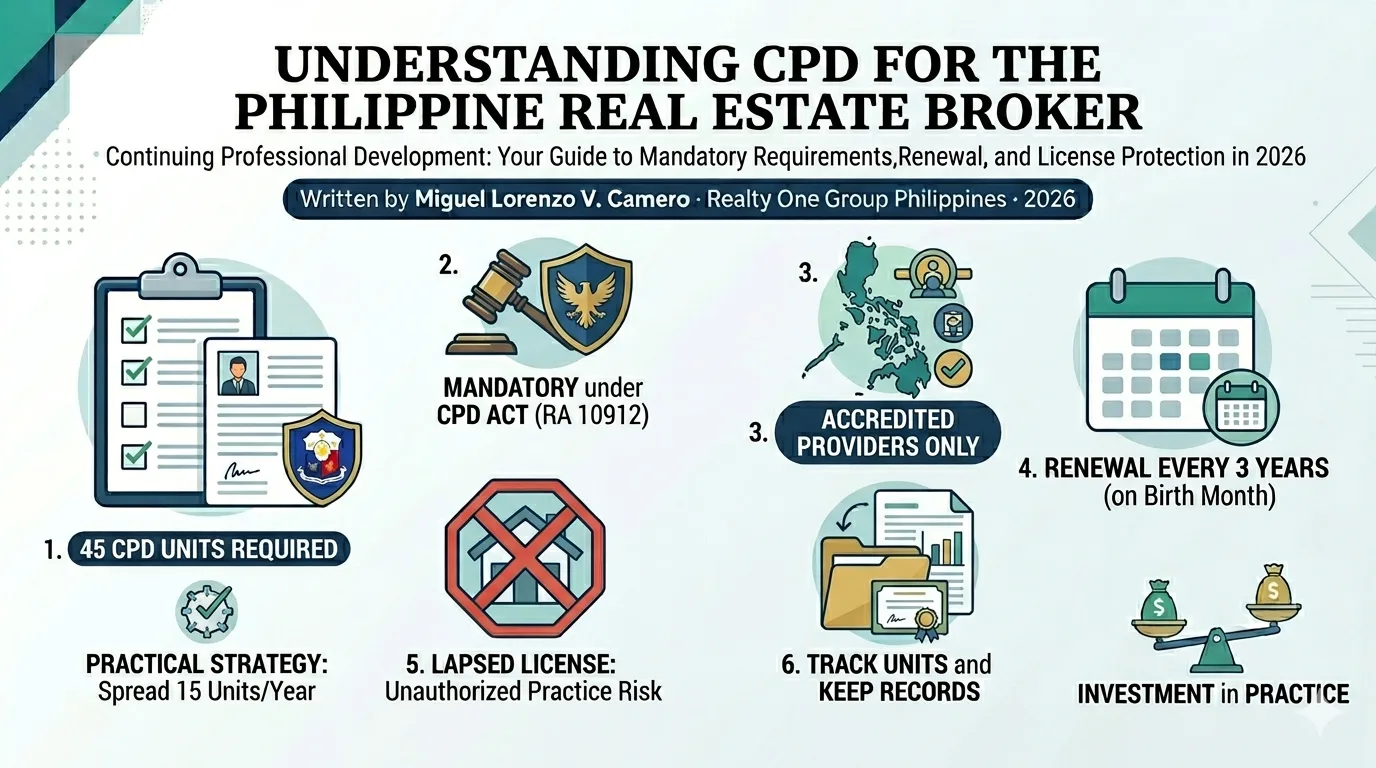
Upon approval, you will receive your PRC Certificate of Accreditation as a Real Estate Salesperson. This document — along with your supervising broker's license — is your legal authorization to practice. Keep it current, as accreditation must be renewed periodically. Renewal typically requires completion of Continuing Professional Development (CPD) units, the specifics of which are subject to PRC guidelines.
Salesperson vs. Broker — Understanding the Key Differences
The differences between a salesperson and a broker come down to five practical dimensions. On the matter of licensure, a salesperson requires no board examination, while a broker must pass the PRC Real Estate Brokers Licensure Examination. On independence, a salesperson must always operate under the supervision of a licensed broker and cannot practice on their own, whereas a broker is fully authorized to work independently. When it comes to signing contracts, a salesperson has no authority to do so — all official documents must flow through the supervising broker, who bears full legal responsibility for the transaction. In terms of supervision, a salesperson cannot oversee other practitioners, while a broker may supervise up to five accredited salespersons at any given time. Finally, on compensation, a salesperson's commission is always coursed through and released by the supervising broker based on an agreed split arrangement, while a broker receives commission directly. Both salespersons and brokers are subject to Continuing Professional Development requirements for the renewal of their accreditation or license.
You can drop this paragraph in place of the table in the article and the flow reads naturally with the surrounding text.
What Can a Salesperson Actually Do?
Within the scope of their accreditation and under the direct supervision of their broker, a real estate salesperson is authorized to:
Market and promote properties for sale, lease, or acquisition
Assist buyers in property viewings, inquiries, and transaction coordination
Prepare and present property information and marketing materials
Facilitate communication between buyers, sellers, and the supervising broker
Receive commission, which is coursed through and released by the supervising broker
A salesperson cannot independently sign contracts, issue official receipts on their own account, or represent themselves as a broker in any capacity. Misrepresentation — presenting yourself as a licensed broker when you are only an accredited salesperson — is a violation of the RESA Law and carries legal consequences.
The Salesperson Track as a Career Entry Point
For most people entering real estate, the salesperson accreditation is the most practical starting point — and it is a legitimate, long-term career path in its own right. Many of the most effective real estate professionals in the Philippines began as salespersons and built substantial careers without ever transitioning to the broker track.
That said, if you eventually want to operate independently, build your own team, or diversify into property management and consultancy, the next natural step is to pursue the PRC Real Estate Brokers Licensure Examination. To be eligible for the broker's exam, candidates are generally required to hold a college degree in real estate management or a related field, or to have completed a real estate management course from a recognized institution — along with a minimum number of years of active real estate practice. Requirements are subject to PRC guidelines at the time of application.
The salesperson track is not a lesser path — it is the foundation. It exposes you to real transactions, real clients, and the real mechanics of property deals in a supervised environment that protects both you and the people you serve.
Practical Tips Before You Begin
Verify everything directly with the PRC. Documentary requirements, processing fees, and CPD guidelines change periodically. The PRC official website at prc.gov.ph is the authoritative source for current requirements. Do not rely solely on information from third parties, including this article.
Choose your supervising broker carefully. Your supervising broker is not just a paperwork requirement — they are your professional lifeline, especially in your first year. Look for someone who is active in the market, willing to mentor, and has a clean PRC record.
Join a reputable real estate organization or brokerage. Being affiliated with a recognized company or network gives you access to listings, training, compliance support, and a professional community. It also adds credibility with clients who are increasingly aware of licensing requirements.
Complete your 12-unit course before you start selling. Some newcomers begin facilitating transactions before formalizing their accreditation. This is a legal risk — for you and for your supervising broker. Get your paperwork in order first.
Understand how your commission flows. As a salesperson, your commission is legally released through your supervising broker. Understand your split arrangement upfront, get it in writing, and make sure it is clearly structured before any transaction closes.
Becoming a PRC-accredited real estate salesperson in the Philippines is one of the most accessible entry points into a professional career in property — and it requires no board examination. What it does require is the right supervising broker, the proper 12-unit education, and a complete documentary submission to the PRC.
The salesperson accreditation is not a workaround or a shortcut. It is a legitimate, legally defined role in the Philippine real estate profession — one that, when practiced with integrity and discipline, can open doors to meaningful income, long-term career growth, and the very real satisfaction of helping Filipino families find a place to call home.
Get your documents in order, find a supervising broker you trust, complete the required training, and build your career on a foundation that is both legal and professional. The real estate market in the Philippines continues to grow — and there is real opportunity waiting for those who enter it the right way.
For the most current accreditation requirements and processing guidelines, visit the official PRC website at prc.gov.ph or visit the nearest PRC Regional Office in your area.
About the Author
Miguel Lorenzo V. Camero · Realty One Group Philippines
This article was written to share general knowledge about the real estate salesperson accreditation process in the Philippines with fellow Filipinos who may not be familiar with how the industry works. It is shared in the spirit of education and community — because every Filipino who dreams of a career in real estate deserves to understand the proper and legal path to entering the profession. For property inquiries or real estate guidance, reach out through Realty One Group Philippines.
Disclaimer: This article is for general informational and educational purposes only. It is not an official publication of the Professional Regulation Commission (PRC), the Housing and Land Use Regulatory Board (HLURB/DHSUD), or any government agency, nor is it endorsed by any regulatory body or real estate organization. Accreditation requirements, documentary submissions, processing fees, CPD requirements, and PRC guidelines are subject to change at any time without prior notice. All information presented in this article reflects general practice and publicly available guidance at the time of writing and may not reflect the most current PRC policies. Always verify current requirements directly with the PRC at prc.gov.ph or at the nearest PRC Regional Office before submitting any application. Consult a licensed real estate broker or a legal professional for personalized guidance.