If you have ever tried to navigate the Philippine real estate profession — whether as someone considering a career in it or as a buyer trying to understand who you are dealing with — you have likely encountered three titles that are often used loosely and sometimes interchangeably: broker, salesperson, and consultant. They are not the same. Each one is a distinct, PRC-regulated role with its own licensing requirements, legal authority, scope of practice, and compensation structure.
This article breaks down all three roles clearly and honestly, so that whether you are entering the profession or simply trying to understand it, you know exactly what each title means and what it authorizes a person to do.
Why the Distinction Matters
Under Republic Act No. 9646, known as the Real Estate Service Act of the Philippines (RESA Law), the practice of real estate service is a regulated profession. This means that anyone who facilitates, negotiates, or advises on real property transactions for a fee or commission must hold a valid PRC license or accreditation in one of the recognized categories. Practicing without proper authorization — regardless of what title you give yourself — is a violation of the law.
The three primary practice categories most relevant to everyday real estate work are the real estate broker, the real estate salesperson, and the real estate consultant. A fourth category — the real estate appraiser — also exists under RESA but focuses specifically on property valuation and is outside the scope of this article.
Understanding which role you are dealing with protects you as a client. And if you are building a career in real estate, understanding which role you are stepping into — and what its boundaries are — protects you legally and professionally.
The Real Estate Salesperson
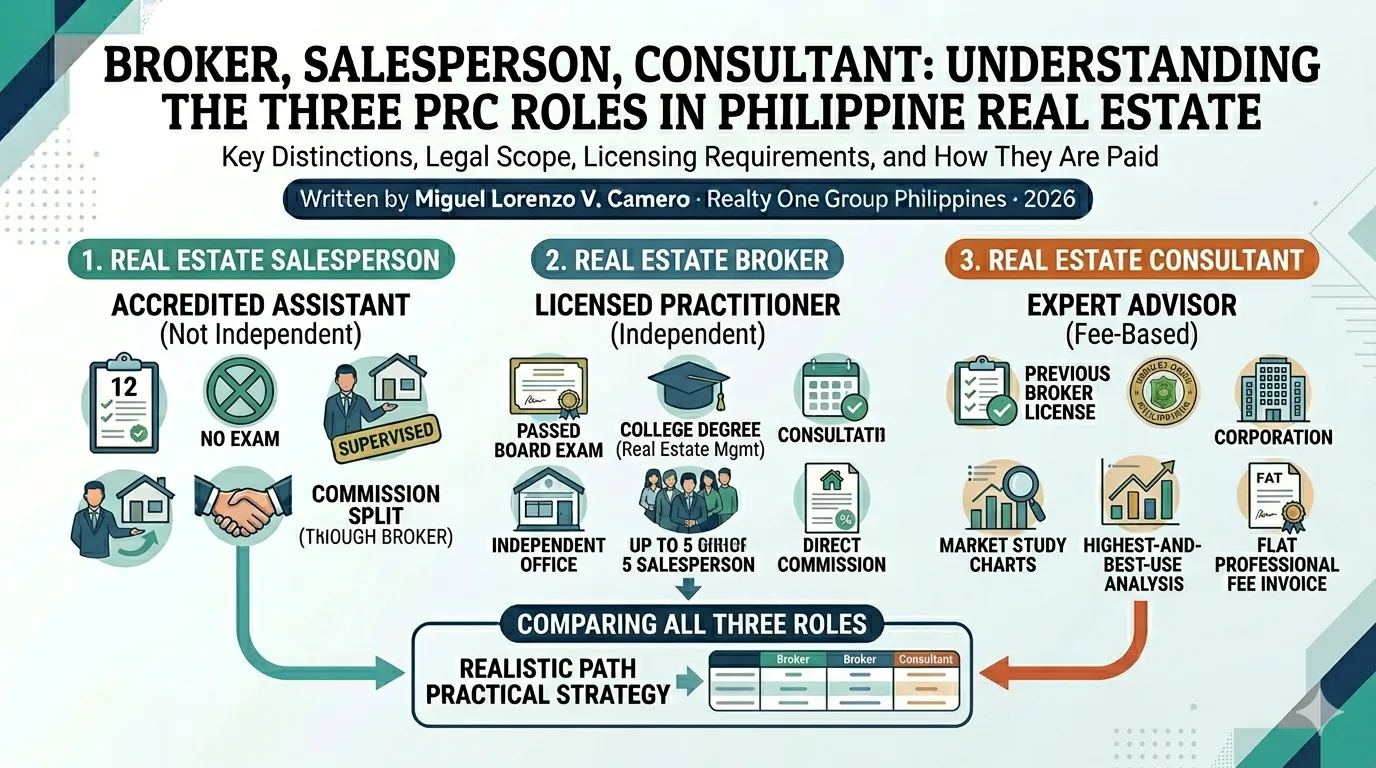
The salesperson is the entry-level role in the PRC-regulated real estate profession and the most common starting point for Filipinos entering the industry. A salesperson is authorized to market properties, assist buyers and sellers, and facilitate transactions — but only under the direct supervision of a licensed real estate broker. They cannot operate independently under any circumstance.
How you become one: No board examination is required. Accreditation is processed directly through the PRC and requires completion of a 12-unit real estate brokerage course from a CHED-recognized institution, a formal affiliation with a supervising broker, and submission of the required documentary requirements to the PRC. Accreditation must be renewed periodically, with Continuing Professional Development units required upon renewal.
What a salesperson can do: Market and promote properties, assist in buyer inquiries and property viewings, coordinate between parties in a transaction, and prepare marketing materials. All official representations, contracts, and document signings must flow through the supervising broker.
What a salesperson cannot do: Operate independently, sign contracts on behalf of any party, supervise other salespersons, or represent themselves as a broker in any capacity. Misrepresentation of one's role is a violation of the RESA Law.
How a salesperson gets paid: Commission is not received directly from the client or the developer. It is released by the supervising broker based on a pre-agreed split arrangement between the two parties. The structure of that split — whether it is 50/50, 70/30, or another arrangement — is a matter negotiated between the salesperson and their supervising broker before any transaction. There is no government-mandated split ratio, so it is essential to get this arrangement in writing before you begin working with any broker.
One supervising broker may handle a maximum of five accredited salespersons at any given time under current PRC rules.
The Real Estate Broker
The broker is the fully licensed practitioner of the three roles — the professional who has passed the PRC Real Estate Brokers Licensure Examination and is authorized to operate independently, sign contracts, represent clients, and supervise salespersons. In the structure of Philippine real estate practice, the broker is the foundation on which everything else rests.
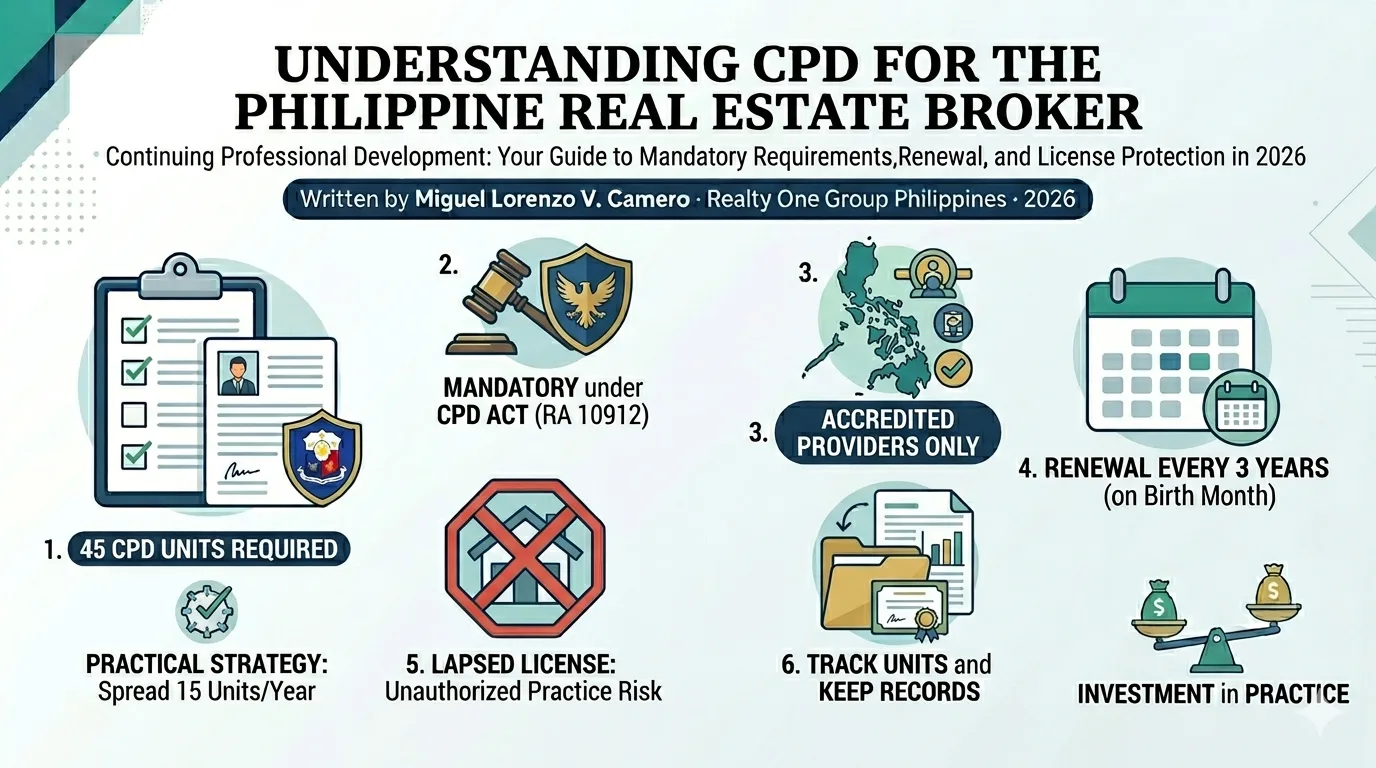
How you become one: A candidate must hold a college degree in real estate management or complete a real estate management course from a recognized institution, meet the required years of real estate practice, and pass the PRC Real Estate Brokers Licensure Examination. Upon passing, the broker is issued a PRC license that must be renewed every three years, with CPD units required for renewal.
What a broker can do: Practice real estate independently without the need for supervision, list and market properties, negotiate and execute contracts on behalf of buyers or sellers, receive commission directly, and supervise up to five accredited salespersons. Brokers may also work with developers, property management companies, or operate their own independent brokerage.
What a broker cannot do: Provide formal valuation reports as a licensed appraiser would, or render investment strategy advice under the formal scope reserved for consultants — unless they also hold those separate PRC licenses. A broker's authority, while broad, is specific to brokerage practice.
How a broker gets paid: Directly through commission, which is typically a percentage of the property's transaction value. In the Philippine market, the standard brokerage commission on a sale generally ranges from 3% to 5% of the selling price, though this is negotiable and varies by property type, market segment, and arrangement with the developer or seller. When a broker supervises salespersons, the gross commission is received by the broker first and then split with the salesperson according to their agreed arrangement. Commission is typically paid by the seller or developer — not the buyer — though this too can vary by transaction structure.
The Real Estate Consultant
The consultant is the most specialized — and least commonly understood — of the three roles. A PRC-licensed real estate consultant is authorized to provide professional advice, analysis, and strategic recommendations on real property matters, going beyond the transactional scope of a broker into the realm of investment strategy, feasibility studies, portfolio analysis, and property market research.
How you become one: Candidates must first be a licensed real estate broker with a minimum number of years of active practice as specified by the PRC at the time of application, and must pass the PRC Real Estate Consultants Licensure Examination. The consultant license is therefore not an entry-level credential — it builds on an established broker track record. As with other PRC licenses, it must be renewed periodically with the required CPD units.
What a consultant can do: Render expert advice on real estate investment decisions, conduct highest-and-best-use analyses, prepare market and feasibility studies, advise corporations and government agencies on property acquisition and disposition strategies, and provide strategic counsel on large-scale real estate portfolios. Consultants are often engaged by developers, institutional investors, government bodies, and corporations — clients who need sophisticated analysis rather than transactional facilitation.
What a consultant cannot do: Perform licensed appraisal work unless they also hold a separate PRC appraiser's license. The consultant's scope is advisory and strategic, not valuation. A consultant who has not maintained an active broker's license also cannot engage in brokerage practice under their consultant license alone.
How a consultant gets paid: Unlike brokers and salespersons who earn through transaction-based commission, consultants typically charge professional fees — either a fixed retainer, an hourly or daily rate, or a project-based fee tied to the scope of the advisory engagement. This model reflects the nature of the work: a consultant's value is in their analysis and judgment, not in closing a specific deal. In some engagements, a performance component may be included, but the dominant compensation structure is fee-based rather than commission-based.
Comparing All Three Roles
To bring the distinctions together, here is how the three roles compare across the dimensions that matter most in practice.
On the question of how you enter each role: the salesperson requires no board exam and enters through PRC accreditation; the broker must pass the Real Estate Brokers Licensure Examination; and the consultant must first be a licensed broker and then pass the separate Real Estate Consultants Licensure Examination. The pathway is sequential — consultant is built on broker, and broker is the foundation for independent practice.
On the question of independence: only the broker and the consultant can operate independently. The salesperson must always be supervised by a licensed broker. A salesperson who markets or sells property without a supervising broker — regardless of how long they have been in the industry — is operating outside the law.
On the question of scope: the salesperson's scope is transactional and assistive, always within the frame set by their supervising broker. The broker's scope is fully transactional — listing, negotiating, contracting, and supervising. The consultant's scope extends beyond transactions into strategy, analysis, and expert advisory work, typically for more complex or institutional clients.
On the question of compensation: the salesperson earns a share of commission released through their broker. The broker earns commission directly from the transaction, then shares a portion with any salespersons involved. The consultant earns professional fees rather than commissions — a fundamentally different model that reflects the advisory rather than transactional nature of the work.
On the question of who they typically serve: the salesperson works closely with individual buyers and sellers in the field, often as the first point of contact. The broker serves buyers, sellers, landlords, and tenants across a wide range of transaction types and may also lead a team. The consultant typically serves developers, corporations, government agencies, and institutional investors who require expert analysis and strategic property advice.
Which Role Is Right for You?
If you are entering real estate for the first time and want to begin earning while learning, the salesperson track is your most practical starting point. It requires no exam, gets you into active transactions quickly, and exposes you to the real mechanics of the market under the guidance of a licensed professional.
If you want full independence — the ability to operate your own practice, build your own client relationships, and supervise a team — the broker's license is your target. It requires passing a board examination and meeting the educational requirements, but it opens every door the profession has to offer at the transactional level.
If your interest lies in the strategic, analytical, and advisory side of real estate — working with large-scale investors, corporations, or government clients on complex property decisions — the consultant track is the direction to aim for. But it is a long-game credential, built on years of active brokerage practice and a separate examination.
There is no shortcut between these roles, and there should not be. The RESA Law structured them deliberately to ensure that the level of authority each role carries is matched by the level of preparation required to hold it. That structure exists to protect the public — and to give the profession the credibility it deserves.
Conclusion
The titles of broker, salesperson, and consultant are not interchangeable labels — they are legally defined roles with distinct requirements, boundaries, and responsibilities under Philippine law. A salesperson is an accredited, supervised practitioner who assists in transactions. A broker is a licensed, independent professional who leads them. A consultant is an expert advisor who operates at the strategic level, beyond the transaction itself.
Knowing the difference helps you make better decisions — whether you are a buyer choosing who to trust, or an aspiring real estate professional choosing where to begin. Whatever role you step into, step into it legally, step into it prepared, and build your practice on a foundation that will hold.
For the most current licensing requirements, examination schedules, and CPD guidelines, visit the official PRC website at prc.gov.ph or contact the nearest PRC Regional Office in your area.
About the Author
Miguel Lorenzo V. Camero · Realty One Group Philippines
This article was written to share general knowledge about the different PRC-regulated roles in Philippine real estate with fellow Filipinos who may not be familiar with how the profession is structured. It is shared in the spirit of education and community — because every Filipino who is entering the real estate industry, or simply working with someone in it, deserves to understand exactly who they are dealing with and what that person is authorized to do. For property inquiries or real estate guidance, reach out through Realty One Group Philippines.
Disclaimer: This article is for general informational and educational purposes only. It is not an official publication of the Professional Regulation Commission (PRC), the Department of Human Settlements and Urban Development (DHSUD), or any government agency, nor is it endorsed by any regulatory body or real estate organization. Licensing requirements, examination qualifications, accreditation processes, CPD requirements, scope of practice definitions, and PRC guidelines are subject to change at any time without prior notice. All information presented in this article reflects general practice and publicly available guidance at the time of writing and may not reflect the most current PRC policies or regulations. Always verify current requirements directly with the PRC at prc.gov.ph or at the nearest PRC Regional Office before making any career or professional decisions. Consult a licensed real estate professional or a legal practitioner for personalized guidance specific to your situation.