Understanding Land Ownership Laws in the Philippines
Owning a piece of the Philippines is a dream for many---a place to build a home, create a legacy, and make a solid investment. However, the path to land ownership can feel confusing, with paperwork like 'titulos' and 'tax decs' creating a maze where it's easy to get lost or fall for a scam.
How can you be 100% sure a deal is safe before handing over your hard-earned money? This guide simplifies the process, showing you the most important things to check when buying land so you can secure your dream with confidence.
Summary
This guide explains how to safely buy or inherit real property in the Philippines by relying on official land titles (TCT/CCT) rather than tax declarations. It shows how to verify a clean title via a Certified True Copy and review of encumbrances, clarifies foreign ownership limits and lawful alternatives, and outlines the key steps and taxes for transferring titles. It also covers inheritance-specific requirements like executing an Extrajudicial Settlement of Estate and paying estate tax within one year. A practical checklist and Q&A reinforce the essential checks to protect your investment.
The 'King' of Property Documents: Why a Title (TCT/CCT) is Non-Negotiable
In any property deal, one document stands as absolute proof of ownership: the Title. Think of it as the official birth certificate for your property; without it, your claim is never truly secure.
You will encounter two main types. A Transfer Certificate of Title (TCT) is for land, including any house built on it. In contrast, a Condominium Certificate of Title (CCT) is for a condo unit, giving you ownership of your specific "slice" plus a share of common areas like the lobby and pool.
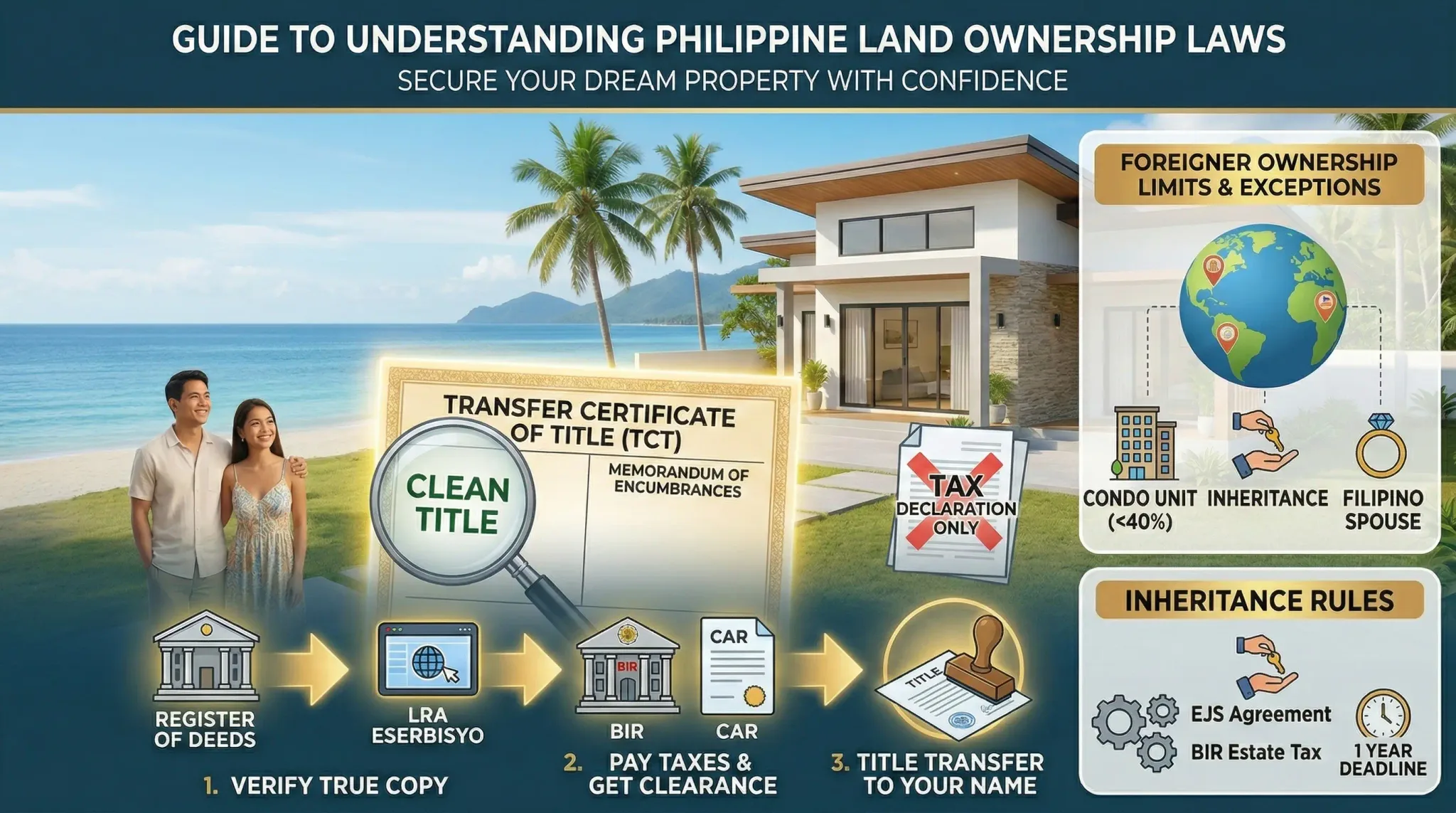
A crucial point many get wrong is that a Tax Declaration is not proof of ownership. This document simply identifies who is registered to pay the yearly real estate taxes. While necessary for the transfer process, it is never a substitute for an official TCT or CCT from the government's Register of Deeds. Insisting on seeing the owner's original Title is your first and most important line of defense.
How to 'Health-Check' a Property: Verifying a 'Clean Title' in 2 Steps
You've probably heard the term "clean title." This means the property is free from hidden legal or financial problems called encumbrances---think of an unpaid mortgage, a pending court case, or other claims. If you buy the property without checking, you could accidentally inherit these expensive problems.
Verifying a title is a straightforward process that gives you peace of mind before you pay. Here's how:
Ask the seller for the title number and the exact owner's name.
Use this information to request a "Certified True Copy" from the Register of Deeds (RD) , the government office that libraries all land titles in a city or municipality. You can also request this online through the Land Registration Authority's (LRA) eSerbisyo portal.
This official copy shows what the government has on record. On the back page, look for the "Memorandum of Encumbrances." A blank page here is fantastic news. If there are entries, you have critical questions to ask the seller. This simple check is the best way to protect your investment.
Can Foreigners Own Land? The Simple Answer and 3 Legal Exceptions
The Philippine Constitution states that only Filipino citizens and corporations can own land. This restriction is in place to preserve national resources for Filipinos.
However, a foreign national is not without options. The law provides three important and legal exceptions:
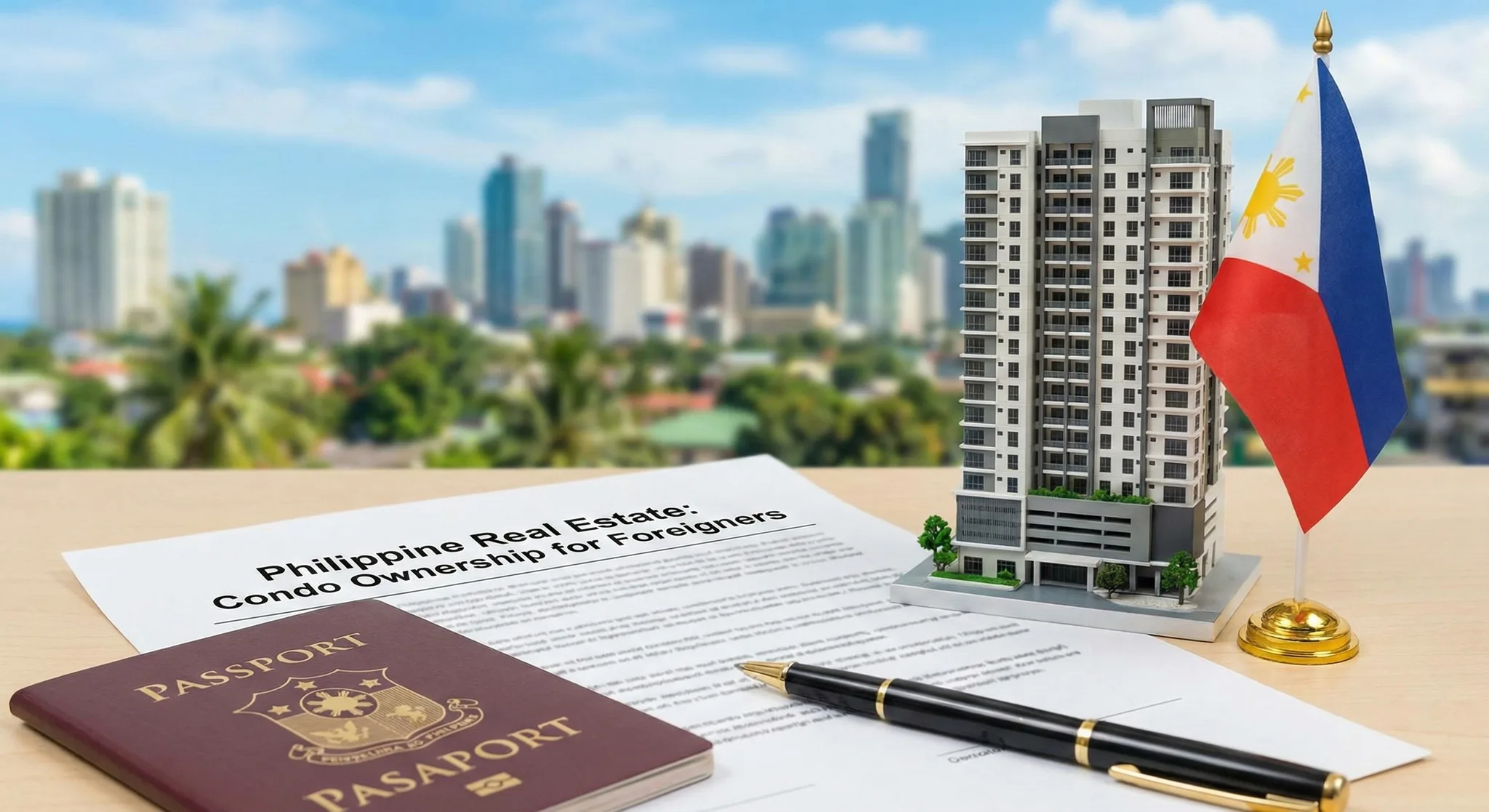
You can own a condominium unit. The Condominium Act of the Philippines allows foreigners to buy and own condo units, as long as foreign ownership in the entire building does not exceed 40%.
You can inherit land. If you are a legal heir of a Filipino citizen (for example, a child who inherited a property from a parent), you can own that land.
Your Filipino spouse can own the land. The land can be purchased by and registered solely under the name of your Filipino spouse. A foreign national's name cannot be on the land title.
For many mixed-nationality couples, the most common path is for the Filipino spouse to be the sole, legal owner of the land, allowing the family to build a home while complying with Philippine law.
The 3 Core Steps to Transferring a Land Title to Your Name
Once you and the seller agree on a price, the first official step is signing the Deed of Absolute Sale. To make it legally binding, you and the seller must sign it in the presence of a Notary Public.
Next, the necessary taxes must be paid at the Bureau of Internal Revenue (BIR) . The main tax is the Capital Gains Tax, shouldered by the seller. After all obligations are met, the BIR issues a Certificate Authorizing Registration (CAR). This document is your proof that the government has cleared the property for transfer.
The final stop is taking your CAR and other documents to the Register of Deeds. They will process your application, cancel the seller's old title, and issue a brand-new title under your name, making your ownership official and secure.
What to Do When You Inherit Property: A First-Timer's Guide
When it comes to inheritance, the process for transferring a title changes. If the owner passed away without a will, the heirs must create a formal agreement called an Extrajudicial Settlement of Estate (EJS). This document must be signed by all heirs and notarized.
Instead of Capital Gains Tax, inheriting property requires you to settle the Estate Tax with the BIR. This is a tax on the net value of the deceased's assets. Securing the BIR's clearance is mandatory before any title can be transferred.
Most importantly, you are working against a deadline. Philippine law gives you one year from the owner's death to file the Estate Tax return. Missing this window can lead to significant penalties and interest charges from the BIR, so acting promptly is essential.
Your 4-Point Checklist for a Safe Property Purchase
Knowing how to verify property documents is the ultimate protection for your investment. You can now confidently tell the difference between true proof of ownership and a simple tax receipt. Before finalizing any deal, complete this checklist to secure your land ownership rights in the Philippines:
See the seller's original Owner's Duplicate Copy of the Title.
Get your own Certified True Copy from the Register of Deeds to compare.
Confirm the seller's valid ID perfectly matches the name on the Title.
Work with a lawyer to draft and notarize the Deed of Sale.
Following these steps transforms the process from a game of chance into a secure investment. You are no longer just a buyer; you are an informed owner, ready to build your future on solid ground.
Q&A
Question: What document proves property ownership in the Philippines, and is a Tax Declaration enough? Short answer: Only a Title is absolute proof of ownership. A Transfer Certificate of Title (TCT) covers land (and any house on it), while a Condominium Certificate of Title (CCT) covers a condo unit plus a share of common areas. A Tax Declaration is not proof of ownership---it merely identifies who pays real property taxes and is never a substitute for a TCT/CCT. Always insist on seeing the owner's original Title.
Question: How do I verify that a property has a "clean title"? Short answer: Ask the seller for the title number and exact owner's name, then request a Certified True Copy from the Register of Deeds (or via the LRA's eSerbisyo portal). Check the "Memorandum of Encumbrances" on the back page: a blank section suggests no mortgages, court cases, or other claims; any entries require follow-up with the seller. This two-step check is the simplest way to protect your investment before paying.
Question: Can a foreigner own land in the Philippines? Short answer: Generally no---only Filipino citizens and corporations can own land. Legal options for foreigners are: (1) own a condominium unit, subject to the 40% foreign ownership cap for the entire building; (2) inherit land as a legal heir of a Filipino; and (3) have land owned and titled solely under a Filipino spouse's name (a foreigner's name cannot appear on a land title).
Question: What are the core steps to transfer a land title to my name after a sale? Short answer: First, sign a Deed of Absolute Sale in the presence of a Notary Public (ideally prepared with a lawyer). Next, pay the required taxes at the BIR; the seller typically shoulders the Capital Gains Tax. After clearance, the BIR issues a Certificate Authorizing Registration (CAR). Finally, submit the CAR and other documents to the Register of Deeds, which cancels the old title and issues a new one in your name.
Question: How does the process differ when inheriting property? Short answer: If the owner died without a will, the heirs must execute a notarized Extrajudicial Settlement of Estate (EJS). Instead of the Capital Gains Tax, you must settle the Estate Tax with the BIR and obtain clearance before any title transfer. You have one year from the date of death to file the estate tax return; late filing results in penalties and interest, so act promptly.