At some point in every real estate broker's career, the question surfaces: should I build this under a franchise, or should I go out on my own? It is one of the most consequential decisions a real estate professional can make — and it is one that deserves a honest, clear-eyed answer rather than a sales pitch disguised as advice.
This article will give you both sides of that conversation. What a franchise genuinely offers, what independence genuinely costs, and why for most brokers — especially those in the earlier and middle stages of their careers — the franchise model is not just convenient but strategically sound. And because context matters, this article will also speak specifically to what joining Realty One Group Philippines looks like in practice, so you can evaluate it as a real option rather than an abstract one.
The Allure of Independence — and the Reality Behind It
The idea of operating independently is genuinely appealing. No splits beyond what you negotiate directly. No franchise fees. No brand guidelines to follow. No organizational structure above you telling you how to run your practice. You are the broker, the brand, and the business — all in one.
For a certain kind of practitioner, at a certain stage of their career, independence works. The broker who has spent a decade building a deeply loyal client base, who has direct developer accreditations across multiple projects, who has a team of accredited salespersons already generating consistent volume, and who has the administrative infrastructure to handle compliance, marketing, and operations without organizational support — that broker can make independence work.
But that description does not fit most brokers, and it almost certainly does not fit anyone in their first five years of practice. The appeal of independence is real. The cost of independence, however, is equally real — and it is a cost that most people who romanticize going solo have not fully calculated.
What Independence Actually Costs You
Going independent as a real estate broker in the Philippines means building everything from scratch, with your own time and your own money, against competitors who have already built it.
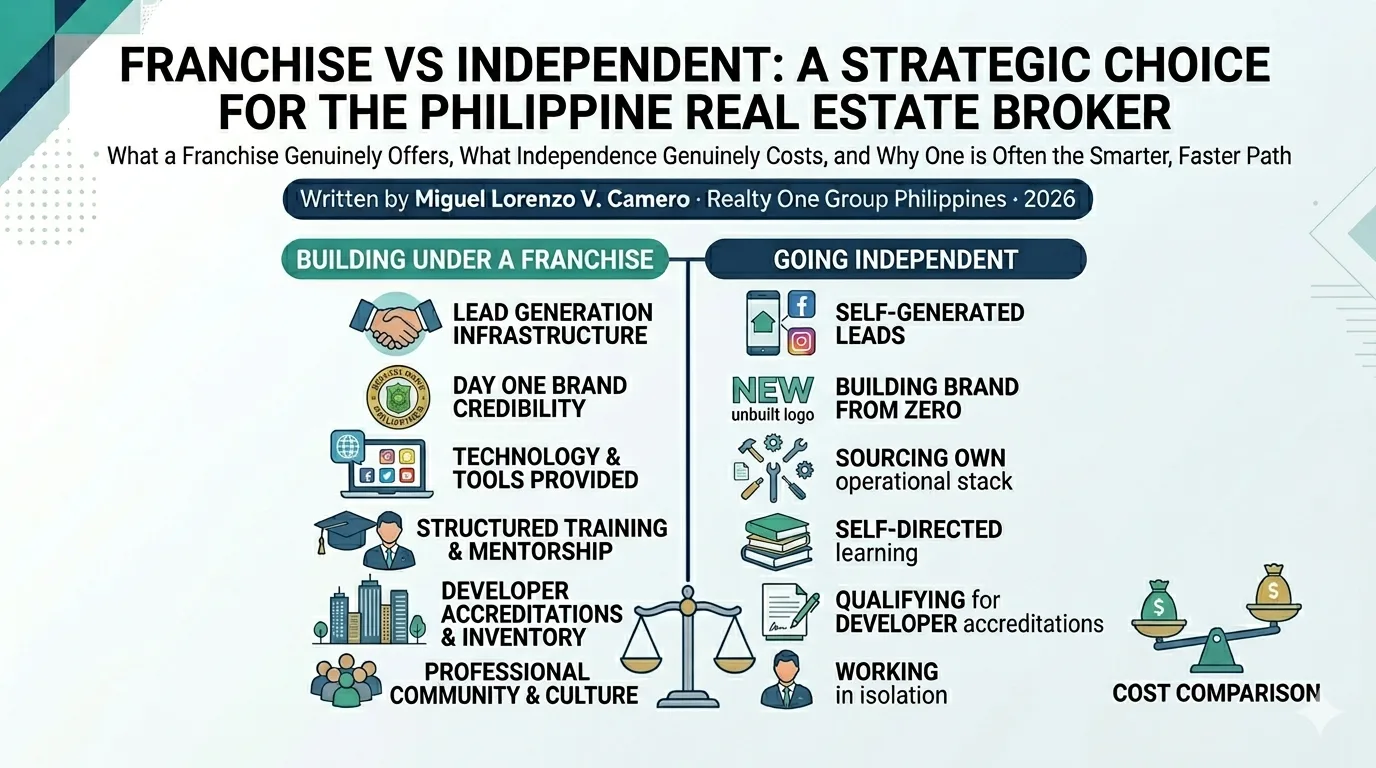
Lead generation is the first and most brutal challenge. In a franchise or established brokerage network, leads come from multiple directions — the organization's website, referral networks, developer partnerships, walk-in inquiries, and the collective marketing spend of the larger organization. An independent broker has none of that by default. Every lead must be generated personally, through personal marketing spend, personal networking, personal social media presence, and personal relationships built over time. In a market as competitive and digitally driven as Philippine real estate in 2026, building a consistent lead pipeline from zero is expensive, slow, and uncertain.
Brand credibility takes years to build independently. When a client evaluates a broker they have never met, one of the fastest proxies for trustworthiness is the organization behind them. A recognized brand — one that has a track record, a visible presence, and a professional reputation — lends credibility to every agent under its umbrella from day one. An independent broker operating under their own name has no such proxy. They must earn every client's trust entirely on the strength of their personal reputation, which is something that compounds over time but offers very little to a client who is meeting you for the first time.
Technology and tools are increasingly central to how real estate business is conducted. CRM systems for managing client relationships and follow-ups, listing platforms, digital marketing tools, transaction management software, market data subscriptions — these are not optional extras in a modern practice. They are the operational baseline. Sourcing, subscribing to, and maintaining these tools independently is a recurring cost that adds up quickly and requires ongoing management that takes time away from actually serving clients.
Training and professional development in an independent setup is entirely self-directed. There is no organizational training calendar, no mentorship structure, no access to the collective knowledge of a peer community. Independent brokers who stay sharp do so by investing in their own education — which is admirable, but costly and often inconsistent without the structure of an organization to anchor it.
Developer accreditations are the lifeblood of a broker's primary market business. Developers accredit brokers and their teams to sell their projects, and those accreditations come with access to inventory, pricing, commission structures, and marketing support. Building a portfolio of developer accreditations independently requires a track record and relationships that take years to establish. Franchise networks, by contrast, often carry organizational accreditations that individual brokers can access through their membership — giving them immediate access to projects they would have taken years to qualify for on their own.
None of this means independence is impossible. It means independence is expensive — in time, in money, and in opportunity cost. For most brokers, the question is not whether they can eventually get there independently. It is whether building under a franchise first is the smarter, faster, and more financially sound path to getting there.
What a Franchise Actually Gives You
A real estate franchise is not just a brand name and a logo. At its best, it is a complete operational platform — a set of systems, relationships, tools, and community that allows a broker to focus on what actually generates income: serving clients and closing transactions.
Lead generation infrastructure is one of the most tangible franchise benefits. Established franchise networks invest significantly in digital presence, SEO, listing portals, and inbound marketing — efforts that generate leads which flow to brokers within the network. Instead of building your own lead generation machine from scratch, you plug into one that is already running.
Brand credibility from day one is perhaps the most underrated franchise advantage, particularly for newer brokers. Walking into a client meeting representing a recognized, established brand changes the dynamic of that first conversation. The client has a frame of reference. The brand has done part of the trust-building work before you even open your mouth. For clients who are spending millions of pesos on a property decision, that initial credibility is not a small thing.
Centralized technology and tools mean you are not spending hours researching, subscribing to, and maintaining your own operational stack. The franchise provides the CRM, the marketing templates, the digital tools, and the platforms — and the cost is shared across the entire network rather than absorbed entirely by you.
Structured training and mentorship gives you access to the accumulated knowledge of the organization and its most experienced practitioners. This is particularly valuable in the early years of practice, when the gap between what you know and what you need to know is widest, and when the mistakes you make are most likely to be costly ones.
Professional community is a benefit that is easy to underestimate until you have spent time working in isolation. Real estate can be a solitary profession, particularly for independent brokers who are building alone. Being part of an organization means having colleagues to think through difficult transactions with, share market intelligence with, and hold yourself professionally accountable to.
Realty One Group Philippines: A Specific Look
Realty One Group is one of the fastest-growing real estate franchise networks in the world, with its Philippine operations expanding steadily as the brand establishes itself in the local market. Understanding what ROG Philippines specifically offers is relevant if you are actively evaluating your options.
Realty One Group operates on a model that is genuinely distinctive in the franchise landscape — one that is designed to maximize what brokers and agents retain from each transaction while still providing the full platform of a major franchise network. The organization's philosophy centers on empowering the individual practitioner rather than building a top-heavy corporate structure that extracts value from the people doing the actual work.
The agent-centric commission model is one of ROG's most significant differentiators. Unlike traditional franchise models where the brokerage retains a substantial ongoing percentage of every commission, ROG Philippines is structured to allow agents to retain a significantly higher share of their earnings once they have met their annual contribution to the organization. This means that as your volume grows, the economics of working within ROG improve substantially compared to many competing franchise structures.
Training and onboarding within ROG Philippines is structured to get new and transitioning brokers productive as quickly as possible. Whether you are a newly licensed broker entering the profession for the first time or an experienced practitioner transitioning from another organization, the training curriculum covers market knowledge, transaction processes, marketing tools, and the organizational systems you will be working with from day one.
Developer accreditations and inventory access through ROG Philippines give affiliated brokers access to a growing portfolio of primary market projects — condominiums, house and lot developments, and commercial properties — that would take years to access independently. This is particularly valuable for brokers who want to work in the primary market but do not yet have the personal track record to secure direct developer accreditations on their own.
Marketing and branding support means you are not starting from zero when it comes to your professional image. ROG Philippines provides marketing materials, digital assets, and brand guidelines that allow you to present yourself professionally from the beginning — without the cost and time of building all of that independently.
The community and culture within ROG Philippines is one of the organization's most frequently cited strengths by those already affiliated. Real estate is a profession where isolation is a genuine occupational hazard, and being part of an organization that is genuinely invested in the success of its individual members — rather than simply extracting value from them — makes a meaningful difference in how you experience the work, particularly in the difficult early months of building your practice.
ROG Philippines currently operates across multiple locations and is actively expanding its network of affiliated brokers and salespersons across Metro Manila and key provincial markets. If you are evaluating whether ROG is the right home for your practice, the best step is a direct conversation with the organization — not to be sold to, but to ask the specific questions that matter to your situation: the commission structure, the support model, the developer accreditations available, and the expectations on both sides of the affiliation.
A Direct Cost Comparison
Comparing the true cost of franchise versus independent practice requires looking at more than just the fees. It requires looking at the full picture of what you spend and what you gain in each model.
An independent broker building their practice from scratch will typically absorb the full cost of their own marketing — social media advertising, a personal website, professional photography, and printed materials. They will pay individually for CRM software, listing platform subscriptions, and any other operational tools they need. They will generate every lead personally, without organizational infrastructure behind them. They will build their developer accreditations one relationship at a time, over years. They will handle all compliance and administrative work without support. The total annual cost of these inputs for a serious independent operator can easily reach six figures — before a single commission is earned.
A broker affiliated with ROG Philippines, by contrast, pays an organizational fee that covers access to the brand, the tools, the training, the community, and the developer accreditations. The specific fee structure is a matter to discuss directly with ROG Philippines, as it is subject to the organization's current terms and may vary by arrangement. But the core point is this: the franchise fee is not an additional cost layered on top of everything you would otherwise spend. For most brokers, it replaces a significant portion of what they would spend independently — often at a lower total cost, with better results, and with the support of an organization behind them.
The honest comparison is not franchise fee versus zero. It is franchise fee versus the full cost of building independently — in money, in time, and in the opportunity cost of slower growth.
When Independence Might Actually Make Sense
In the spirit of honesty that has run through every article in this series, it is worth being clear about the circumstances where independence genuinely makes sense — because there are some.
If you have spent ten or more years in the profession, have a deeply established personal brand, carry a substantial book of repeat and referral clients, hold direct developer accreditations across multiple active projects, and have the administrative and operational infrastructure already in place — independence gives you the highest possible retention of the income you generate. At that stage, the franchise value proposition is less compelling because you have already built, independently, most of what the franchise provides.
If you are a broker who operates in a very specialized niche — a specific geographic market, a specific property type, a highly targeted client segment — where your personal brand is the primary draw and the franchise brand adds little incremental credibility with your specific clients, independence may also make strategic sense.
But these are the exceptions, not the rule. For the vast majority of brokers — and for virtually every broker in the first decade of their practice — the franchise model provides a platform, a community, and an operational infrastructure that would cost significantly more to replicate independently, and would take significantly longer to build.
The choice between franchise and independence is not a question of which is objectively better. It is a question of where you are in your career, what you are trying to build, and what resources you have available to build it with.
For most brokers, most of the time, a franchise affiliation is the smarter strategic choice — not because independence is impossible, but because the franchise gives you a faster, more supported, and more cost-efficient path to the practice you are trying to build. The leads, the brand, the tools, the training, the community, and the developer access that a franchise provides are not luxuries. They are the infrastructure of a productive real estate practice, and building that infrastructure independently is far more expensive and far more time-consuming than most people realize before they try it.
Realty One Group Philippines represents a specific version of that proposition — one built around agent empowerment, a competitive commission model, and a culture that takes the success of its individual practitioners seriously. If you are evaluating your options, it deserves a serious look.
Reach out to Realty One Group Philippines directly to learn more about affiliation, ask the questions that matter to your specific situation, and make the decision that is right for where you are and where you want to go.
About the Author
Miguel Lorenzo V. Camero · Realty One Group Philippines
This article was written to share an honest and practical perspective on one of the most consequential decisions a real estate broker can make — whether to build their practice under a franchise or independently. It is shared in the spirit of education and professional community, because every Filipino real estate professional deserves to make that decision with a clear understanding of what each path truly involves. For property inquiries, career opportunities, or real estate guidance, reach out through Realty One Group Philippines.
Disclaimer: This article is for general informational and educational purposes only. References to Realty One Group Philippines reflect the author's personal affiliation and perspective and do not constitute an official endorsement, guarantee of income, or representation of specific terms, fees, or arrangements offered by Realty One Group Philippines or its parent organization. Franchise terms, commission structures, developer accreditations, fees, and organizational offerings are subject to change and must be verified directly with Realty One Group Philippines before any decision is made. Income figures and cost comparisons presented in this article are illustrative and based on general market practice — actual results will vary significantly depending on individual effort, market conditions, transaction volume, and other factors. Nothing in this article constitutes financial, legal, or career advice. Always conduct your own due diligence and consult a licensed professional before making any career or business decisions.