You passed the board exam. You have your PRC license. You are active in the market, closing deals, building your client base, and doing the work. Then renewal season arrives — and suddenly you are scrambling to figure out how many CPD units you have, whether your provider is accredited, and whether you still have enough time to comply before your license lapses.
This is a situation more real estate brokers find themselves in than most would care to admit. Continuing Professional Development — CPD — is not the most exciting part of the profession, but it is one of the most consequential. A lapsed license does not just mean paperwork. It means you are no longer legally authorized to practice. Every transaction you facilitate while unlicensed is a legal exposure — for you and for any client who trusted you with one of the biggest financial decisions of their life.
This article gives you a clear, practical breakdown of what CPD means for PRC-licensed real estate brokers in 2026: how many units you need, where to get them, when your renewal is due, and what happens if you miss it.
What Is CPD and Why Does It Exist?
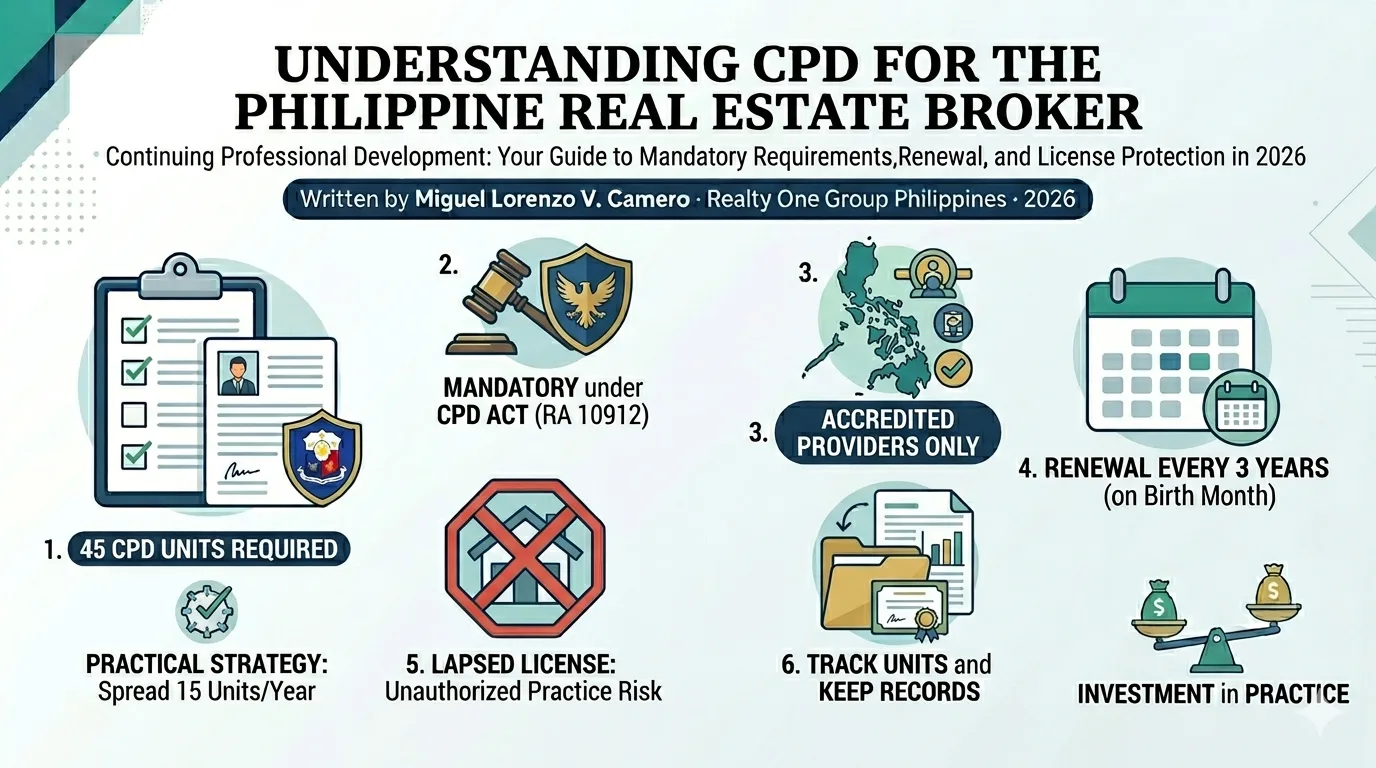
Continuing Professional Development is a mandatory requirement under Republic Act No. 10912, known as the CPD Act of 2016, which applies to all PRC-regulated professions in the Philippines — including real estate brokers, consultants, and appraisers. The law exists for a straightforward reason: a professional license is not a permanent certification of competence. Markets change, laws are amended, financing structures evolve, and the body of knowledge that makes a real estate broker genuinely useful to their clients in 2026 is not identical to what it was in 2016 or even 2020.
CPD is the mechanism by which licensed professionals demonstrate that they are keeping pace with those changes. It is not a punishment or an administrative burden invented to generate revenue for training providers — though it is fair to say that not everyone experiences it that way. At its best, CPD is an investment in the quality of your practice and the protection of your clients. At its minimum, it is the price of keeping your license active.
How Many CPD Units Does a Real Estate Broker Need?
Under current PRC guidelines, real estate brokers are required to complete 45 CPD units per three-year license renewal cycle. This means that over the course of three years — from the date your license was issued or last renewed — you must accumulate 45 units of qualifying CPD activities from PRC-accredited providers before you can renew your license.
It is important to understand what a CPD unit represents. One CPD unit generally corresponds to one hour of qualifying learning activity. A seminar that runs for eight hours counts as eight CPD units. A two-day training program running six hours per day counts as twelve CPD units. The unit counting is straightforward — what matters is that the activity is conducted by a PRC-accredited CPD provider and that you receive proper documentation of your completion.
The 45-unit requirement is not something you need to fulfill in a single month or even a single year. You have three years to accumulate them, which works out to an average of 15 units per year — roughly one to two training programs annually if you plan it properly. The brokers who run into trouble are almost always those who put it off until the third year and then find themselves short on time, short on available programs, or short on budget to complete everything at once.
Start early. Spread it out. Treat CPD as a recurring professional expense and schedule it the same way you would schedule any other business activity.
What Topics Qualify for CPD Credit?
Not all seminars, webinars, or training programs qualify for CPD credit. The activity must be conducted by a PRC-accredited CPD provider, and the content must fall within the scope of subjects recognized for the real estate profession. While the PRC periodically updates its guidelines on qualifying subject areas, the general categories that have historically been recognized for real estate CPD include the following.
Real estate laws, regulations, and jurisprudence — covering updates to RESA, the Maceda Law, the Condominium Act, DHSUD regulations, and other legislation directly relevant to real estate practice. Real estate finance and taxation, including updates on mortgage structures, capital gains tax, documentary stamp tax, and financing products available in the market. Property valuation principles and methodologies, even for brokers who are not licensed appraisers, as a working understanding of valuation supports more effective brokerage practice. Urban planning, land use, and zoning regulations, which directly affect the properties brokers deal with and the advice they give clients. Real estate marketing and technology, covering digital marketing, property platforms, data analytics, and other tools increasingly central to how the profession operates. Ethics and professional responsibility in real estate practice. General business management, contracts, and negotiation — subjects with direct application to real estate transactions.
Programs that are purely motivational, unrelated to professional practice, or conducted by providers without valid PRC accreditation do not count toward your CPD requirement, regardless of how many hours they run or how much you paid to attend.
Who Are the Accredited CPD Providers?
CPD programs for real estate brokers must be delivered by providers that hold valid PRC accreditation. These providers are listed in the PRC's official registry, which is updated periodically and accessible through the PRC website. The categories of accredited providers generally include the following.
Professional real estate organizations — such as the Philippine Association of Real Estate Boards (PAREB), the Philippine Realty and Builders Association (PRBOA), the Chamber of Real Estate and Builders' Associations (CREBA), and other PRC-recognized real estate professional organizations — regularly conduct CPD seminars and training programs for their members and the broader real estate community. These organizations are among the most reliable and accessible sources of CPD programs for active brokers.
Higher education institutions with recognized real estate management programs also offer CPD activities, typically through their continuing education or extension services divisions. Government agencies and regulatory bodies sometimes conduct programs that qualify for CPD credit, particularly those covering regulatory updates directly relevant to real estate practice. Private training providers and corporate entities may also offer qualifying programs, provided they hold valid PRC accreditation at the time of the activity.
The critical point is this: always verify that a provider's PRC accreditation is current before you register and pay for any program. An expired accreditation means the units will not count. Ask the provider directly for their PRC accreditation number and validity period, and cross-reference it with the PRC's official list if you have any doubt. The responsibility for ensuring your CPD units are valid rests with you — not with the provider, and not with the PRC.
The Renewal Timeline: When Does Your License Expire?
PRC professional licenses in the Philippines follow a fixed three-year renewal cycle. For real estate brokers, the renewal deadline is tied to your birth month — specifically, your license expires on your birth month in the third year of your renewal cycle. This system staggers renewals across the calendar year to manage volume at PRC offices.
For example, if your license was last renewed in March 2023, your next renewal deadline is March 2026. If you were born in August and your license cycle aligns accordingly, your expiry falls in August of your renewal year. The specific date and cycle applicable to your license is printed on your PRC ID and Certificate of Registration, and can also be verified through the PRC's online portal.
Renewal must be completed on or before the expiry date. This means your 45 CPD units must be completed, documented, and submitted as part of your renewal application before that date — not on the date itself, and certainly not after. Processing times at PRC offices, particularly during peak renewal months, can add days or weeks to the administrative side of renewal. Build that buffer into your timeline.
The renewal process itself generally requires submission of your accomplished PRC renewal application form, your CPD certificates of completion totaling at least 45 units from accredited providers, payment of the applicable renewal fee, and any other documents required by the PRC at the time of renewal. Always check the current requirements on prc.gov.ph, as the PRC periodically updates its renewal procedures.
Tracking Your CPD Units: The PRC CPDAS
The PRC operates the CPD Accreditation System, commonly referred to as CPDAS, which serves as the official online platform for recording and tracking CPD credits. Accredited providers are required to report completed activities through this system, and licensed professionals can log in to monitor their accumulated units.
In practice, the reliability of CPDAS as a real-time tracking tool has been uneven — providers sometimes experience delays in uploading completion records, and the system's user interface has not always been the most intuitive for everyday use. Do not rely solely on CPDAS to tell you where you stand. Keep your own physical and digital records of every CPD program you attend: the certificate of completion, the provider's name and PRC accreditation number, the date and duration of the program, and the number of units awarded. Organize these in a folder — physical or digital — and update it every time you complete a qualifying activity.
If there is ever a discrepancy between your records and what appears in CPDAS, your certificates of completion are your evidence. You cannot dispute a gap in your record if you have no documentation to support your claim.
What Happens If You Miss the Deadline?
This is the question most brokers do not want to ask until they are already in the situation — and by then, the options are narrower than they would have liked.
If your PRC license expires without renewal, it lapses. A lapsed license means you are no longer a licensed real estate broker in the eyes of the law. You are not authorized to practice, to negotiate or sign contracts on behalf of clients, or to supervise salespersons. Any real estate activity you conduct during the period of lapse is unauthorized practice — a violation of the RESA Law that carries legal consequences.
The PRC does allow for the renewal of lapsed licenses, but the process is more complicated, more time-consuming, and potentially more expensive than a timely renewal would have been. A lapsed license may require you to apply for restoration, which can involve additional documentary requirements, surcharges or penalties on top of the standard renewal fee, and in some cases, additional CPD units beyond the standard 45. The specific requirements for license restoration are subject to PRC rules and may vary depending on how long the license has been lapsed.
Beyond the administrative complications, a lapsed license has practical consequences for your practice. Developer accreditations tied to your broker's license may be suspended or terminated. Salespersons under your supervision lose their legal basis for practice during the period your license is inactive. Clients who discover your license has lapsed — and in an increasingly transparent market, this is not difficult to verify — will reasonably question your professionalism and credibility.
The simplest, cheapest, and most professional approach to all of this is to never let it happen. Set a calendar reminder two years into your renewal cycle. Start accumulating units in year one. Treat the 45-unit requirement as a professional baseline, not a finish line to lunge at in the final month.
A Practical CPD Strategy for Active Brokers
Given that 45 units over three years averages out to 15 units per year, here is a simple approach that keeps you compliant without making CPD a crisis.
In the first year of your renewal cycle, target at least 15 to 20 units. Attend two or three programs — a legal update seminar, a marketing or technology training, and a professional ethics program will typically cover this comfortably. In the second year, target another 15 units. By the end of year two, you should be at or near 30 to 35 units. In the third year, you need only the remaining 10 to 15 units to complete your requirement — and you have the entire year to get them before your renewal deadline arrives.
This approach keeps CPD as a background rhythm of your professional life rather than a last-minute emergency. It also means you are regularly exposed to updates and developments in the profession throughout your renewal cycle, which is the entire point of the requirement.
Join your professional real estate organization if you have not already. PAREB, PRBOA, CREBA, and others regularly conduct CPD programs — often at member rates — and their calendars are typically published well in advance. Staying active in your professional community makes CPD easier to access and turns it into something you do alongside colleagues rather than something you scramble to finish alone.
CPD compliance is not optional, and it is not complicated — but it does require the same thing that every other part of a successful real estate career requires: planning, discipline, and the professional seriousness to treat your license as the foundation of everything you do.
Forty-five units over three years. Accredited providers only. Renewal before your birth month deadline. Personal records kept and organized. That is the framework. Everything else is execution.
Your license is not just a card in your wallet. It is your legal authority to practice, your professional credibility with every client you serve, and the foundation on which your entire career rests. Protect it accordingly.
For the most current CPD requirements, accredited provider lists, and renewal procedures, visit the official PRC website at prc.gov.ph or contact the nearest PRC Regional Office in your area. You may also monitor your CPD credits through the PRC's online CPDAS portal.
About the Author
Miguel Lorenzo V. Camero · Realty One Group Philippines
This article was written to share practical, straightforward guidance on CPD compliance for PRC-licensed real estate brokers in the Philippines. It is shared in the spirit of education and professional community — because every licensed broker deserves to understand their renewal obligations clearly, with enough lead time to meet them without stress. For property inquiries or real estate guidance, reach out through Realty One Group Philippines.
Disclaimer: This article is for general informational and educational purposes only. It is not an official publication of the Professional Regulation Commission (PRC), the Department of Human Settlements and Urban Development (DHSUD), or any government agency, nor is it endorsed by any regulatory body or real estate organization. CPD unit requirements, accreditation guidelines, renewal procedures, deadlines, and PRC policies are subject to change at any time without prior notice. All information presented in this article reflects general practice and publicly available guidance at the time of writing and may not reflect the most current PRC policies or regulations. Always verify current CPD requirements, accredited provider lists, and renewal procedures directly with the PRC at prc.gov.ph or at the nearest PRC Regional Office. The author and Realty One Group Philippines assume no liability for decisions made based on the contents of this article. Consult the PRC directly or a licensed legal professional for guidance specific to your situation.