Most real estate brokers in the Philippines understand that a PRC license is the foundation of their legal authority to practice. What significantly fewer brokers understand — until they are already in the middle of a transaction that requires it — is that the PRC license is not the only registration a practicing real estate broker needs. The Department of Human Settlements and Urban Development, known as DHSUD, maintains a separate registration requirement for real estate service practitioners, and operating without it carries consequences that can affect not just your practice but your clients and the transactions you facilitate.
This is one of the most consistently overlooked compliance obligations in the Philippine real estate profession. It does not get discussed as frequently as PRC renewal or CPD requirements, it is not always covered in training programs, and because the enforcement environment has historically been uneven, many brokers have practiced for years without it — sometimes without even knowing it was required. That does not make non-compliance acceptable. It makes clear information about the requirement more important, not less.
This article gives you a complete, honest breakdown of DHSUD registration for real estate brokers in the Philippines: what it is, why it exists, what the requirements are, how the process works step by step, what mistakes practitioners commonly make, and what the processing timeline realistically looks like.
What Is DHSUD and Why Does It Regulate Real Estate Brokers?
The Department of Human Settlements and Urban Development is the primary government agency responsible for the governance, regulation, and development of the housing and real estate sector in the Philippines. It was established under Republic Act No. 11201, which reorganized and consolidated the functions of several predecessor agencies — including the Housing and Land Use Regulatory Board, known as HLURB — into a single, unified department.
Among DHSUD's mandates is the regulation of real estate developers, subdivision and condominium projects, and real estate service practitioners. This regulatory authority over practitioners exists alongside — and separately from — the PRC's authority over professional licensing. The distinction is important: the PRC governs the professional license, which is about individual competence and professional standards. DHSUD governs the registration of practitioners within the housing and real estate sector, which is about market regulation, consumer protection, and the integrity of real estate transactions in the context of the broader housing industry.
Think of it this way. Your PRC license establishes that you are qualified to practice as a real estate broker. Your DHSUD registration establishes that you are recognized and registered within the regulatory framework of the housing and real estate market you are practicing in. Both are required. Neither substitutes for the other.
The legal basis for DHSUD registration of real estate service practitioners flows from the Real Estate Service Act of the Philippines — Republic Act No. 9646 — and the implementing rules and regulations that govern its administration, parts of which fall under DHSUD's regulatory jurisdiction following the reorganization from HLURB.
Who Is Required to Register with DHSUD?
DHSUD registration requirements apply to real estate service practitioners who are engaged in the sale, marketing, or facilitation of real estate transactions covered under DHSUD's regulatory scope — which includes subdivision lots, condominium units, memorial lots, and other real estate products regulated under Presidential Decree No. 957 and related legislation.
In practical terms, this covers the vast majority of active real estate brokers and their accredited salespersons who work in the primary market — selling developer projects, subdivision properties, and condominium units. If you are brokering the sale of properties that fall under DHSUD's regulatory umbrella, registration is a compliance requirement, not an optional credential.
Real estate developers who sell their own projects are also subject to DHSUD registration and licensing requirements, but the specifics of developer registration are a separate matter outside the scope of this article, which focuses specifically on the registration requirements applicable to licensed brokers and accredited salespersons.
The Distinction Between PRC and DHSUD Registration: Why Both Matter
Because the two registrations are separate and issued by different government bodies, it is worth being explicit about what each one covers and why both are necessary for a fully compliant practice.
Your PRC license, issued by the Professional Regulation Commission, is your authorization to practice as a real estate broker. It is your professional credential — the document that establishes you have passed the required examination, met the educational requirements, and are recognized by the PRC as a licensed practitioner. PRC renewal is every three years, tied to your birth month, and requires CPD completion.
Your DHSUD registration, issued by the Department of Human Settlements and Urban Development, is your registration as a real estate service practitioner within the housing and real estate regulatory framework. It is separate from your PRC license, processed through different channels, subject to different renewal timelines, and enforced under a different regulatory mandate.
A broker who holds a valid PRC license but has not completed DHSUD registration is PRC-compliant but not fully DHSUD-compliant. A broker who completed DHSUD registration years ago but has not renewed it is carrying an expired registration. Neither situation constitutes full regulatory compliance, and both carry exposure — for the broker personally and for the transactions they facilitate.
Step-by-Step: The DHSUD Registration Process for Real Estate Brokers
The following is a step-by-step breakdown of the DHSUD registration process as it generally applies to licensed real estate brokers. Because DHSUD periodically updates its procedures, forms, and requirements, always verify the current process directly with DHSUD before submitting your application.
Step One: Prepare Your Documentary Requirements
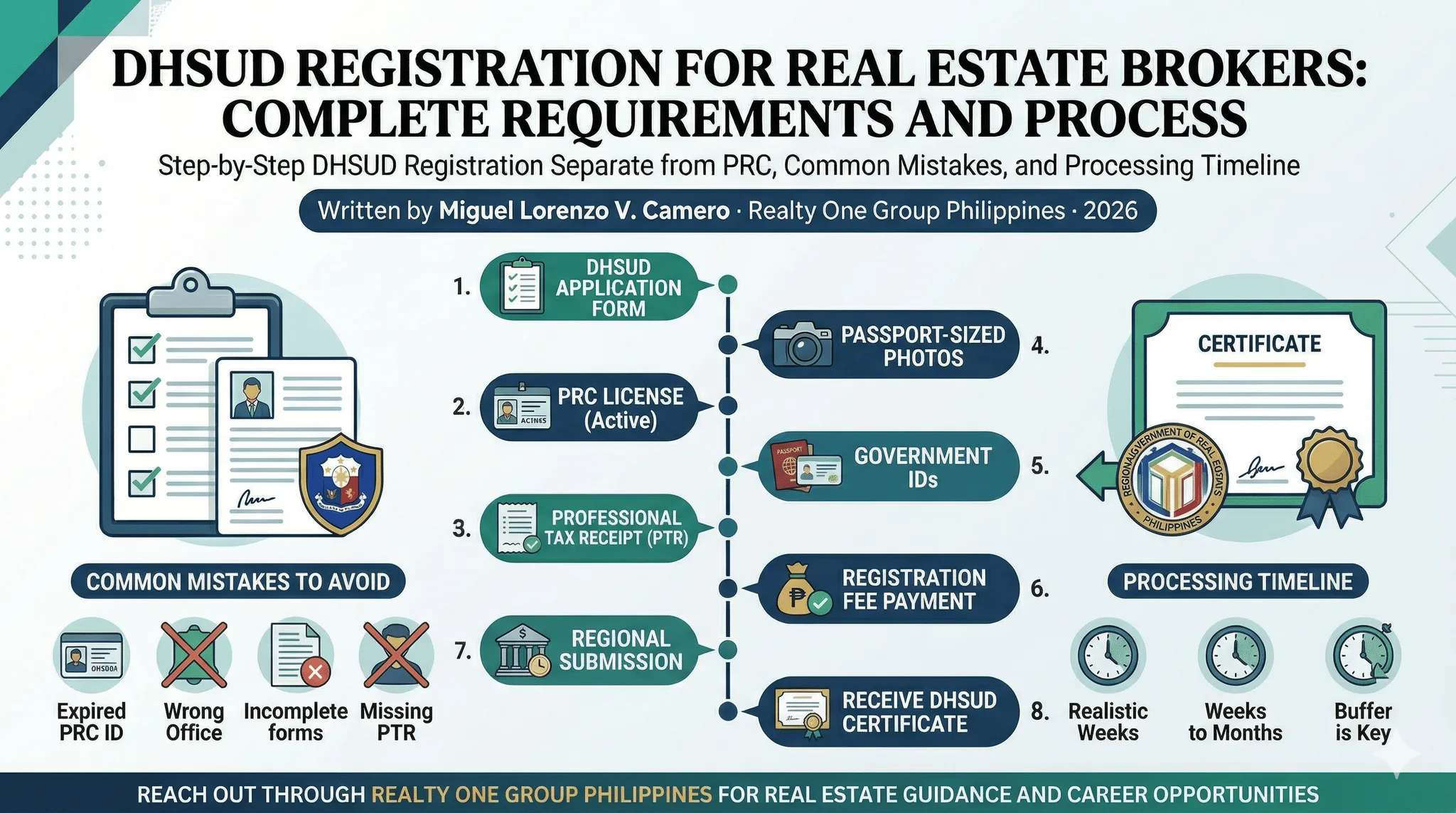
Before approaching any DHSUD office or online portal, gather all required documents. Submitting an incomplete application is one of the most common causes of delays — and in some cases, outright rejection — in the DHSUD registration process. The general documentary requirements for real estate broker registration with DHSUD include the following.
A duly accomplished DHSUD application form for real estate service practitioner registration. This form must be completed in full, with no blank fields, and signed where required. Obtain the current version of the form directly from DHSUD — do not use outdated forms downloaded from unofficial sources, as forms are periodically updated and outdated versions will not be accepted.
A photocopy of your valid PRC ID or PRC Certificate of Registration as a licensed real estate broker. This must be current — an expired PRC license will not support a DHSUD registration application. If your PRC license is due for renewal, complete the PRC renewal first before proceeding with DHSUD registration.
A photocopy of your PRC Professional Tax Receipt, commonly referred to as the PTR. The PTR is issued annually by your local government unit upon payment of the professional tax and is a standard documentary requirement across most professional registration and renewal processes in the Philippines.
Passport-sized ID photographs, typically with a white background and in the number specified by DHSUD's current requirements. Check the current specifications carefully, as the required number and format have varied across different application periods.
A valid government-issued ID in addition to your PRC ID — such as a passport, driver's license, or Philippine Identification System card — as a secondary identification document.
Proof of payment of the applicable DHSUD registration fee. Fee amounts are subject to change and must be verified directly with DHSUD at the time of application. Do not rely on fee amounts listed in older references or unofficial sources.
For brokers who supervise accredited salespersons, additional documentation related to those affiliations may be required. Verify with DHSUD whether your current supervisory arrangements require additional disclosure or documentation at the time of registration.
Step Two: Verify the Correct DHSUD Office or Submission Channel
DHSUD maintains regional offices across the Philippines, and registration applications are generally processed through the regional office with jurisdiction over the area where you practice. Identify the correct regional office for your location before submitting your application.
DHSUD has also been developing online submission channels and electronic processing systems as part of broader government digitization initiatives. The availability and functionality of these channels vary and are subject to ongoing development. Check the current DHSUD website and official social media channels for the most up-to-date guidance on whether online submission is available for your registration type and location.
Step Three: Submit Your Application and Pay the Registration Fee
Submit your complete documentary requirements to the appropriate DHSUD office or through the available online channel. Pay the applicable registration fee as directed — whether at a DHSUD cashier, through an accredited payment channel, or through an online payment gateway if applicable.
Keep the original receipt of your payment. This receipt is your proof of submission and payment and will be required if there are any questions or discrepancies in the processing of your application.
Step Four: Follow Up on Application Status
Processing timelines at DHSUD offices vary depending on application volume, staffing, and the completeness of your submission. After submitting, follow up on the status of your application through the contact channels provided by the DHSUD office where you submitted. Keep a record of your submission date, your application reference number if one was issued, and the name of the staff member who received your documents.
If DHSUD requests additional documents or corrections during the processing of your application, respond promptly. Delays in responding to DHSUD's requests for additional information are one of the most common reasons applications take longer than they should.
Step Five: Receive and Safeguard Your DHSUD Certificate of Registration
Upon approval of your application, DHSUD will issue your Certificate of Registration as a real estate service practitioner. This certificate is a document of significant professional and legal importance — treat it with the same care as your PRC license. Keep a digital scan in a secure location, maintain the physical original in a safe place, and note the validity period and renewal deadline on your professional calendar.
Common Mistakes That Delay or Derail DHSUD Registration
Having walked through the process, it is worth addressing the mistakes that most commonly cause applications to be delayed, returned, or rejected. Many of these are entirely avoidable with proper preparation.
Submitting an expired PRC license. This is the most fundamental error and immediately disqualifies an application. Your PRC license must be current and valid at the time of DHSUD registration submission. If your PRC renewal and your DHSUD registration are both due around the same time, complete the PRC renewal first, then proceed with DHSUD.
Using outdated application forms. DHSUD updates its forms periodically, and applications submitted on outdated versions are returned for resubmission on the current form. Always download or obtain your forms directly from DHSUD — either from their official website or from the regional office directly — immediately before you intend to submit. Do not use forms you downloaded months ago or forms shared by colleagues from a previous application cycle.
Incomplete or inconsistent information on the application form. Every field on the DHSUD application form exists for a reason. Leaving fields blank, writing illegibly, or providing information that is inconsistent with your supporting documents — for example, a name spelling on the form that does not match your PRC ID — creates discrepancies that must be resolved before your application can proceed. Fill out every field completely, clearly, and consistently with your documentary evidence.
Missing or incorrect photographs. ID photo requirements — size, background color, number of copies, recency — are specified in DHSUD's current guidelines and must be followed exactly. Photographs that do not meet specifications are a surprisingly common reason for applications to be returned.
Failure to include the PTR. The Professional Tax Receipt is a standard requirement that brokers sometimes overlook because it feels like a minor administrative document. It is not minor to DHSUD's processing staff. Include it, and make sure it is current for the applicable year.
Submitting to the wrong regional office. DHSUD regional offices have specific jurisdictional coverage. Submitting your application to the wrong office means it will need to be redirected or resubmitted, adding time to your processing timeline. Confirm the correct office for your practice location before you submit.
Not keeping copies of everything submitted. Before you hand over any documents to a DHSUD office, make photocopies of every single document in your submission package. If something is lost, disputed, or questioned during processing, your copies are your evidence. This is a simple precaution that too many applicants skip.
Waiting until the last moment. DHSUD registration, like PRC renewal, should not be left until the deadline is imminent. Processing timelines are not guaranteed, offices experience volume surges near deadlines, and any complication in your application — a missing document, a requested correction — requires additional time that you may not have if you are already up against the deadline.
Processing Timeline: What to Realistically Expect
The honest answer about DHSUD processing timelines is that they vary — and in some cases, vary significantly. Under normal conditions and with a complete, correctly prepared application, processing at many DHSUD regional offices can take anywhere from a few weeks to a couple of months. During peak periods — particularly when large numbers of practitioners are submitting renewal applications simultaneously near a common deadline — processing times can extend further.
This variability is not unique to DHSUD. It reflects the realities of government processing across agencies in the Philippines, where staffing levels, application volumes, and administrative systems do not always align perfectly with the expectations of applicants. Knowing this in advance allows you to plan accordingly rather than being caught off guard.
The practical implication is clear: do not treat DHSUD registration as something you can initiate a week or two before you need it to be done. Initiate it with enough lead time that even an extended processing period does not leave you in a compliance gap. A buffer of two to three months between submission and your target completion date is a reasonable starting point.
Follow up proactively. Politely but persistently checking on the status of your application — rather than submitting and then waiting passively — keeps your application visible and allows you to respond quickly to any additional requirements that arise during processing.
What Happens If You Practice Without DHSUD Registration
Operating as a real estate service practitioner in transactions covered by DHSUD's regulatory scope without valid registration is a compliance violation that carries real consequences. DHSUD has the authority to impose sanctions on unregistered practitioners, which can include fines, cease-and-desist orders, and referral for further regulatory or legal action.
Beyond the direct regulatory consequences, there are practical implications for your transactions. Developers and project sellers who are themselves subject to DHSUD oversight are required to ensure that the brokers and salespersons they accredit and work with are properly registered. A broker without valid DHSUD registration may find their developer accreditations questioned or withdrawn. Transactions that are later scrutinized — particularly in cases of buyer complaints filed with DHSUD — may surface the broker's registration status as a relevant compliance issue.
The reputational consequences are equally significant. In a market where trust is the foundation of every client relationship, a compliance gap of this nature — if it becomes known — undermines the professional credibility you have worked to build. The cost of proper registration is modest. The cost of non-compliance, if it surfaces at the wrong moment, is not.
Keeping Your DHSUD Registration Current: Renewal Basics
DHSUD registration is not a one-time process. Like your PRC license, it must be renewed periodically to remain valid. The renewal period and requirements are subject to DHSUD's current guidelines — verify the specific renewal timeline applicable to your registration directly with DHSUD, as renewal schedules and procedures are subject to change.
The renewal process generally follows a similar documentary structure to the initial registration — a renewal application form, current PRC ID and PTR, photographs, and payment of the applicable renewal fee. As with the initial application, the same discipline applies: prepare completely, submit early, follow up proactively, and keep copies of everything.
Treat your DHSUD renewal deadline as a standing item on your professional compliance calendar — just as you treat your PRC renewal and CPD requirements. All three are interconnected pillars of your legal authority to practice, and all three require ongoing attention to keep your compliance status intact.
A Note on Staying Updated
DHSUD is an active regulatory body that issues memoranda, circulars, and updated guidelines with some regularity. Procedures that applied last year may have been updated this year. Forms that were current six months ago may have been revised. Fee amounts and submission channels evolve as the department continues to develop its systems and processes.
The most reliable sources for current DHSUD requirements are the official DHSUD website, the regional office with jurisdiction over your practice area, and the official communications of recognized real estate professional organizations — PAREB, PRBOA, CREBA, and others — which typically monitor and disseminate updates on regulatory requirements affecting their members.
Do not rely on this article, or any article, as your definitive and final source on current DHSUD requirements. Use it as a framework for understanding the process — then verify every specific requirement directly with DHSUD before you submit. That verification step is the most important single action you can take to ensure your application goes smoothly.
DHSUD registration is not optional, and it is not interchangeable with your PRC license. It is a separate, independently required registration that forms part of the complete compliance picture for a fully authorized real estate broker in the Philippines. The process is manageable — it requires preparation, attention to detail, and the discipline to start early rather than scramble at the last moment.
Know the requirements. Prepare your documents completely. Submit to the correct regional office with enough lead time to absorb any processing delays. Keep copies of everything. Follow up proactively. And build both your DHSUD renewal and your PRC renewal into the same professional compliance calendar so that neither one catches you unprepared.
Your license, your registration, and your reputation are the three pillars on which your practice stands. Protect all three with equal seriousness.
For the most current DHSUD registration requirements, forms, and processing guidelines, visit the official DHSUD website or contact the DHSUD regional office with jurisdiction over your practice area directly.
About the Author
Miguel Lorenzo V. Camero · Realty One Group Philippines
This article was written to share practical, clear guidance on one of the most consistently overlooked compliance requirements in the Philippine real estate profession. It is shared in the spirit of education and professional community — because every licensed real estate broker in the Philippines deserves to practice with full awareness of their regulatory obligations, and every Filipino client deserves to be served by practitioners who take those obligations seriously. For property inquiries or real estate guidance, reach out through Realty One Group Philippines.
Disclaimer: This article is for general informational and educational purposes only. It is not an official publication of the Department of Human Settlements and Urban Development (DHSUD), the Professional Regulation Commission (PRC), or any government agency, nor is it endorsed by any regulatory body or real estate organization. DHSUD registration requirements, documentary submissions, processing fees, timelines, forms, and regulatory guidelines are subject to change at any time without prior notice. All information presented in this article reflects general practice and publicly available guidance at the time of writing and may not reflect the most current DHSUD policies, procedures, or requirements. Always verify current requirements directly with DHSUD at dhsud.gov.ph or at the nearest DHSUD regional office before submitting any application. The author and Realty One Group Philippines assume no liability for decisions made based on the contents of this article. Consult the relevant government agencies directly or a licensed legal professional for guidance specific to your situation.