Every new real estate agent enters the profession with the same fundamental problem: no pipeline. No leads, no active buyers, no referred clients, no database of prospects warming up in the background. Just a freshly processed PRC accreditation, a phone, and the dawning realization that nobody is going to hand you a client simply because you are now licensed to serve one.
This is the moment where most new agents either figure it out or fade out. The dropout rate in Philippine real estate is high — not because the profession is inaccessible, but because building a client pipeline from zero is genuinely difficult work, and most people underestimate how much consistent, unglamorous effort it requires before it starts producing consistent results.
This article is about that effort — specifically, where to focus it, how to structure it, and what actually works in the Philippine market for agents who are just getting started. There are no shortcuts here. But there is a clear path, and knowing it before you begin is worth more than any single lead you will ever generate.
Understanding What a Pipeline Actually Is
Before talking about how to build one, it helps to be precise about what a client pipeline actually means — because the word gets used loosely in ways that obscure how it actually functions.
A pipeline is not a list of people who might someday buy a property. It is a structured, actively managed system of relationships at different stages of readiness — from people who have never heard of you, to people who know you exist, to people who trust you enough to call you when they are ready to move, to people who are actively transacting with you right now. The pipeline has multiple stages, and your job as an agent is to be consistently moving people through those stages while simultaneously adding new people at the beginning.
The mistake most new agents make is focusing entirely on finding people who are ready to buy right now. Ready buyers exist, and closing them feels good — but they are the smallest and most competitive segment of the market. The agents who build sustainable practices are the ones who invest as much energy in people who are twelve or twenty-four months away from a decision as they do in people who are ready today. Because those people, cultivated well, become clients without the frantic competition that surrounds every obviously ready buyer.
Build the whole pipeline, not just the end of it.
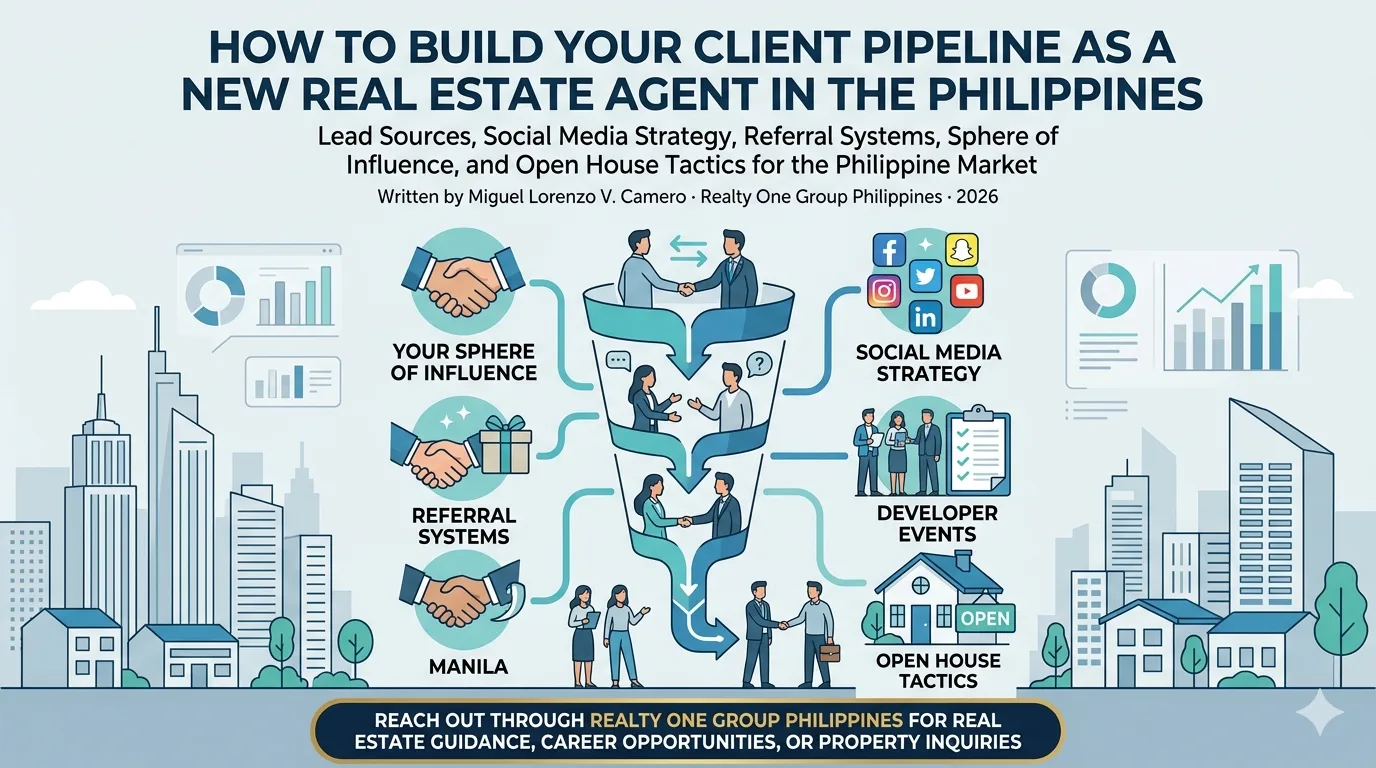
Lead Source One: Your Sphere of Influence
Your sphere of influence — the network of people who already know you, trust you, and have some existing relationship with you — is the single most valuable lead source available to any new agent, and it is the one most consistently underutilized.
Your sphere includes family members, former classmates from high school and college, former colleagues from previous jobs, neighbors, members of your church or community organization, fellow parents at your children's school, gym companions, former clients from any previous profession, and anyone else with whom you have an existing personal connection. In the Philippines, where personal relationships and community ties are central to how trust is built and business is done, this network is not just a starting point — it is a genuine competitive advantage if you work it properly.
Working your sphere does not mean sending a mass message to your entire contact list announcing that you are now in real estate and asking if anyone wants to buy a condo. That approach is transparent, uncomfortable for everyone, and largely ineffective. What it means is having genuine, individual conversations — reaching out personally, catching up authentically, and at the right moment, letting people know what you do and how you can help them or someone they know.
The goal of working your sphere is not to sell to everyone in it. Most of the people in your sphere are not in the market for a property right now. The goal is to ensure that every person in your sphere knows you are a real estate professional — so that when they are in the market, or when someone they know mentions they are looking, your name is the first one that comes to mind.
Do this consistently and personally. A handwritten message, a genuine check-in call, a comment on someone's post that is actually thoughtful rather than algorithmic — these things compound over time into a reputation as someone who stays in touch and who is present in people's lives beyond just the transaction.
In the Philippine context specifically, do not underestimate the power of extended family networks. A single tito or tita who is well-connected in their community and who trusts you can generate referrals that sustain a practice for years. Treat every person in your sphere as a potential center of influence — someone who, if they believe in you, can introduce you to multiple clients over time.
Lead Source Two: Social Media — Done the Right Way
Social media is where most new real estate agents in the Philippines instinctively go first, and it is where most of them make the same set of mistakes. They post nothing but property listings. They use stock photos and developer-provided marketing materials without any personal voice. They post inconsistently — five times in one week and then nothing for three weeks. And then they wonder why nobody is engaging and nobody is reaching out.
Social media works for real estate agents who understand what it is actually for. It is not a property portal. It is a relationship-building platform — a way to build familiarity, trust, and credibility with an audience over time, so that when that audience is ready to make a real estate decision, they already feel like they know you.
The content that builds that kind of relationship is not primarily listings. It is content that demonstrates your knowledge, your personality, and your genuine investment in helping people navigate the property market. Think about what your potential clients are actually searching for and worrying about: how much down payment they need, what the difference is between Pag-IBIG and bank financing, what to look for when visiting a property, how to tell if a developer is reputable, what the real cost of buying a home is beyond the selling price. These are the questions that keep people up at night, and the agent who answers them consistently and clearly — without making every answer a sales pitch — builds an audience that trusts them before they have ever met.
For the Philippine market specifically, Facebook remains the dominant platform for reaching a broad audience across age groups and income levels. Instagram is effective for visually driven content, particularly for higher-end properties and lifestyle-oriented buyers. TikTok and YouTube Shorts have grown significantly as platforms for educational short-form video content, and agents who are comfortable on camera and can explain property concepts clearly and engagingly have found genuine audiences there. LinkedIn is worth maintaining for referrals from the professional and corporate market, particularly for agents working in Metro Manila's business districts.
A practical content rhythm that works for new agents: three to four posts per week, rotating across different content types. One post that educates — a tip, an explainer, a myth-busted. One post that shows your market activity — a property visit, a closing, a developer briefing you attended. One post that is personal — something that lets people see who you are beyond the profession. And periodically, a property listing or project feature — but never as the majority of what you post.
Consistency matters more than production quality at the start. A genuine, clear, helpful video filmed on a decent phone will outperform a perfectly produced marketing piece with no personality behind it. Show up regularly. Be useful. Be human. The audience and the leads will follow.
One important discipline: always respond to every comment and every message promptly. Social media engagement is not just a vanity metric — it is a signal of availability and responsiveness that potential clients are watching. An agent who answers a question in the comments quickly is demonstrating, publicly, exactly the kind of agent they will be during a transaction.
Lead Source Three: Referral Systems
Referrals are the highest-quality leads in real estate — and they are the leads that most new agents do not systematically pursue because they feel awkward asking for them. That discomfort is understandable, but it is worth pushing through, because a referred client comes with a pre-existing level of trust that no amount of advertising can replicate.
A referral system does not have to be complicated. At its core, it is simply a consistent practice of letting the people in your life know that referrals are the most meaningful way they can support your business — and then making it easy for them to refer.
After any positive interaction with a client — a successful viewing, a helpful phone call, a transaction that closed well — that is the moment to ask. Not in a pushy or transactional way, but genuinely: "I'm really glad I could help you with this. If you know anyone else who's thinking about buying or looking for guidance on the property market, I'd be grateful if you thought of me." That is it. Simple, sincere, and surprisingly effective when done consistently.
Make referring you easy. Have a clear, professional social media profile that your referrers can share. Have a digital business card or contact page that loads quickly on mobile — because in the Philippines, WhatsApp and Facebook Messenger are often the channels through which referrals are actually transmitted, and a clean link to your profile is more shareable than a VCard. Make sure that when a referred person reaches out, you respond quickly and treat them as a priority — because how you handle the referral reflects directly on the person who made it, and their willingness to refer again depends on that experience.
Consider also building referral relationships with professionals in adjacent fields — mortgage officers at banks and Pag-IBIG service centers, accountants who work with clients planning major purchases, lawyers who handle property-related legal work, and interior designers or contractors who are engaged by people who have recently bought or are planning to buy. These professionals interact regularly with people who are in or near the property market, and a genuine, reciprocal referral relationship with even two or three of them can generate a meaningful and consistent stream of leads.
Lead Source Four: Developer and Project Events
Most property developers in the Philippines conduct regular sales events — project launches, buyer's nights, property fairs, and developer-organized open houses — and these events are one of the most underutilized lead sources available to accredited agents.
Attending these events, both as a participant and as an agent representing the developer's project, puts you in direct contact with buyers who have already self-selected as interested in real estate. They are not cold leads. They are warm prospects who showed up because they are actively considering a purchase. Your job at these events is not to hard-sell — it is to be genuinely helpful, to answer questions clearly and honestly, and to build enough of a connection that the person remembers you and is comfortable reaching out afterward.
Follow up after every event contact. A simple, personalized message the following day — not a mass blast, but an individual note that references something specific from your conversation — demonstrates the kind of attention to detail that sets a professional agent apart from the crowd. Most agents collect contacts at events and never follow up. The ones who do follow up, and follow up well, capture a disproportionate share of the transactions that eventually close from that room.
Lead Source Five: Open Houses and Property Viewings
In the Philippine market, the traditional open house — a scheduled period where a property is open for walkthrough by prospective buyers without a prior appointment — is less universally practiced than in some other markets, but it is gaining traction particularly in the condominium and subdivision segments, especially for developer-launched projects and high-turnover resale properties.
For new agents, volunteering to conduct or assist with open houses is one of the most practical ways to meet live, motivated prospects in a low-pressure context. An open house visitor has already taken a meaningful step — they researched the property, made the trip, and showed up. That level of initiative signals genuine interest, and the in-person interaction gives you an opportunity to demonstrate your knowledge, your professionalism, and your character in a way that no digital content can fully replicate.
Conduct every open house as if the next client of your career is walking through the door — because they might be. Know the property thoroughly before anyone arrives: the floor plan, the finishes, the developer's track record, the financing options available, the nearby amenities, the transport access, the monthly amortization at different down payment levels, and the comparative pricing of similar units in the area. A buyer who asks a question you cannot answer walks away with doubt. A buyer whose questions you answer completely and confidently walks away with confidence in you.
Capture contact information from every visitor — not aggressively, but naturally. A simple sign-in sheet or a QR code linking to a brief form is standard practice. Follow up personally within twenty-four hours. Ask how their search is going, offer to answer any additional questions, and make the follow-up about them rather than about closing a sale.
Building the Habit: Consistency Over Intensity
Every lead source described in this article works. None of them work if you do them sporadically, half-heartedly, or only when you are feeling motivated. The agents who build strong pipelines are not necessarily the most talented or the most charming — they are the most consistent. They post when they do not feel like posting. They follow up when they would rather not. They show up to events when staying home would be easier. They reach out to their sphere when it feels awkward, because they know that the awkwardness fades and the relationship deepens if they persist through it.
Pipeline building is a daily practice, not a periodic campaign. It is the accumulation of small, consistent actions over months and years that eventually produces a business that sustains itself through referrals and repeat clients — the kind of practice where the phone rings because of who you are and what you have built, not just because of what you are advertising this week.
Set daily and weekly activity targets for yourself, and hold yourself to them even when the results are not immediately visible. How many people did you reach out to in your sphere this week? How many posts did you publish? How many follow-up messages did you send? How many events did you attend? Track these inputs, not just the outcomes. The outcomes — the leads, the viewings, the offers, the closings — lag behind the inputs by weeks or months. If you manage the inputs consistently, the outputs will follow.
What the Philippine Market Specifically Rewards
Every real estate market has its own character, and the Philippine market has specific dynamics that shape what pipeline-building strategies work best.
Relationships come before transactions here, in a way that is more pronounced than in many other markets. A Filipino buyer who does not trust you will not buy from you, regardless of how attractive the property is or how competitive the price. Trust is built through time, consistency, presence, and genuine care — and it is destroyed by a single interaction that feels pushy, dishonest, or dismissive. Invest in the relationship before you push for the transaction, every time.
Community is a genuine lead source in the Philippine context in a way that cannot be reduced to a social media strategy. Being visibly present and genuinely helpful in your local community — your barangay, your church, your alumni network, your professional organization — builds a kind of grassroots reputation that generates word-of-mouth referrals no algorithm can replicate. Show up. Contribute. Be known as someone who helps people, not just someone who sells property.
OFW buyers are a significant and often underserved segment of the Philippine property market. Overseas Filipino Workers sending remittances home often have the financial capacity for a property purchase but limited access to trustworthy, responsive agents who can guide them through the process from abroad. Agents who build genuine competence in serving OFW buyers — understanding the documentation requirements, the financing options available to them, and the communication rhythms that work across time zones — access a client segment that is less competitive and often highly motivated.
Building a client pipeline as a new real estate agent in the Philippines is not complicated, but it is demanding. It requires working your sphere with genuine intention, showing up consistently on social media with content that actually helps people, building referral relationships that are reciprocal and maintained, engaging actively with developer events and open houses, and doing all of it with the patience to understand that the results come months after the effort.
There is no single lead source that will build your practice by itself. The agents who succeed are the ones who work multiple channels simultaneously, consistently, and with the professionalism to make every interaction — whether it closes a deal or not — an investment in their long-term reputation.
The pipeline you build in your first year will not sustain you in your first year. It will sustain you in your second and third. That is the uncomfortable truth of real estate pipeline building — and the agents who internalize it early are the ones who are still in the profession five years later, building something that compounds.
Start today. Do the work that will pay off in twelve months. Repeat.
For real estate guidance, career opportunities, or property inquiries, reach out through Realty One Group Philippines.
About the Author
Miguel Lorenzo V. Camero · Realty One Group Philippines
This article was written to give new and aspiring real estate agents in the Philippines an honest, practical guide to building a client pipeline from scratch. It is shared in the spirit of education and professional community — because every Filipino entering this profession deserves to know not just how to get licensed, but how to actually build a practice that lasts. For property inquiries or real estate guidance, reach out through Realty One Group Philippines.
Disclaimer: This article is for general informational and educational purposes only. It is not an official publication of the Professional Regulation Commission (PRC), the Department of Human Settlements and Urban Development (DHSUD), or any government agency, nor is it endorsed by any regulatory body, real estate organization, or financial institution. The strategies, tactics, and approaches described in this article reflect general market practice and the author's professional perspective at the time of writing. Results will vary significantly depending on individual effort, market conditions, geographic location, network size, and other factors outside the author's control. Nothing in this article constitutes financial, legal, or career advice. Always consult a licensed real estate professional or a legal practitioner for guidance specific to your situation.