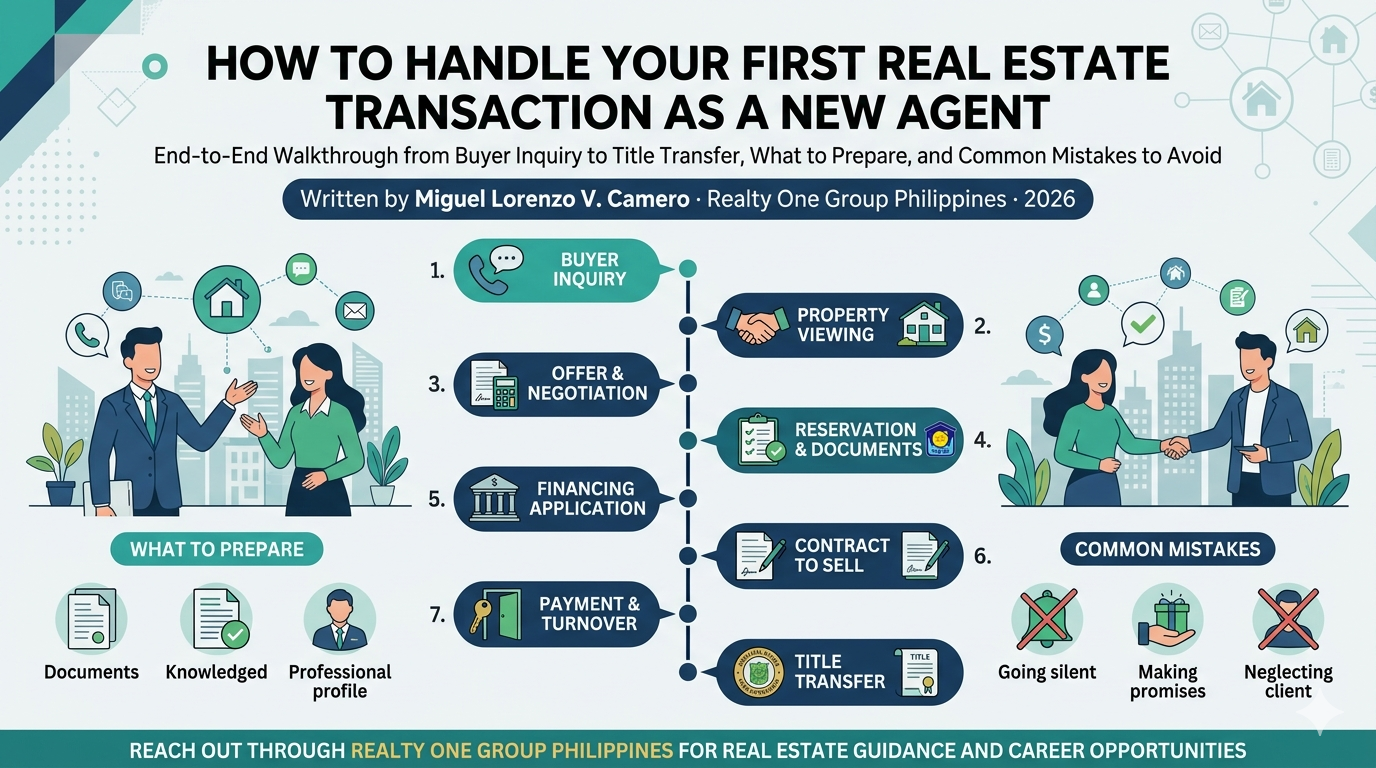
Becoming a licensed real estate broker in the Philippines requires a BS Real Estate Management degree, passing the PRC licensure exam, and registering with DHSUD. This guide covers every step — from education and exam preparation to licensing fees, career paths, and how to join a franchise brokerage like Realty ONE Group Philippines.
What Is a Licensed Real Estate Broker in the Philippines?
A licensed real estate broker is a professional authorized by the Professional Regulation Commission (PRC) to negotiate, arrange, and close real estate transactions in the Philippines. Under Republic Act No. 9646, also known as the Real Estate Service Act (RESA), anyone who wants to practice as a real estate broker must hold a valid PRC license.
Brokers are distinct from salespersons. While salespersons work under the direct supervision of a broker and are not required to pass a licensure exam, brokers operate independently. They can sign contracts, manage their own brokerage firms, hire salespersons, and earn full commissions on transactions they facilitate.
The real estate profession in the Philippines is regulated by two agencies: the PRC, which handles professional licensing and examinations, and the Department of Human Settlements and Urban Development (DHSUD), which handles business registration for brokers, salespersons, and firms engaged in real estate transactions.
What Are the Requirements to Become a Real Estate Broker?
To qualify for the Real Estate Broker Licensure Examination, you must meet the following requirements:
Educational requirement: You must hold a Bachelor of Science in Real Estate Management (BS REM) degree from a CHED-recognized institution. This was mandated by CHED Memorandum Order No. 28 and is the primary educational pathway. Alternatively, holders of other bachelor's degrees may qualify if they have completed the required number of real estate-related academic units as specified by the PRC and the Professional Regulatory Board of Real Estate Service (PRB-RES).
Age requirement: You must be at least 18 years old at the time of application.
Citizenship: You must be a Filipino citizen, or a foreign national from a country that grants reciprocity to Filipino real estate professionals.
Good moral character: You must not have been convicted of any crime involving moral turpitude.
Documentary requirements for PRC application:
- Completed PRC application form
- NSO/PSA birth certificate (original and photocopy)
- NSO/PSA marriage certificate for married female applicants (original and photocopy)
- Transcript of Records with Special Order number or diploma
- NBI clearance (valid and original)
- Four recent passport-sized photos (white background, with name tag)
- PRC examination fee payment receipt
How Do You Pass the PRC Real Estate Broker Licensure Exam?
The Real Estate Broker Licensure Examination is administered by the PRC through the Professional Regulatory Board of Real Estate Service. The exam is typically held twice a year — once in March and once in October — though the PRC may adjust the schedule. Always verify the current exam dates on the official PRC website or their Facebook page.
Exam structure: The exam is conducted over one full day and is divided into two main subjects:
Subject 1 covers real estate laws, principles of real property ownership, the Condominium Act, and the legal aspects of sale, mortgage, and lease. It also includes questions on documentation, registration procedures, and the Real Estate Service Act itself.
Subject 2 covers real estate brokerage practice, property valuation and appraisal methods, real estate finance and economics, real estate marketing, land use planning and zoning, subdivision development, and ethics and responsibilities of real estate practitioners.
Passing criteria: You need a general weighted average of at least 70%, with no rating below 50% in any individual subject. Results are typically released within 3 to 10 working days after the exam and are published on the PRC website.
Preparation strategies:
Most successful examinees enroll in a review program at an accredited review center. These programs typically run 4 to 8 weeks and cover all major exam topics with practice tests that simulate the actual exam format. Key areas to focus on include the Civil Code provisions on property, the Maceda Law (RA 6552), the Condominium Act (RA 4726), and the Real Estate Service Act (RA 9646).
Self-study is also possible, but the exam is law-heavy, and many candidates find that a structured review significantly improves their pass rate — particularly for the legal and valuation portions.
What Happens After Passing the Exam?
Once you pass the licensure exam, the process involves several steps before you can legally practice:
Step 1: Oath-taking ceremony. All successful examinees must attend the PRC oath-taking ceremony. This is a formal requirement before your license is issued.
Step 2: PRC registration. Register online through the PRC Licensure Examination and Registration Information System (LERIS). You will receive your Professional Identification Card (PRC ID) and Certificate of Registration. The PRC ID is valid for three years and must be renewed along with the required Continuing Professional Development (CPD) units.
Step 3: Secure a surety bond. Brokers are required to post a surety bond of at least ₱20,000 with the PRC as obligee. This bond is a legal requirement under RESA and must be maintained throughout your active practice.
Step 4: Register with DHSUD. All practicing brokers must register with the Department of Human Settlements and Urban Development. DHSUD registration is separate from PRC licensing and is required before you can legally engage in real estate transactions involving subdivision lots, condominium units, or other regulated properties. You will need to submit your PRC license, surety bond, and other documentary requirements to the DHSUD regional office.
What Is the Difference Between a Real Estate Broker and a Real Estate Salesperson?
This is one of the most commonly misunderstood distinctions in Philippine real estate. Here is a clear comparison:
Real estate broker: Must hold a bachelor's degree (BS REM or equivalent), must pass the PRC licensure exam, can independently negotiate and close transactions, can sign contracts on behalf of clients, can hire and supervise salespersons, must register with both PRC and DHSUD, and must maintain a surety bond.
Real estate salesperson: Must have completed at least two years (72 units) of college education, does not need to pass a licensure exam but must be PRC-accredited, must work under the direct supervision of a licensed broker, cannot independently sign transaction agreements, cannot receive compensation from anyone other than their supervising broker, and must renew PRC accreditation annually during their birth month.
In practice, salespersons handle much of the day-to-day client interaction — showing properties, answering inquiries, and facilitating viewings. However, all formal agreements and contracts must involve the supervising broker. This structure exists to protect consumers and ensure accountability in real estate transactions.
How Much Does It Cost to Become a Licensed Real Estate Broker?
The total cost varies depending on your educational path and location, but here is a general breakdown of the fees involved:
PRC examination fee: Approximately ₱900 to ₱1,000 per attempt.
PRC registration and ID fee: Approximately ₱600 to ₱800 upon initial registration.
Surety bond: Minimum ₱20,000 (this is posted with the PRC and maintained throughout your practice).
DHSUD registration fee: Varies by regional office; typically ₱500 to ₱1,500.
Review center fees: ₱8,000 to ₱25,000 depending on the program length, location, and whether it includes mock exams and mentoring.
NBI clearance: ₱155 to ₱255.
Other document costs: Transcript of records, NSO certificates, photos, notarization — typically ₱1,000 to ₱3,000 total.
All in, expect to invest approximately ₱30,000 to ₱55,000 from exam preparation through full registration — excluding your undergraduate degree.
What Are the CPD Requirements for Real Estate Brokers?
Licensed real estate brokers must complete Continuing Professional Development (CPD) units as a condition for PRC license renewal every three years. The Professional Regulatory Board of Real Estate Service sets the specific CPD unit requirements, which typically include a mix of formal education, professional development seminars, and self-directed learning.
CPD programs are offered by PRC-accredited providers, including real estate associations like the Philippine Association of Real Estate Boards (PAREB), the Chamber of Real Estate and Builders' Associations (CREBA), and various review centers and educational institutions.
Failure to complete the required CPD units will prevent you from renewing your PRC license, which means you cannot legally practice until the requirement is met.
What Career Paths Are Available for Licensed Real Estate Brokers?
A PRC broker license opens several career directions:
Independent brokerage: You can establish your own real estate brokerage firm, recruit salespersons, and build your own brand. This is the most entrepreneurial path and offers the highest income potential, but also requires business management skills, marketing investment, and regulatory compliance.
Franchise brokerage: You can partner with an established franchise brand like Realty ONE Group Philippines, which provides a proven business model, training, technology platforms, marketing support, and a global brand identity — while you retain ownership of your local operation. Franchise models reduce the startup risk of going fully independent while giving you access to systems that would take years to build on your own.
Employment with a developer or brokerage firm: Many licensed brokers work for property developers (Ayala Land, SMDC, DMCI, Megaworld) or established brokerage firms. This path offers a stable base with commission structures and is common for brokers building their early track record.
Real estate consulting and appraisal: With additional specialization, brokers can pursue careers in property valuation, investment consulting, or project feasibility studies. These services command professional fees separate from transaction commissions.
Property management: Brokers with experience in leasing and building operations can move into property management, overseeing residential or commercial buildings on behalf of owners or developers.
How Do You Join Realty ONE Group Philippines as a Broker?
Realty ONE Group Philippines operates franchise offices with licensed brokers and agents nationwide. The network is designed for both experienced brokers looking to grow their practice and newly licensed professionals seeking a structured environment with comprehensive support.
To join as a broker under a Realty ONE Group franchise office, you need a valid PRC broker license and DHSUD registration. Each franchise office is independently owned and operated, so specific terms and commission structures are discussed directly with the franchise owner in your area.
To explore franchise ownership — opening your own Realty ONE Group office — visit realtyonegroup.ph/partner-with-us or contact contact@realtyonegroup.ph.
For a complete overview of the property buying process, see our step-by-step guide to buying property in the Philippines.
Disclaimer: This article is for informational purposes only and does not constitute legal or professional advice. Licensing requirements, fees, and procedures may change. Verify current information with the PRC (prc.gov.ph) and DHSUD (dhsud.gov.ph) before proceeding.

.png)